Parkinson's Insights

No Silver Bullet 4PD
"Changing the gut to change Parkinson's: Faecal Microbiota Transplantation (FMT)" with Dr Arnout Bruggeman preview

"Changing the gut to change Parkinson's: Faecal Microbiota Transplantation (FMT)" with Dr Arnout Bruggeman

Could changing the gut microbiome help change the course of Parkinson's disease? In this session, Dr Arnout Bruggeman, neurologist and researcher at Ghent University in Belgium, explores the increasingly important relationship between the gut and Parkinson's disease, with a particular focus on fecal microbiota transplantation (FMT). FMT involves transferring gut microbiota from a carefully screened healthy donor to a person with Parkinson's, with the aim of changing the composition of the gut microbiome. Arnout explains why the gut-brain axis is attracting so much attention in Parkinson's research, including the role of the vagus nerve, the immune system, inflammation and gut barrier integrity. He discusses the evidence suggesting that changes in the gut microbiome may be associated with Parkinson's, as well as the "body-first" and "brain-first" hypotheses of how the disease may develop. The session looks at the evidence from animal studies, where changing the gut microbiota has been shown to influence Parkinson's-like symptoms and pathology, before turning to human clinical trials. Arnout presents results from his own double-blind, placebo-controlled clinical trial involving 46 people with Parkinson's, including findings on motor symptoms and constipation, and explains why the results are encouraging but still need to be confirmed in larger, multicentre studies. The discussion also explores how FMT is performed, how healthy donors are selected, the different methods of administering FMT, potential side effects, and the challenges involved in identifying the ideal donor and the people most likely to respond. Arnout also discusses the possible relationship between the gut microbiome and levodopa absorption, the role of short-chain fatty acids, probiotics, diet, exercise and fasting, and whether FMT could eventually become a disease-modifying treatment used alongside existing Parkinson's therapies. Throughout the session, Arnout emphasises that the research is still at an early stage. Although some clinical trials have produced promising results, studies have used very different methodologies, and there are still many unanswered questions about how FMT should be performed, who should receive it and how long any benefits might last.

Panel Discussion Next steps for Parkinson’s research on neurotrophic factors preview

Panel Discussion Next steps for Parkinson’s research on neurotrophic factors

This panel session explores the future of neurotrophic factors in Parkinson’s research, moving beyond the history of the field to focus on recent advances, key lessons learned and emerging opportunities. Bringing together leading experts, the discussion examines how our understanding of neurotrophic factors has evolved, the challenges that remain and the strategies being developed to overcome them. Topics include novel neurotrophic factors, innovations in delivery technologies and the priorities that are shaping the next generation of research. The chair, Jodie Forbes, is joined by Professor Aideen Sullivan and Dr Simon Stott. Find out more about these meetings - https://cureparkinsons.org.uk/research If you found this webinar helpful, please like the video, subscribe to the channel, and share it with someone living with Parkinson's. Together, we can help more people become informed, proactive participants in their own care. Medical Disclaimer The information provided in this video and description is for educational and informational purposes only and should not be considered medical advice. Always consult your neurologist, physician, gastroenterologist, or another qualified healthcare professional before making changes to your Parkinson's treatment, medication, diet or use of supplements. For our full disclaimer, please visit: No Silver Bullet medical disclaimer: https://nosilverbullet4pd.com/disclamer-.html

Food As Medicine for Parkinson’s Series Part 9: The Parkinson’s Food Myths - What Should We Actually Eat?

Food As Medicine for Parkinson’s Series Part 9: The Parkinson’s Food Myths - What Should We Actually Eat?

​Following our previous discussions on nutrition, we are delighted to welcome back Dr Tanya Denne for the next instalment in our Food as Medicine series. In a world saturated with conflicting headlines, wellness trends, and online advice, deciding what to put on your plate can quickly feel overwhelming. This session is designed to clear through the noise, replace anxiety with clarity, and separate genuine clinical evidence from popular online trends. ​We will begin by tackling the everyday foods that cause the most confusion. Dr Denne will explore the real story behind dairy, including its often misunderstood interaction with levodopa timing and whether it truly needs to be cut out entirely. We will look closely at alcohol, addressing moderate drinking and the oft-promoted benefits of red wine and resveratrol, alongside gluten and whether an elimination diet holds any genuine therapeutic value. From there, we will unpack carbohydrates, looking at how sugars influence inflammation, blood glucose stability, and daily energy levels, before concluding the first part with a pragmatic look at ultra-processed foods and where to realistically draw the line. ​The second part of our discussion shifts to the popular dietary patterns frequently discussed within the community. Rather than getting bogged down in rigid rules, we will ask a direct question for each approach: should someone with Parkinson's consider this diet? We will examine plant-dominant eating, ketogenic and low-carbohydrate approaches, and time-restricted fasting. For each pattern, Dr Denne will outline what current scientific research actually supports, what shows promise, where the potential risks lie, and who ought to proceed with caution. ​This session offers a refreshing, evidence-led look at practical nutrition, giving you the facts and confidence to make informed choices that best support your daily wellbeing. ​About the speaker: ​We are honoured to be joined by Dr Tanya Denne, a distinguished Naturopathic Doctor and researcher. Dr Denne is a leading advocate for "Personalised Medicine," a philosophy that treats the whole person rather than just a set of symptoms. Her evidence-based approach views nutrition as a foundational pillar of care, bridging the gap between traditional neurology and complementary disciplines. With her extensive research background, including her work on Mucuna pruriens, Dr Denne empowers people to move from being passive recipients of care to proactive partners in their own health journey.

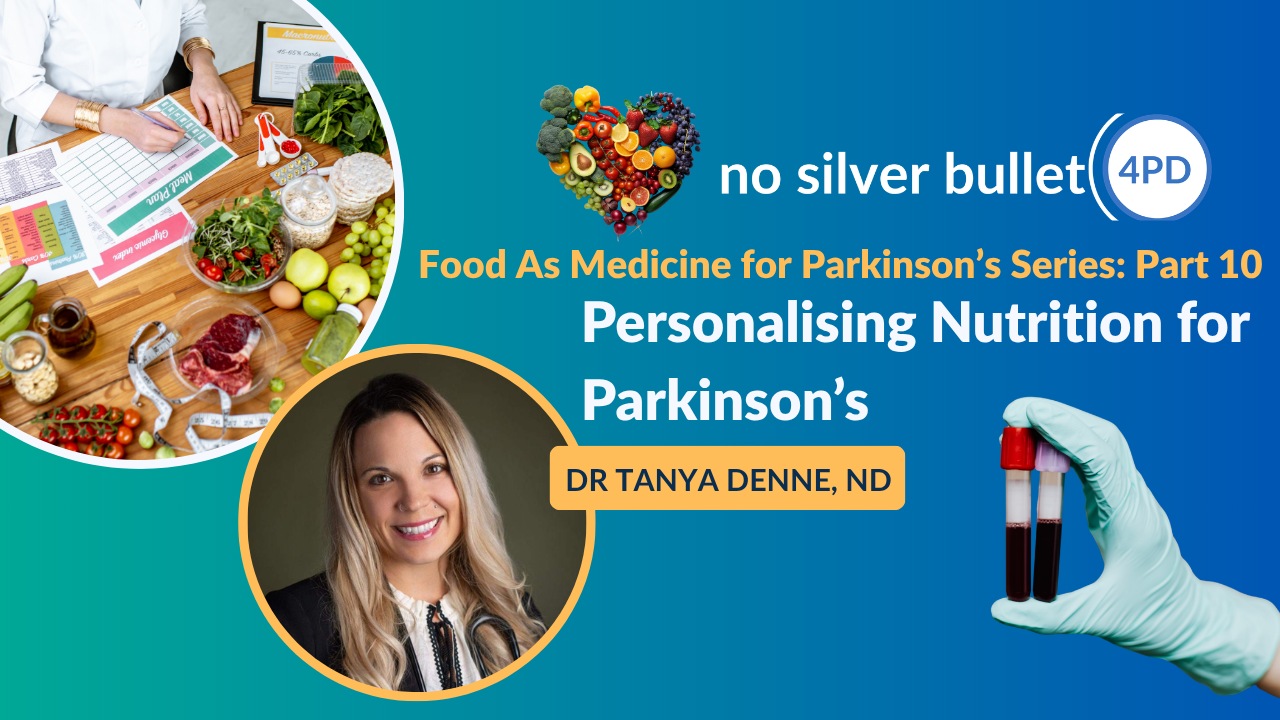
Food As Medicine for Parkinson’s Series Part 10: Personalising Nutrition for Parkinson’s

Food As Medicine for Parkinson’s Series Part 10: Personalising Nutrition for Parkinson’s

Building on our exploration of dietary evidence, we are welcoming back Dr Tanya Denne this December for a session that moves beyond general dos and don'ts. Rather than asking which foods are universally good or bad, this webinar focuses on a far more crucial question: how do you tailor nutrition to your unique body, daily life, and specific experience with Parkinson's? Because no two people experience the condition in the same way, a one-size-fits-all diet simply does not exist. ​We will examine how distinct symptoms and physical changes dictate very different nutritional priorities. Dr Denne will discuss how to adapt what you eat to support unintentional weight loss or gain, maintain vital muscle mass and bone density, and manage practical challenges such as constipation, swallowing difficulties, hydration, and daytime fatigue. Crucially, we will also explore how the timing and composition of your meals can profoundly affect sleep quality and the reliability of your medication response. ​To bring these principles to life, the session will examine distinct real-world cases and clinical scenarios. We will look closely at three contrasting situations: someone struggling with unintended weight loss and muscle depletion, someone managing persistent constipation alongside low appetite and fatigue, and someone navigating frustrating on and off medication fluctuations despite eating an otherwise impeccable diet. By comparing these scenarios, Dr Denne will illustrate why offering identical dietary advice across all three would completely miss the mark, highlighting why nutritional strategies must directly reflect individual needs. ​Finally, we will cut through the confusion surrounding diagnostic testing and day-to-day tracking. You will learn which blood tests genuinely matter, including vitamin D, B12, folate, and iron markers, while examining whether popular microbiome and stool tests offer actionable insight or simply clever marketing. We will look at how tracking meals alongside symptoms and medication timing can reveal personal triggers, and provide actionable guidance on how to partner effectively with your GP, neurologist, or specialist dietitian to translate your personal data into a clear, sustainable routine. ​About the speaker: ​We are honoured to be joined by Dr Tanya Denne, a distinguished Naturopathic Doctor and researcher. Dr Denne is a leading advocate for "Personalised Medicine," a philosophy that treats the whole person rather than just a set of symptoms. Her evidence-based approach views nutrition as a foundational pillar of care, bridging the gap between traditional neurology and complementary disciplines. With her extensive research background, including her work on Mucuna pruriens, Dr Denne empowers people to move from being passive recipients of care to proactive partners in their own health journey.

Michel Planquart

Michel Planquart

Diagnosed in 2020, Michel manages his condition with the dedicated rigour of an athlete. Through his holistic routine and practical tools, he empowers others to actively influence their own progression.

Newsletter

Subscribe to receive regular emails with the latest news, webinars, Bas Bloem podcasts, and Michael Okun posts.

Frequency

You can unsubscribe at any time from the link in every newsletter.

Prof. Bas Bloem

Prof. Bas Bloem

Radboud University

A world-leading neurologist and pioneer of patient-centred care, specialising in lifestyle and exercise interventions for Parkinson's.

EP 41 - The Parkinson Weekly Helpdesk

EP 41 - The Parkinson Weekly Helpdesk

🎙️ In Episode 41 of Parkinson Weekly, Prof. Bas Bloem opens the Helpdesk once again to answer questions submitted by listeners.In this fourth Helpdesk episode, Bas explores three very different but important topics. He begins with women and Parkinson’s, discussing the menstrual cycle, menopause, hormone replacement therapy and pregnancy, and why women with Parkinson’s may require more individualised approaches to care.He then looks at whether infections, stressful events or even mosquito bites could trigger Parkinson’s, explaining the difference between causing the disease and potentially unmasking symptoms that were already developing.Finally, Bas discusses delayed gastric emptying in Parkinson’s, how it can affect the absorption and reliability of oral medication, signs such as bloating and unpredictable medication response, and some of the approaches that may help manage it.Have a question you’d like Bas to answer in a future episode? Email us at parkinsonweekly@gmail.com – we’d love to hear from you.

PodcastVideo
EP 40 - A Faster Way to Find New Treatments for Parkinson’s?

EP 40 - A Faster Way to Find New Treatments for Parkinson’s?

In Episode 40 of Parkinson Weekly, Prof. Bas Bloem explores what he describes as one of the most exciting and encouraging developments in Parkinson’s clinical research: multi-arm, multi-stage (MAMS) clinical trial platforms.As our understanding of the biological processes underlying Parkinson’s disease continues to grow, so too does the number of potential treatments that could target these mechanisms and potentially slow disease progression. The challenge is how to test these promising therapies quickly, efficiently and reliably.Traditional clinical trials can take years, require large numbers of participants and often need a separate placebo group for every treatment being investigated. MAMS platforms offer a different approach, allowing several potential treatments to be tested simultaneously against a shared control group.Crucially, these platforms also incorporate planned interim analyses. Treatments showing little or no evidence of benefit can be stopped early and replaced by new candidates, while those showing promising signals can continue through the trial. The aim is to reduce costs, make better use of participants and, most importantly, identify promising therapies more quickly.Prof. Bloem discusses how this approach has already been successfully used in areas such as cancer and COVID-19, and looks at the growing international movement to bring the same model to neurological diseases.For Parkinson’s disease, he highlights the Edmond J. Safra Accelerating Clinical Trials in Parkinson’s Disease (EJS ACT-PD) platform in the UK, alongside similar initiatives emerging internationally. He also discusses some of the treatments being evaluated through these new trial approaches, including telmisartan, terazosin and UDCA.The episode also considers the challenges involved, from selecting appropriate placebo groups to identifying sensitive biomarkers that can provide an early indication of whether a treatment is working.While these platforms will not change clinical care tomorrow, Prof. Bloem explains why they represent genuine hope for the Parkinson’s community: a smarter, faster and more collaborative way of determining which potential treatments deserve to move forward.Could this new generation of clinical trials help accelerate the search for disease-modifying treatments in Parkinson’s?Have a question you’d like Bas to answer in a future episode? Email us at parkinsonweekly@gmail.com – we’d love to hear from you.

PodcastVideo
Prof. Michael Okun

Prof. Michael Okun

University of Florida

A renowned neuroscientist and medical director of the Parkinson's Foundation, widely regarded as a global authority on advanced Parkinson's therapies.

Moderating the session “When Research Reaches People: Real-World Success Stories” at the National Parkinson’s Advisory Council reminded me that the true measure of scientific progress is not simply discovery or publication, but whether research actually reaches people and changes their lives. Simon Little, MD, PhD, from the University of California, San Francisco, shared the remarkable evolution of deep brain stimulation from treating motor symptoms to adaptive approaches that respond to brain circuit dysfunction, with opportunities to address nonmotor symptoms, sleep, and other challenges. Bill Martin, PhD, formerly of Johnson & Johnson, described the long journey of bringing amyloid PET imaging into clinical practice for Alzheimer’s disease, including the importance of Medicare coverage, overcoming regulatory barriers, and ensuring that diagnostic advances become accessible to patients. Claudio Soto, PhD, from the University of Texas Health Science Center at Houston, highlighted how alpha-synuclein seed amplification assays are transforming our ability to detect Parkinson’s biology earlier, potentially before symptoms emerge, while reminding us that validation and commercial sustainability are essential for translating discoveries into clinical tools. David Vaillancourt, PhD, from the University of Florida, shared the journey of NeuroPacs, an MRI-based diagnostic aid designed to improve differentiation among Parkinson’s disease and related disorders, illustrating how persistence over many years, regulatory engagement, and eventual coverage decisions can determine whether a promising technology reaches the clinic. What resonated most with me across all four presentations was that discovery is only the beginning. We must screen, measure, validate, navigate regulatory pathways, secure coverage, and ultimately deliver innovations to patients. From the early 2000's to 2026, these stories illustrated that translation often takes decades, requiring scientists, clinicians, industry, regulators, payers, and patients to work together. Our responsibility is not simply to fund discovery, but to build and sustain the entire pathway from the laboratory to the person.

Moderating the session “When Research Reaches People: Real-World Success Stories” at the National Parkinson’s Advisory Council reminded me that the true measure of scientific progress is not simply discovery or publication, but whether research actually reaches people and changes their lives. Simon Little, MD, PhD, from the University of California, San Francisco, shared the remarkable evolution of deep brain stimulation from treating motor symptoms to adaptive approaches that respond to brain circuit dysfunction, with opportunities to address nonmotor symptoms, sleep, and other challenges. Bill Martin, PhD, formerly of Johnson & Johnson, described the long journey of bringing amyloid PET imaging into clinical practice for Alzheimer’s disease, including the importance of Medicare coverage, overcoming regulatory barriers, and ensuring that diagnostic advances become accessible to patients. Claudio Soto, PhD, from the University of Texas Health Science Center at Houston, highlighted how alpha-synuclein seed amplification assays are transforming our ability to detect Parkinson’s biology earlier, potentially before symptoms emerge, while reminding us that validation and commercial sustainability are essential for translating discoveries into clinical tools. David Vaillancourt, PhD, from the University of Florida, shared the journey of NeuroPacs, an MRI-based diagnostic aid designed to improve differentiation among Parkinson’s disease and related disorders, illustrating how persistence over many years, regulatory engagement, and eventual coverage decisions can determine whether a promising technology reaches the clinic. What resonated most with me across all four presentations was that discovery is only the beginning. We must screen, measure, validate, navigate regulatory pathways, secure coverage, and ultimately deliver innovations to patients. From the early 2000's to 2026, these stories illustrated that translation often takes decades, requiring scientists, clinicians, industry, regulators, payers, and patients to work together. Our responsibility is not simply to fund discovery, but to build and sustain the entire pathway from the laboratory to the person.

PostOpen details
What resonates most with me about this important study by McGinley and colleagues in the Journal of Parkinson’s Disease is that surviving a hip fracture and recovering from a hip fracture are two very different things. In this Australian study of 5,553 individuals with hip fractures, including 208 with Parkinson’s disease, researchers found no statistically significant differences in hospital length of stay, ICU admissions, or mortality at 30 days and one year after adjustment for clinical differences. That is encouraging, although the relatively small Parkinson’s cohort warrants caution. However, people with Parkinson’s were approximately twice as likely to be discharged to rehabilitation rather than directly home. Only 10% of those with Parkinson’s returned directly home, compared with 22% without the disease. These findings remind us that the consequences of a fall extend far beyond the broken bone. A hip fracture can threaten independence, mobility, confidence, and quality of life. We need to be much more proactive about bone health, osteoporosis screening, balance training, fall prevention, and Parkinson’s-specific rehabilitation. We also need to ensure that Parkinson’s medications are delivered on time during hospitalization and that patients are mobilized safely and early. My biggest takeaway is that we should not measure success simply by whether someone survives hospitalization. We should measure success by whether we can help them return to the life they were living before the fracture. Prevention matters, but so does the journey home.
https://cutt.ly/uyUWuLjo

What resonates most with me about this important study by McGinley and colleagues in the Journal of Parkinson’s Disease is that surviving a hip fracture and recovering from a hip fracture are two very different things. In this Australian study of 5,553 individuals with hip fractures, including 208 with Parkinson’s disease, researchers found no statistically significant differences in hospital length of stay, ICU admissions, or mortality at 30 days and one year after adjustment for clinical differences. That is encouraging, although the relatively small Parkinson’s cohort warrants caution. However, people with Parkinson’s were approximately twice as likely to be discharged to rehabilitation rather than directly home. Only 10% of those with Parkinson’s returned directly home, compared with 22% without the disease. These findings remind us that the consequences of a fall extend far beyond the broken bone. A hip fracture can threaten independence, mobility, confidence, and quality of life. We need to be much more proactive about bone health, osteoporosis screening, balance training, fall prevention, and Parkinson’s-specific rehabilitation. We also need to ensure that Parkinson’s medications are delivered on time during hospitalization and that patients are mobilized safely and early. My biggest takeaway is that we should not measure success simply by whether someone survives hospitalization. We should measure success by whether we can help them return to the life they were living before the fracture. Prevention matters, but so does the journey home. https://cutt.ly/uyUWuLjo

PostOpen details

Recommended Activities