


Quantum Secrets of the Brain: How Magnetic Isotopes Influence Nerve Health
February 23, 2026
A ground-breaking study from the University of Waterloo in Canada has introduced a fascinating new theory that could change how we understand and treat neurodegenerative conditions. The research, published in the journal Science Advances, explores the world of quantum biology to explain how the very building blocks of our brain cells react to magnetic fields. This discovery focuses on a process called tubulin polymerization, which is essential for maintaining the structure and transport systems within our nerves.
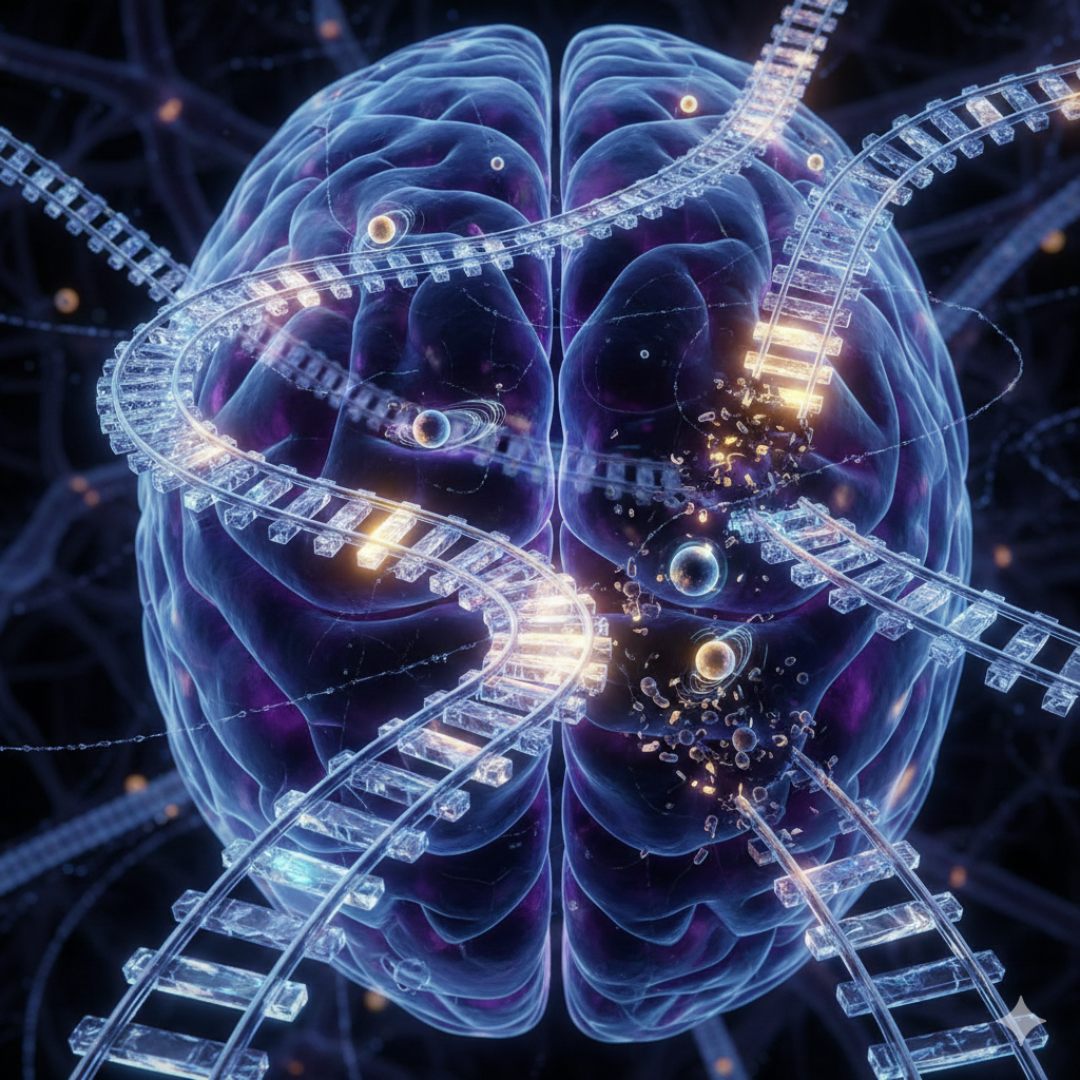
To understand why this matters, we first need to look at microtubules. Think of these as the "railway tracks" inside your nerve cells. They are responsible for moving vital nutrients and chemical messengers from one end of the cell to the other. These tracks are made of a protein called tubulin. In a healthy brain, tubulin pieces constantly join together—a process called polymerization—to keep the tracks strong and functional. If these tracks break down, the nerve cell cannot communicate or survive, which is a hallmark of conditions like Parkinson’s.
The researchers, led by Professor Zarko Pavlovic and his team, discovered that this "track-building" process is influenced by something called the "magnetic isotope effect." They found that different versions of certain atoms, known as isotopes, can speed up or slow down how quickly tubulin pieces join together. Specifically, they looked at isotopes with a property called "nuclear spin," which acts like a tiny internal magnet. When these magnetic atoms are present, the chemical reactions that build microtubules happen differently than when non-magnetic atoms are used.
This suggests that the brain is not just a collection of chemical reactions, but a place where quantum physics is at work. The study points to a "radical pair mechanism," a quantum process where the spin of electrons and nuclei affects the outcome of a chemical reaction. By testing how tubulin behaved when exposed to different magnetic environments and isotopes, the team proved that gravity and simple chemistry weren't the only things in charge; magnetic forces at the quantum level play a leading role in how our brain cells maintain their shape and internal transport.
For people with Parkinson’s, this discovery is particularly significant. We know that in the condition, the transport system within nerve cells often fails, leading to the buildup of proteins and the eventual loss of the cells that produce dopamine. If the stability of these "microtubule tracks" is governed by magnetic quantum effects, it opens up a completely new way to look at treatment. Instead of just using traditional drugs, scientists might eventually develop "quantum therapies" that use specific magnetic fields or tailored isotopes to help stabilize the brain's internal structure.
This research offers a fresh wave of hope by providing a deeper explanation for why nerves degenerate in the first place. By identifying that the very foundation of our nerve cells is sensitive to magnetic spin, the University of Waterloo team has given the scientific community a new set of tools. While still in the early stages, this "quantum theory" of brain health reminds us that the solutions to complex conditions may lie in the smallest, most mysterious corners of our biology. Understanding these tiny magnetic secrets could be the key to keeping our neural "railway tracks" running smoothly for years to come.
Comments (0)
Loading comments...