


First U.S. Ultrasound Surgery for Parkinson’s
October 29, 2025
A quiet revolution in Parkinson’s care has just begun in the United States. For the first time, doctors at Oregon Health & Science University have treated a person with Parkinson’s disease using a brand-new incisionless surgery — a procedure that requires no scalpel, no drilling, and no implanted device. The operation was made possible after the U.S. Food and Drug Administration recently approved the use of focused ultrasound for advanced Parkinson’s, marking a major shift in how this condition can be managed.
The woman who underwent the treatment in August was awake throughout the procedure. Guided by MRI scans, doctors used more than a thousand beams of ultrasound energy to target a precise spot deep in her brain — a neural pathway involved in movement control. The beams meet at that single point, creating enough heat to disrupt the faulty brain signals responsible for tremor and stiffness. Everything happens without breaking the skin.
For the patient, the effect was immediate. Within hours, she could move more freely and even smile again — a small gesture that captured the power of what had just taken place. The whole process took about an hour, and she went home the same day.
This method, known as high-intensity focused ultrasound or HIFU, has been used before for other movement disorders such as essential tremor. What makes this moment historic is that it’s now officially recognised as a treatment for Parkinson’s itself. The approval allows hospitals like OHSU to begin offering the procedure outside of clinical trials, giving people another choice when medication no longer keeps symptoms under control.
Until now, the main surgical option for advanced Parkinson’s has been deep brain stimulation, or DBS. That involves placing electrodes inside the brain and connecting them to a pacemaker-like device in the chest. DBS remains highly effective and widely used, but it’s not suitable for everyone. Some people are unable to undergo invasive surgery, or they simply prefer a less permanent alternative. Focused ultrasound offers that middle ground — the precision of a surgical approach without the physical intrusion.
None of this means DBS is on its way out. Even the surgeons leading the work at OHSU are clear that ultrasound is not a replacement but an additional option. Parkinson’s is a complex condition, and no single treatment suits everyone. What this development represents is progress — another tool in the kit for managing the disease more gently and precisely.
As promising as it is, the technique is still in its early days. The FDA approval is fresh, and hospitals are only just beginning to introduce it. Insurance coverage in the U.S. has not yet caught up, and long-term data are still being collected. Doctors will need to see how lasting the improvements are, whether both sides of the brain can be treated safely, and which patients benefit the most.
Even so, it’s hard not to see this as a turning point. The idea that tremor and stiffness can be eased without a single incision would have sounded like science fiction a decade ago. Today, it’s reality — the first of many incisionless surgeries that may transform how we treat Parkinson’s in the years ahead.
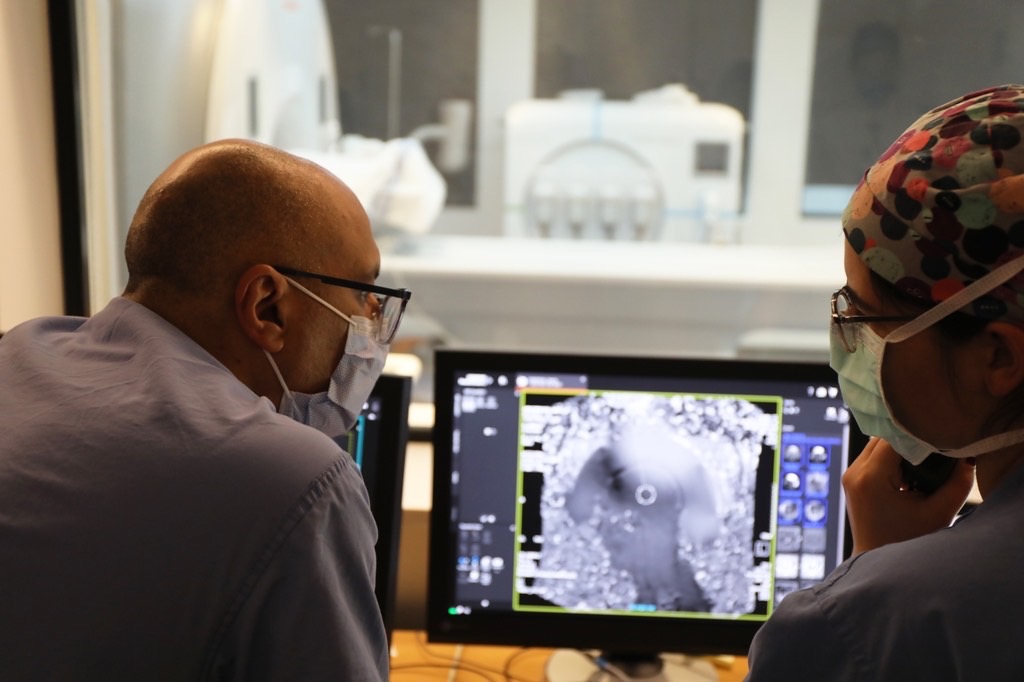
Photo: Neurosurgeons at Oregon Health & Science University examine real-time magnetic resonance imaging during a case involving the use of high-frequency focused ultrasound. (OHSU/Christine Torres Hicks)
Comments (0)
Loading comments...