


Medical Cannabis and Parkinson’s: Sorting Fact from Fiction
November 11, 2025
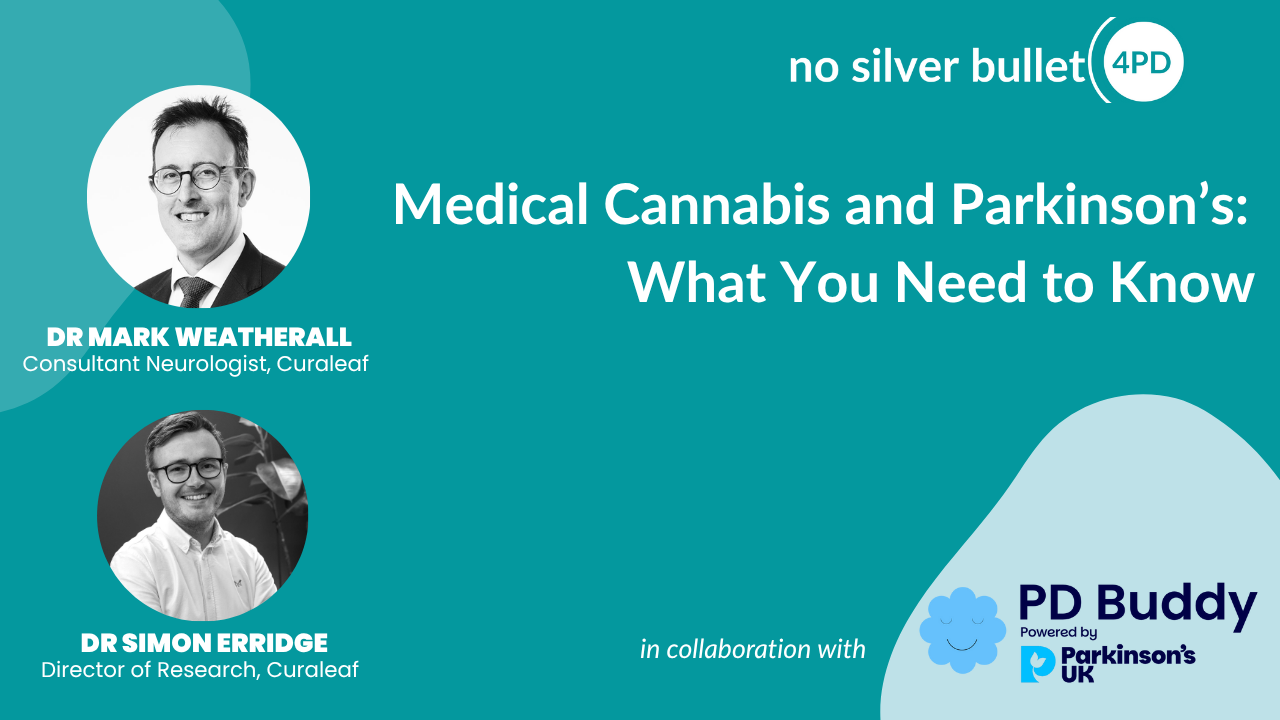
Join Béatrice from PD Buddy and Curaleaf UK experts Dr Mark Weatherall and Dr Simon Erridge for a clear, practical discussion on the role of medical cannabis in Parkinson’s care — a collaborative webinar between PD Buddy and No Silver Bullet 4 PD.
Interest in medical cannabis is growing fast among people with Parkinson’s, but so is the confusion. Many are unsure what cannabis can actually help with, how to access it legally, or why some products seem to work while others don’t.
To bring clarity, Béatrice, founder of the PD Buddy app, invited two leading specialists from Curaleaf UK for an open conversation focused on real-world issues: Which symptoms might cannabis ease? How does medical cannabis differ from recreational use? What dose or format works best? What are the risks — and how does someone start the process of getting a prescription?
Throughout the session, the discussion stays grounded in everyday challenges such as poor sleep, pain, stiffness, and maintaining quality of life. The goal is not to promote cannabis, but to share reliable, evidence-based information so people can make informed and safe choices.
Medical cannabis is regulated very differently across the world, and what is legal or available varies widely. Nothing in this session should be taken as medical or legal advice — always check the laws and medical guidance in your own country or region.
Medical vs Recreational Cannabis
Medical cannabis is not the same as the kind sold for recreational use. It’s produced under strict pharmaceutical standards, ensuring it’s consistent, safe, and free from contaminants like pesticides or mould. Cannabis is a bioaccumulator, meaning it can absorb heavy metals and toxins from the soil, so careful cultivation and testing are essential. In Europe, medical cannabis is legal in most countries, while recreational cannabis remains illegal. Germany is one of the few places moving towards broader access.
Who Can Get It in the UK
In the UK, access to medical cannabis through the NHS is tightly limited. Only a few licensed products are available:
Sativex (Nabiximols) for spasticity in multiple sclerosis
Epidyolex for rare epilepsy syndromes such as Dravet and Lennox-Gastaut
Nabilone for chemotherapy-induced nausea
Everyone else — including people with Parkinson’s — can only access it privately through clinics like Curaleaf. To qualify, a person must have tried the usual licensed therapies without sufficient relief. That might include medications for motor symptoms, chronic pain, insomnia, or anxiety — all of which are common in Parkinson’s.
What the Evidence Shows
Because cannabis was prohibited for decades, clinical research has lagged behind. Randomised trials are still rare, and results so far are mixed. Some have found small improvements in motor symptoms or quality of life; others found no significant change. The most promising evidence comes from real-world, observational studies showing benefits in sleep, pain management, and overall wellbeing.
What Doctors Are Seeing
Dr Weatherall recalls his first Parkinson’s patient prescribed cannabis oil: “He had severe sleep problems and pain, and nothing else helped. Within weeks, he was sleeping through the night for the first time in years.”
That case highlighted what doctors now see repeatedly — that cannabis doesn’t necessarily fix motor symptoms directly, but it can ease the non-motor issues that make Parkinson’s harder to live with. Poor sleep, anxiety, and chronic pain can all worsen movement control. Addressing them often lifts overall functioning and mood.
Michel’s Story
Michel developed severe insomnia in early 2023. Melatonin worked briefly, but sleeping pills made her Parkinson’s symptoms worse. After starting a combination of THC and CBD oil, prescribed through Curaleaf, he finally began sleeping six to seven hours a night. “It’s been life-changing,” he said. “Before, I’d sleep two or three hours and couldn’t function. I wasn’t exercising, my mood dropped — it was a downward spiral.”
He takes a controlled-release levodopa dose alongside his evening cannabis oil. “I’ve had no side effects, but I’m careful. If I get up at night, I walk like I’m on a boat. Anyone older or unsteady should be cautious.”
How It Works — and What We Don’t Yet Know
The body’s endocannabinoid system is a network of receptors that help regulate pain, sleep, and mood. Cannabis compounds like THC and CBD interact with these receptors, but exactly how they influence Parkinson’s symptoms remains uncertain. There’s growing evidence that they can modulate pain and promote sleep, but far less understanding of how they might affect motor circuits or disease progression.
As Dr Weatherall put it, “We’re still scratching the surface — but what we see clinically suggests real potential.”
Different Forms and How They’re Taken
Smoking is off the table for medical cannabis. Instead, patients can use:
Vaporised flower – heated (not burned) in a medical-grade vaporiser for fast relief that wears off within a few hours.
Oils – placed under the tongue for slow, steady absorption that lasts longer.
Pastilles – dissolve in the mouth, useful for those who struggle with droppers or vapourisers.
The choice depends on symptoms, dexterity, and personal preference. Some use oils for baseline control and vape for breakthrough symptoms — much like people adjust their Parkinson’s medication timing to suit their day.
CBD, THC, or Both?
Whole-plant extracts containing both THC and CBD generally work better than pure CBD alone. THC provides the main therapeutic effect, while CBD helps balance it and reduce side effects. The goal isn’t to get high but to find the “sweet spot” where symptoms improve without feeling sedated or disoriented.
Street cannabis is often bred for high THC content, which increases risk. Medical products are carefully formulated and dosed, allowing patients to start with tiny amounts and build up slowly under supervision.
Side Effects and Safety
Mild drowsiness or dizziness are the most common side effects. Some people also experience mild nausea. Serious effects like psychosis are extremely rare when cannabis is prescribed properly and used under medical supervision. The golden rule, especially for older adults, is “start low and go slow.”
Doctors are cautious with patients who have balance problems, low blood pressure, or heart disease, but these are relative — not absolute — contraindications.
Costs and Access
In the UK, medical cannabis isn’t covered by the NHS except in rare cases. At Curaleaf, consultations cost £5 per month on a subscription, £30 per appointment, or £50 for an annual plan. Medication prices vary widely depending on formulation and dose, typically between £35 and £200 per month. Patients must provide their NHS summary record showing their diagnosis and previous treatments.
As Michel explained, the process was “seamless — I just uploaded my NHS record and was approved within days.”
The Research Road Ahead
Dr Erridge believes the next step is stronger clinical evidence. “If cannabis proves effective on a population level, we need randomised controlled trials to unlock NHS access,” he said. His team is working on both laboratory studies and clinical data collection to identify which cannabis formulations work best for Parkinson’s and other neurological conditions.
The Bottom Line
Medical cannabis isn’t a cure, nor is it a replacement for Parkinson’s medication. But for people struggling with insomnia, chronic pain, or anxiety, it may offer meaningful relief. Used carefully under expert supervision, it can improve sleep, ease discomfort, and help people regain a better rhythm of life.
Watch the full interview here by clicking on the below link.
Comments (0)
Loading comments...