


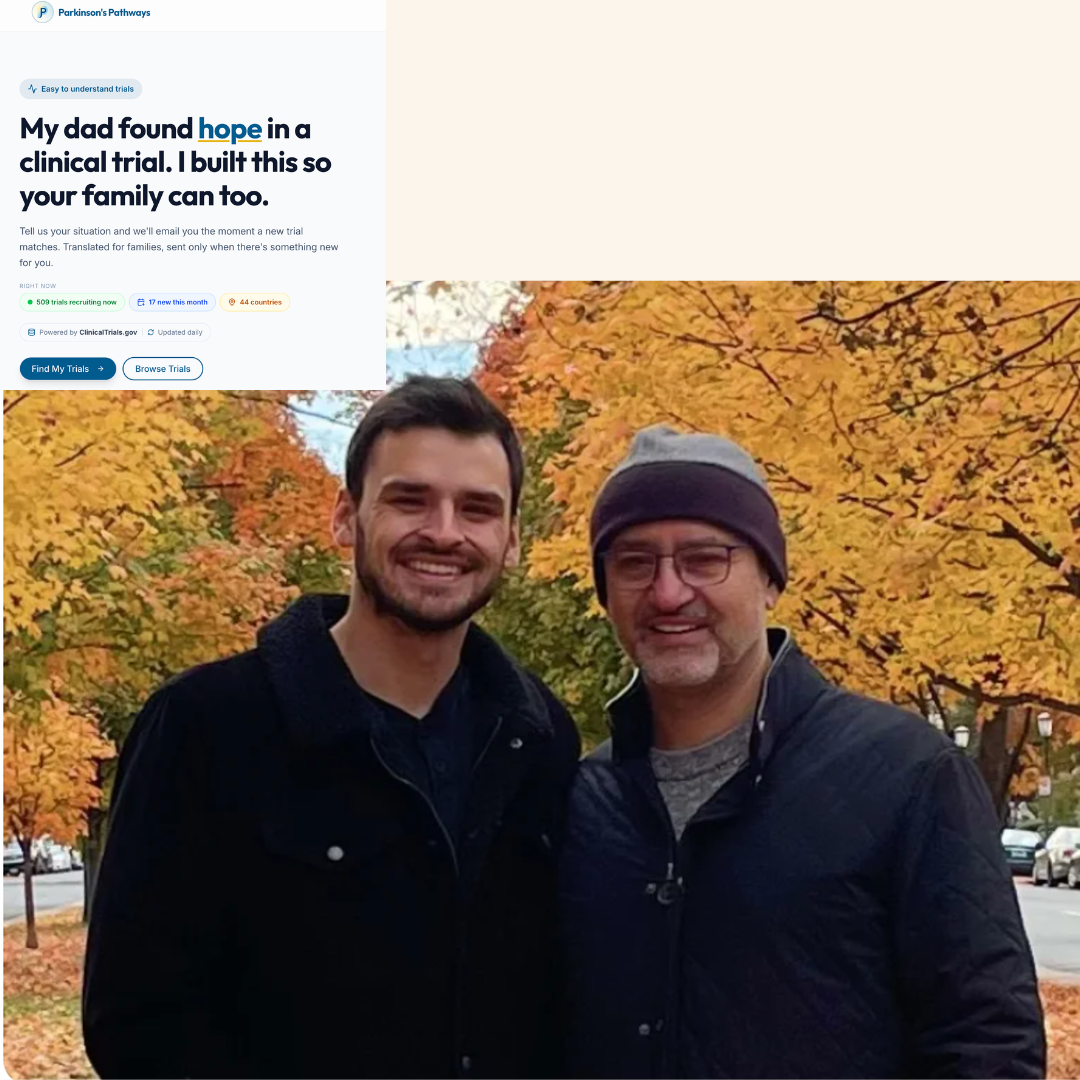
How a son’s quest to help his father created a simple map for Parkinson’s clinical trials
June 23, 2026
We recently met Spencer, the creator of Parkinson’s Pathways, and after a few weeks of using his website, we highly recommend it. Navigating the world of medical research can feel overwhelming, but this platform is a breath of fresh air. It is exceptionally well done, remarkably easy to use, and honestly, it is something that has been sorely needed for a very long time.
The story behind the website is deeply personal. When Spencer’s father was diagnosed with Parkinson's, the family wanted to explore every possible option, including clinical trials. Clinical trials are research studies that test new treatments, therapies, or lifestyle changes. While they offer a powerful sense of hope and the chance to access cutting-edge care, finding them is notoriously difficult.
The official registry for these studies is a massive government database called ClinicalTrials.gov. Right now, there are over five hundred trials recruiting worldwide. However, that official site is written by scientists, for scientists. It is packed with dense medical jargon, complicated acronyms, and confusing eligibility criteria that can leave anyone feeling lost and stressed.
Spencer experienced this frustration firsthand while trying to help his father. He realised that families needed a bridge between complex science and everyday life. Instead of walking away, he used his skills to build Parkinson’s Pathways, a passion project designed to translate that intimidating scientific data into clear, simple language that non-experts can actually understand.
The website works by syncing with the official database every single day, but it filters the information through a much friendlier lens. When you visit the site, you are not met with walls of technical text. Instead, you can easily browse trials based on specific symptoms that matter to you, such as tremor, gait and balance, sleep, or cognition.
For people with Parkinson's and their families, the platform helps in a few very practical ways. Firstly, it explains exactly what a trial is testing, who qualifies to take part, and what to expect during the process, entirely in layman's terms. Secondly, it includes a smart location tool, allowing you to see which studies are happening near your home rather than halfway across the world.
One of the best features is the matching service. You can input your specific situation, and the website will monitor the global databases for you. The moment a new trial opens up that fits your criteria, you receive a direct email alert. This means you do not have to spend hours searching the internet every week; the relevant updates come straight to you, but only when there is something genuinely new to report. Spencer also sends out a weekly Monday digest summarising new trials, keeping subscribers informed without the usual data overwhelm.
Importantly, the website is completely free, secure, and private. Spencer built this purely to help the community, so there are no hidden fees, adverts, or subscriptions, and personal information is never shared with trial sponsors or third parties.
While Spencer’s platform provides a brilliantly streamlined experience, there are several other excellent resources where you can search for opportunities to get involved in research. The Michael J. Fox Foundation hosts an international online finder tool to connect volunteers with relevant clinical studies across the globe. Parkinson’s UK maintains a comprehensive research support network directory highlighting open projects and testing opportunities specifically for those living in Britain. For those interested in how genetics influence the condition, PD Frontline is a specialised platform that coordinates free home genetic testing to help match people with upcoming targeted drug trials.
By stripping away the medical jargon, Parkinson's Pathways gives people the confidence to understand what research is out there and have informed, meaningful conversations with their doctors. It turns a complicated scientific database into a simple, accessible map, offering a genuine sense of clarity and hope to families navigating life with Parkinson's.
Comments (0)
Loading comments...