


Oxford Breakthrough in Ultrasound Stimulation
March 27, 2026
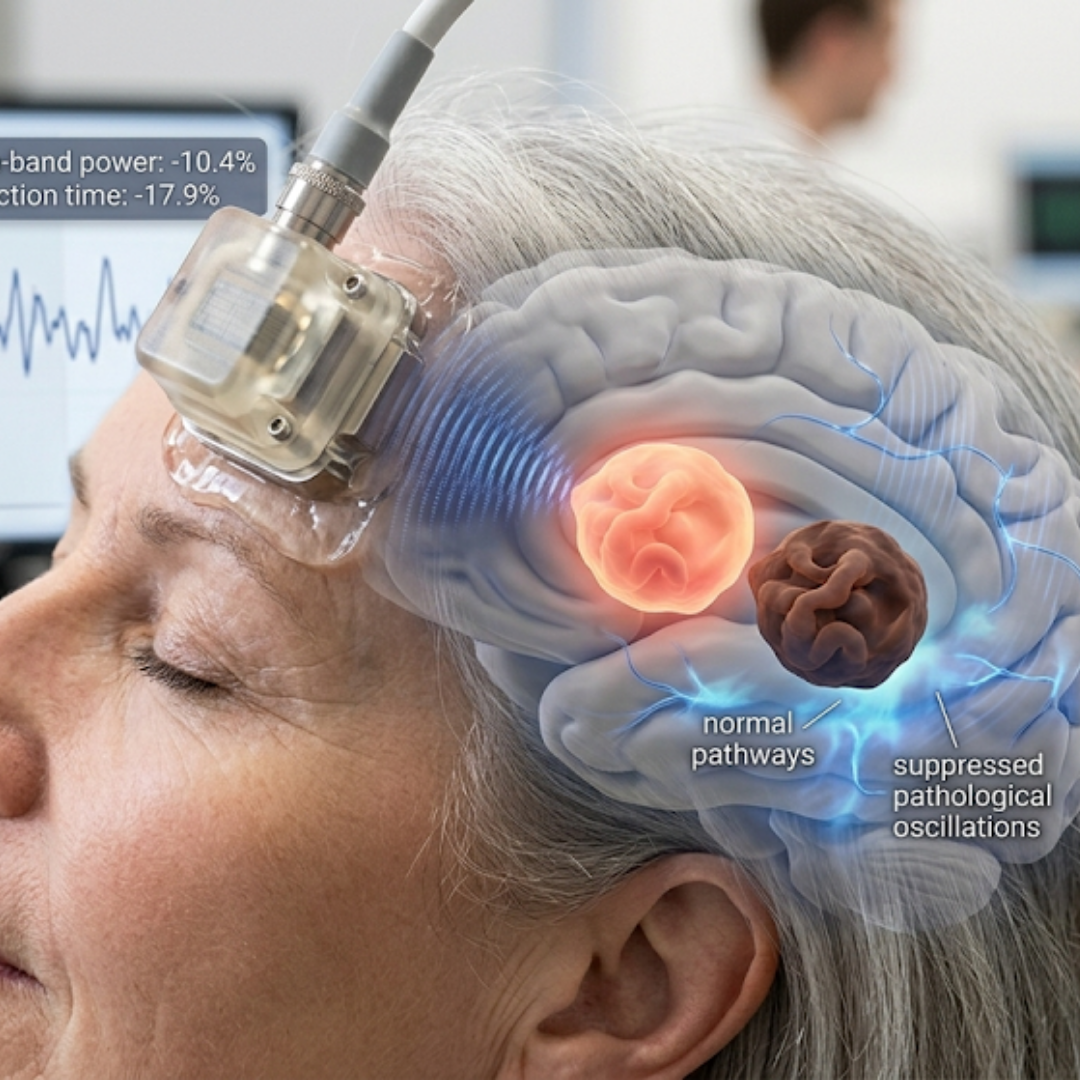
A pioneering study from the University of Oxford’s Brain Network Dynamics Unit (BNDU) has demonstrated that a non-invasive form of brain stimulation can significantly reduce the abnormal brain activity associated with Parkinson’s. This new approach, known as transcranial ultrasound stimulation (TUS), offers a potential future where the benefits of deep brain stimulation might be achieved without the need for surgery.
The Challenge of Brain Oscillations
In Parkinson’s, the brain’s internal communication becomes disrupted by "pathological oscillations." These are essentially rhythmic electrical patterns—specifically in the "beta-band"—that become too strong, acting like static on a radio that drowns out clear signals for movement. These oscillations are a primary cause of bradykinesia, the slowness of movement that many people experience.
Until now, the most effective way to "silence" this static has been through Deep Brain Stimulation (DBS), which requires the surgical implantation of electrodes deep within the brain.
A Non-Invasive Alternative
The Oxford research team, led by a collaborative group of scientists including Professor Tim Denison and Professor Alexander Green, set out to see if ultrasound could achieve a similar effect from outside the skull. Unlike the ultrasound used for imaging, TUS uses low-intensity sound waves to gently modulate the activity of neurons.
In this randomised study, participants received ultrasound pulses targeted at the globus pallidus, a deep structure involved in motor control. The results were immediate and measurable:
Reduction in "Brain Static": The pathological beta-band activity in the subthalamic nucleus was reduced by over 10%.
Improved Movement Speed: Most importantly, this change in brain activity translated to the real world. Participants saw an average reduction in reaction time of nearly 18%, meaning they could move faster and more fluidly during the stimulation.
Why This is a Significant Step
This proof-of-concept study is a major milestone because it proves for the first time that ultrasound can directly modulate the specific brain biomarkers linked to Parkinson's symptoms. It bridges the gap between high-tech laboratory science and practical, non-invasive therapy.
Because TUS can reach deep structures without an incision, it could eventually provide a "test-run" for those considering surgery, or even become a standalone therapy for those who are not candidates for traditional DBS. It allows clinicians to "tune" the brain’s circuits using sound waves rather than electrical currents.
The Road Ahead
While these findings are early, they open a brand-new door for Parkinson's care. The next stage of research will focus on how long these effects last and whether repeated sessions can provide long-term relief from motor symptoms. This Oxford-led discovery brings the community one step closer to a future where managing the condition is as simple as a targeted, non-invasive session of "acoustic" modulation.
Comments (0)
Loading comments...