


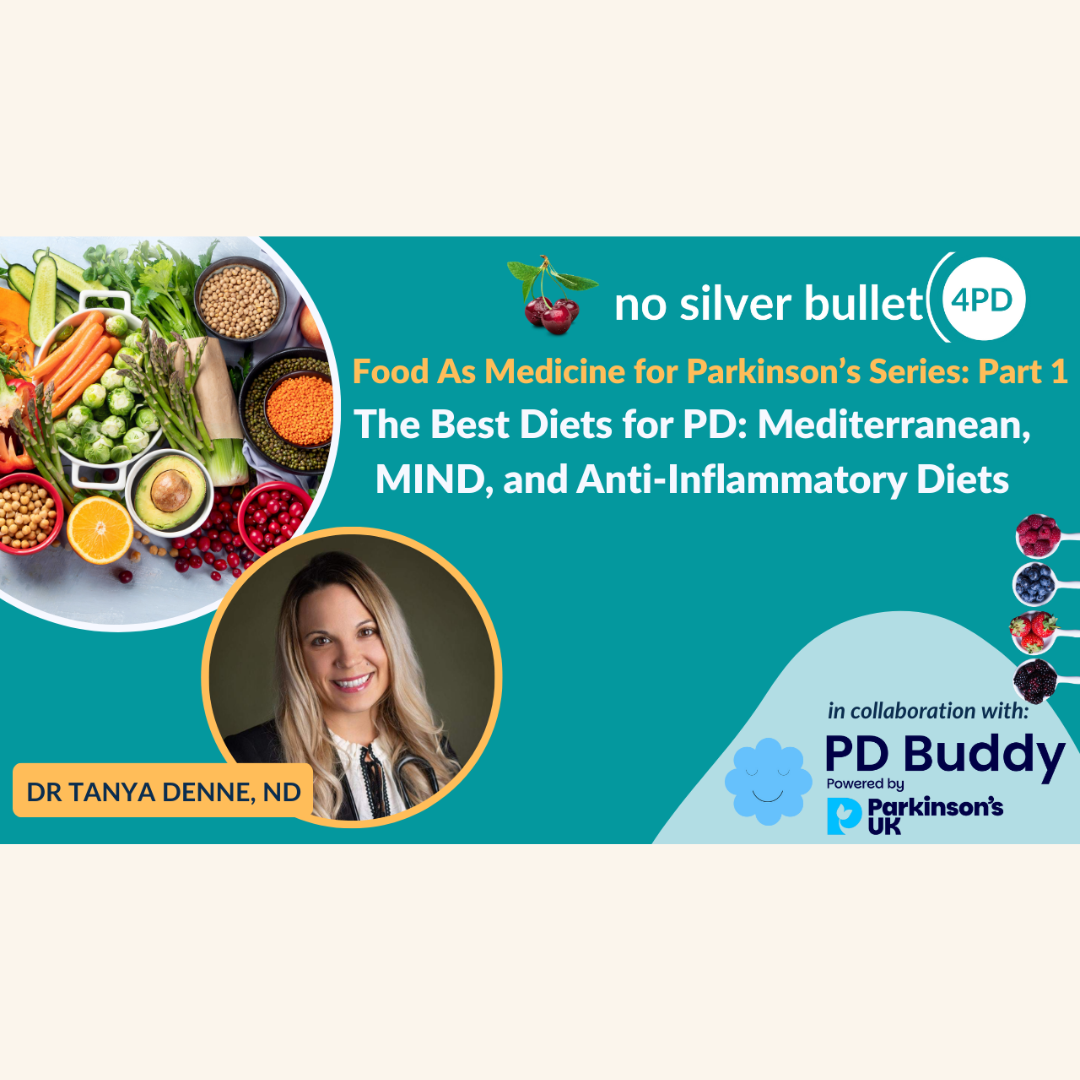
Food is Your Medicine (Part 1): The Ultimate Guide to the Mediterranean, MIND, and Anti-Inflammatory Diets for Parkinson’s
January 30, 2026
Based on the presentation by Dr. Tanya Denne, ND Hosted by PD Buddy & No Silver Bullet
When we talk about managing Parkinson’s, we often focus entirely on dopamine replacement. But what if the fuel you put into your body was just as critical as the medication you take?
We recently launched our 2026 series, "Food is Your Medicine," with a deep dive into the nutritional foundations of neuroprotection. We were joined by Dr. Tanya Denne, a distinguished Naturopathic Doctor and researcher who specialises in "Personalised Medicine." Dr. Denne doesn't just treat symptoms; she looks at the biochemistry of the body to understand how we can slow progression.
The session was packed with information—so much so that we wanted to provide this extensive written guide to ensure you didn’t miss a single detail. Here is the complete breakdown of how to eat for your brain.
1. Defining the Diets: Mediterranean vs. MIND
We often hear these terms thrown around interchangeably, but Dr. Denne clarified the distinct biological goals of each.
The Mediterranean Diet: The Longevity Specialist
- This diet originates from the "Blue Zones"—areas like Italy and Greece where people statistically live longer and have lower rates of cardiovascular issues.
- The Focus: Cardiovascular health and longevity.
- The Key Ingredients: An abundance of fruits, vegetables, and complex carbohydrates (breads, grains, pastas).
- The "Secret Sauce": Olive oil is the primary source of fat.
- Proteins: A huge focus on fish, with moderate dairy and eggs.
- The Lifestyle: It includes wine in low-to-moderate amounts and emphasises the social aspect of eating.
The MIND Diet: The Cognitive Specialist
- The MIND diet is a hybrid. It combines the Mediterranean diet with the DASH diet (Dietary Approaches to Stop Hypertension).
- The Focus: Specifically designed to protect the brain, improve cognitive performance, and prevent Alzheimer’s and dementia.
- The Difference: While the Mediterranean diet looks at the heart and lifespan, the MIND diet looks strictly at the brain. It is more prescriptive about "brain-healthy" food groups (like berries and leafy greens) and "unhealthy" groups (like red meats and pastries).
- Why This Matters: Research, including the MVP Study by Dr. Laurie Mischley, shows that adherence to these dietary patterns is statistically significant. The closer you stick to these diets, the fewer Parkinson’s symptoms you are likely to report over time.
2. Sourcing: Why An Apple Is Not Always An Apple
One of Dr. Denne’s most crucial points was that food is chemistry. In a globalised world, a chicken in the UK is not the same as a chicken in the US, and an apple in an orchard is not the same as an apple in a mass-production farm.
The Toxin Burden: In many countries (particularly the US), chemicals like Paraquat are still sprayed on crops. Paraquat is a known neurotoxin strongly linked to Parkinson’s risk.
- Chlorinated Chicken: Industrial farming often uses bleach baths to clean poultry, which changes the chemical composition of the food.
- The Solution: The "Dirty Dozen" & "Clean 15"
You do not need to buy everything organic, but you should be strategic.
- The Dirty Dozen: These are the 12 fruits and vegetables that absorb the most pesticides (e.g., strawberries, spinach, nectarines). Rule: Buy these organic, or don't eat them at all. The chemical burden is too high for a vulnerable neurological system.
The Clean 15: These are foods with thick skins or natural barriers (e.g., avocados, onions, pineapples). Rule: You can buy these conventionally (non-organic) if you are on a budget.
3. Meal Hygiene: Digestion Starts in the Mouth
It is not just what you eat, but how you eat. Dr. Denne highlighted a common issue: Low Stomach Acid. Many people with Parkinson’s have lower levels of stomach acid, which makes breaking down nutrients difficult.
Actionable Strategies:
- Stimulate Enzymes: Drink a small amount of water with Apple Cider Vinegar (ACV) or lemon juice before a meal. This primes your stomach to break down food.
- Chewing: It sounds simple, but chewing increases the surface area of the food, making it easier for your gut to absorb micronutrients.
- Mobilise Blood Sugar: Walking for just five minutes after a meal helps move glucose from your blood into your muscles, preventing inflammation spikes.
- Dental Hygiene is Brain Hygiene: The oral cavity is a hidden source of inflammation. Pathogens like H. pylori and E. coli often reside in the mouth and gut of those with Parkinson’s. Flossing and dental check-ups are actually part of your neurological care.
4. The Gut-Brain Axis: Managing Constipation
Constipation is not just a nuisance; in Parkinson’s, it is a major detoxification failure. Dr. Denne referred to bowel movements as the "Keystone for elimination."
The Problem: Parkinson’s often causes Gastroparesis (slowing of the stomach and gut). If bowels don't move daily, toxins reabsorb into the bloodstream, and medication (Levodopa) cannot get to the small intestine to be absorbed.
The "Poop Protocol" (Daily Targets):
- Fibre: Aim for 30–45 grams per day (start slow!).
- Hydration: Fibre without water creates concrete. You must hydrate.
- Magnesium: Different forms of magnesium can help relax the bowel muscles.
- Chia Seed Pudding: Dr. Denne’s top tip. Chia seeds form a gel (mucilage) that soothes the gut lining and helps things move.
- Tip: Keep 5–6 jars in the fridge. Eat one daily.
- The "Pro-kinetics": Ginger tea or lemon-ginger water stimulates movement (pro-kinetic means "pro-movement").
5. Inflammation and Healthy Fats
Parkinson’s is an inflammatory condition. To fight this, we need to alter the lipid (fat) profile of the brain. The brain is essentially a "phospholipid bilayer"—it is made of fat and cholesterol.
The Anti-Inflammatory Toolkit:
- Omega-3s: Sourced from fish oil (one of the best ways to counter inflammatory burden).
- Omega-9s: Found in coconut oil and avocados.
- GLP-1 Regulation: Avocados also contain glutathione (the master antioxidant).
What to Avoid:
- Arachidonic Acid: Found in high amounts in factory-farmed red meats and dairy, which can drive inflammation pathways.
6. Feeding the Microbiome: Polyphenols & The "Lentil Effect"
Your gut bacteria produce Short-Chain Fatty Acids (SCFAs), which regulate your immune system and reduce brain inflammation. In Parkinson’s, SCFAs are notoriously low.
How to fix it? Feed the good bacteria.
- Polyphenols: These are the "fuel" for good bacteria (like Akkermansia).
- Sources: Dark berries, pomegranates, olives, green tea, turmeric, and coffee.
- Diversity: Aim for a variety of plants. Diversity in diet = diversity in the microbiome.
- Legumes & The "Lentil Effect": This is fascinating science. Legumes (beans, lentils) regulate blood sugar not just for the meal you are eating, but for the next meal too. Eating beans at dinner can prevent blood sugar spikes the following morning.
7. The Big Technical Challenge: Protein vs. Levodopa
This was perhaps the most important technical takeaway from the session.
The Science: Levodopa (your medication) is an amino acid. Protein is also made of amino acids. They both use the exact same transporter to get from your gut into your bloodstream. If you eat a steak with your medication, the protein will "win" the seat on the bus, and your medication will be left behind, leading to an "OFF" period.
The Strategy: Protein Redistribution You do not need to cut protein; you need to move it.
- Daytime (Active Hours): Keep protein intake lower (approx. >10g per meal). Focus on plant-based proteins which are easier to digest.
- Evening (Rest Hours): Load up on your protein at dinner. Since you will be sleeping, it matters less if your medication absorption is slightly delayed.
Note: This is highly individual. Some people tolerate protein well; others are very sensitive.
8. Bone Health: The Silent Risk
People with Parkinson’s have twice the risk of osteoporosis. This is due to a combination of lower activity levels and metabolic changes.
Dr. Denne’s Advice:
- Dietary Calcium: Get it from greens (spinach, kale, collard greens) rather than just relying on dairy.
- Weight-Bearing Exercise: Bones need stress to stay strong. Walking is good, but resistance training or wearing a weighted vest is better for signalling the bones to retain density.
- Vitamin D: Ensure your levels are optimised via blood work.
9. The "Kitchen Pharmacy": Practical Tips
Dr. Denne left us with practical ways to turn a kitchen into a medicine cabinet:
- Turmeric: A powerful anti-inflammatory. Dr. Denne uses it on roasted squash, potatoes, and Brussels sprouts. Note: It turns your toothbrush orange—that is how you know it’s medicinal!
- Batch Cooking: Parkinson’s causes fatigue. Cook once, eat, multiple times. Make a large pot of quinoa with bay leaves and tomatoes (for Lycopene).
- Tea Hygiene: When making medicinal teas (peppermint, lemon verbena), put a lid on the jar while it steeps. Otherwise, the medicinal volatile oils evaporate into the air instead of staying in your cup.
- Hydration with Electrolytes: Adding electrolytes to water can help prevent the leg cramping that plagues so many people at night.
Summary: Your Action Plan
- Shift towards Plants: Focus on the Mediterranean/MIND principles.
- Clean Up Your Sourcing: Avoid the "Dirty Dozen" non-organic foods.
- Move Your Bowels: Daily chia pudding + hydration + magnesium.
- Redistribute Protein: Save the heavy proteins for dinner to let your meds work during the day.
- Feed Your Gut: Dark berries, legumes, and diverse spices are non-negotiable.
Missed the webinar? You can watch the full recording on our YouTube channel.
Comments (0)
Loading comments...