


Can We "Recharge" the Brain? New Research on Non-Invasive Stimulation for Parkinson’s
January 19, 2026
A major new systematic review published in the Journal of NeuroEngineering and Rehabilitation has taken a deep dive into "non-invasive neuromodulation"—essentially, technologies that stimulate the brain without surgery—to see if they can truly help with cognitive function and daily living.
For us in the Parkinson’s community, the focus has long been on movement. But as many of us know, the "fog," the slowed thinking, and the difficulty with planning (executive function) can be just as frustrating. This study compared data across Parkinson’s, Alzheimer’s, and stroke to see which technologies actually move the needle.
Here is what they found and why it matters for us.
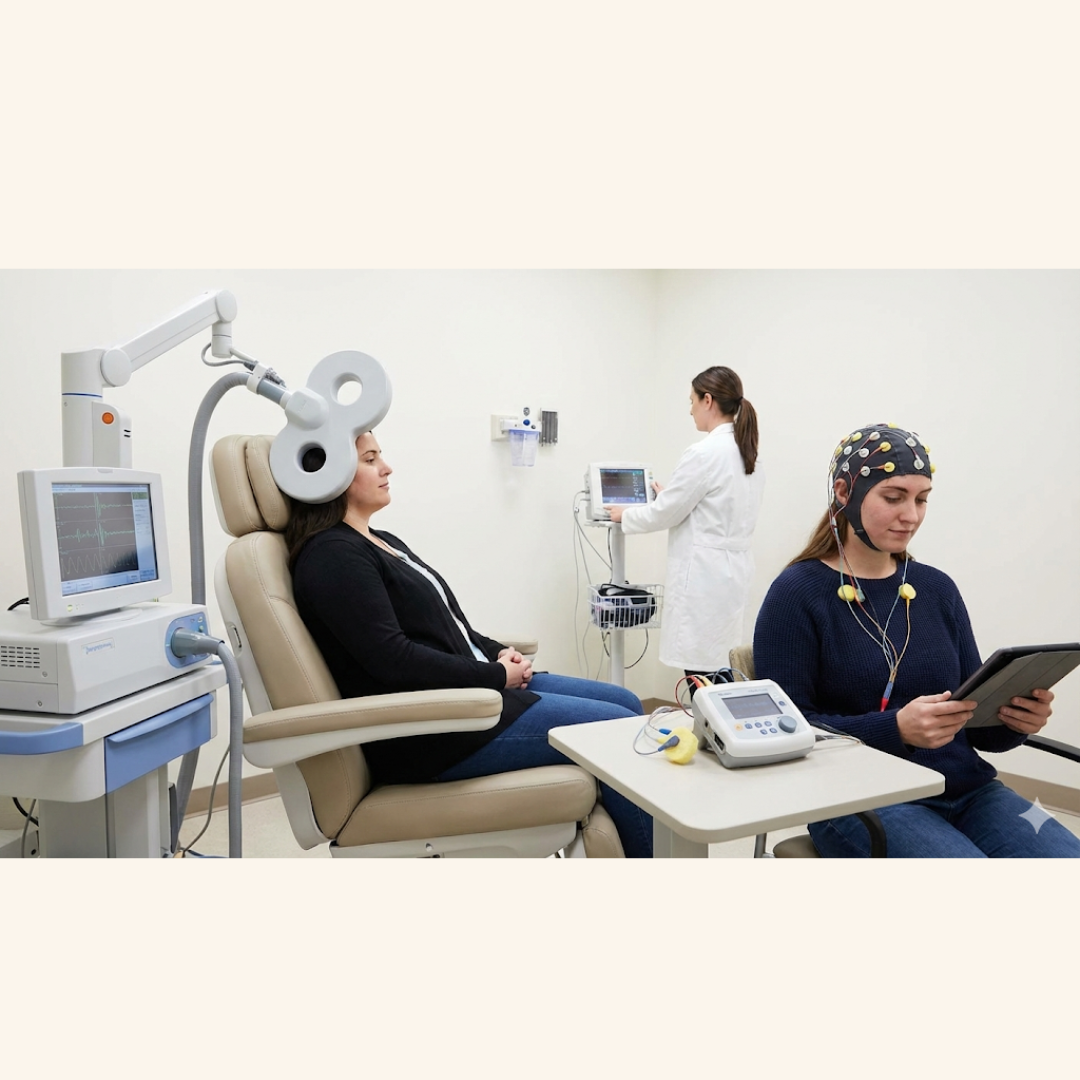
The Two Key Players: Magnets and Currents The review focused on two main technologies that are becoming increasingly available in clinics:
rTMS (Repetitive Transcranial Magnetic Stimulation): This involves sitting in a chair while a device places a magnetic coil near your head. It delivers magnetic pulses to "wake up" specific areas of the brain.
tDCS (Transcranial Direct Current Stimulation): This is a gentler approach using a small device with sponge electrodes on the head to deliver a very low, barely perceptible electrical current.
The Verdict for Parkinson’s The researchers found that these technologies are not just science fiction—they are showing genuine, measurable benefits for cognitive function.
Executive Function Boost: The strongest evidence for Parkinson’s suggested that rTMS, particularly when targeting the front of the brain (the dorsolateral prefrontal cortex), significantly improves executive function. This is the part of our brain responsible for multitasking, planning your day, and solving problems—skills that often get "sticky" or slow in Parkinson’s.
Daily Living: By improving these "managerial" brain functions, the therapy helps people manage their activities of daily living more independently.
The "Thinking" Benefit: While medication (like Levodopa) is brilliant for movement, it doesn't always clear the cognitive fog. This study suggests that neuromodulation could be the "add-on" therapy that specifically targets the thinking circuits that medication misses.
How It Compares to Alzheimer’s and Stroke The study was interesting because it looked at three different conditions. While Alzheimer’s patients saw benefits primarily in memory, for us with Parkinson’s, the "win" was clearly in processing speed and executive control. This makes sense, as Parkinson’s affects the brain’s "front-desk manager" (the frontal lobe) more than the "file storage" (memory) areas.
What This Means for You This is a hopeful step away from the idea that we can only treat symptoms with more pills.
It is Non-Invasive: No surgery, no anesthesia.
It is Targeted: unlike a pill that goes everywhere in your body, this targets specific brain networks.
It is an Option: If you feel your main struggle is shifting from "movement" to "thinking" or "planning," it might be worth asking your neurologist if rTMS is available as a therapy in your area.
The Takeaway We are entering an era where we can potentially "tune" the brain's circuits directly. While it’s not a cure, this review confirms that for the cognitive challenges of Parkinson’s, a little external "boost" might be exactly what our brains need to cut through the fog.
Comments (0)
Loading comments...