


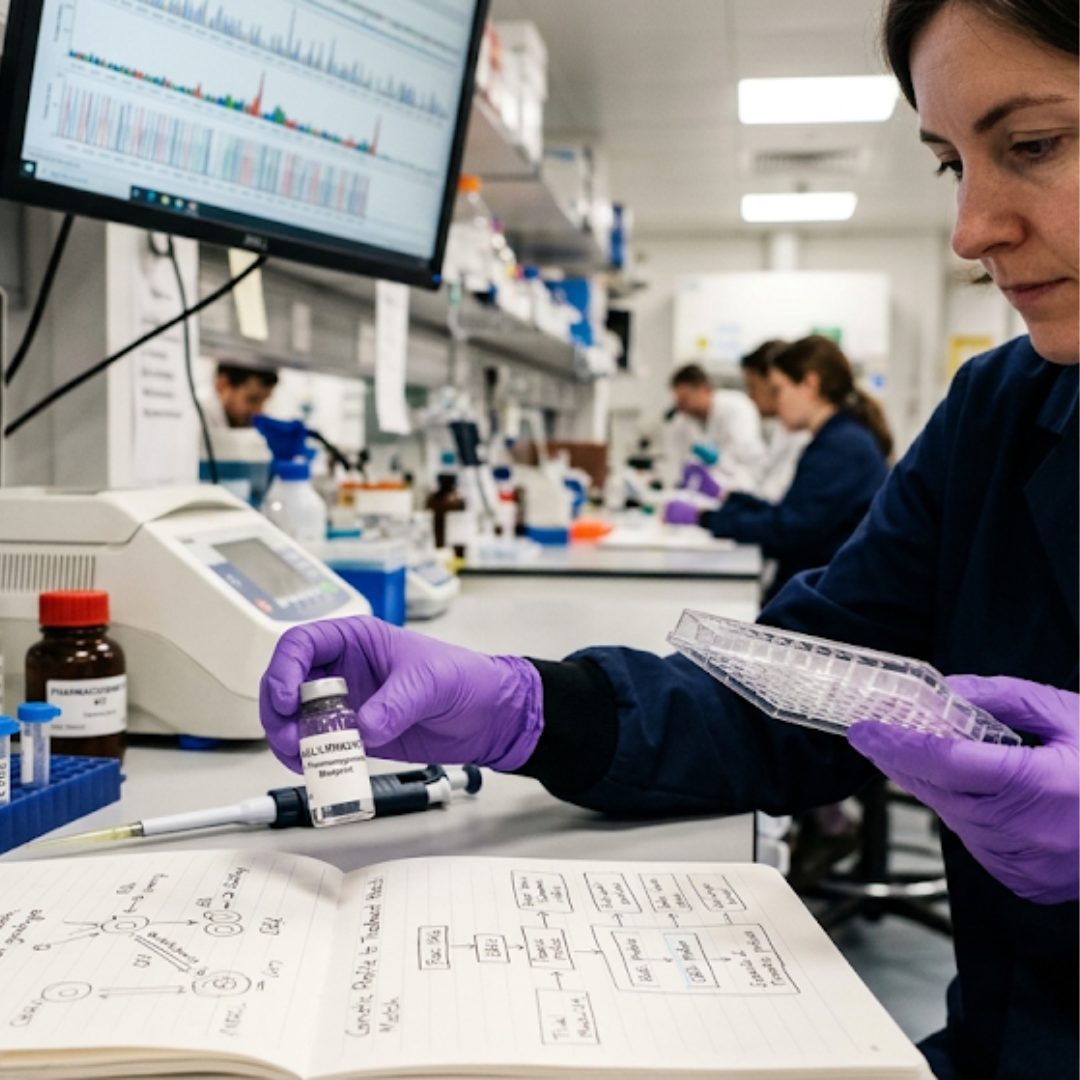
Researchers at University College London propose a genetic blueprint to help clinical trials match new treatments to the right people with Parkinson's
September 7, 2026
 Beatrice
Clinical trials searching for therapies to slow down or halt the progression of Parkinson's have frequently arrived at disappointing results. For many years, large studies evaluated potential treatments on broad groups of volunteers under the assumption that the condition behaves the same way in everyone. In a review published in September 2026 in the journal npj Parkinson's Disease, researchers Rowan Gurney, Huw Morris, and Thomas Foltynie from University College London argue that the path forward requires pharmacogenetics, which is the science of using an individual's genetic profile to predict how they will respond to a treatment. By shifting away from a universal approach and designing trials around genetics, scientists can ensure that candidate therapies are tested on the exact participants most likely to benefit.
The central challenge in Parkinson's research is that the condition is biologically diverse. Two people might experience comparable tremors or stiffness, yet the underlying biological disruptions in their brains could stem from completely different cellular problems. One person might have difficulties clearing out recycled cellular debris, while another might experience issues linked to energy production in mitochondria or inflammation. When everyone is grouped together in a single clinical study, a drug that successfully addresses one specific cellular issue can easily appear to fail because its true benefits are diluted across a crowd of non responders. To resolve this dilemma, the authors propose a clear framework divided into three major genetic domains: mechanistic matching, drug and host interactions, and the rate of progression.
The first domain, mechanistic matching, focuses on pairing a therapy with participants whose biology directly matches the drug's target. In recent years, researchers have identified several specific genetic variations linked to Parkinson's, such as changes in the GBA or LRRK2 genes. These genes provide the instructions for enzymes that keep cells healthy, and mutations can impair vital processes like waste disposal. If an experimental treatment is designed to restore the function of that exact enzyme, testing it on people who carry the relevant genetic change makes logical sense. Beyond single rare mutations, the framework also highlights polygenic risk scores, which look across thousands of tiny genetic variations across the entire genome. By combining these subtle variations, researchers can calculate which overarching biological pathway is most active in each individual and select therapies that address that specific pathway.
Finding the right target is only half the battle, which is why the second domain addresses how the body processes the medication. Once swallowed or infused, a treatment must be absorbed, broken down, and transported across the blood brain barrier to reach vulnerable brain cells. Every step of this journey is influenced by a person's genetic make up. Differences in liver enzymes mean that a standard dose might be broken down very quickly in one person, rendering it ineffective, while remaining in another person's system for too long and causing unpleasant side effects. By examining these personal variations beforehand, trial teams can adjust dosages for each participant, ensuring that everyone receives enough active medicine in the brain without risking unnecessary toxicity.
The third domain, known as prognostic enrichment, deals with the natural speed of progression. Clinical trials testing whether a treatment slows down the condition rely on measuring changes over time. If a study enrolls people whose symptoms change very slowly over several years, it becomes nearly impossible to tell whether the treatment actually slowed anything down within the timeline of a typical trial. Enrolling participants with genetic profiles known to produce more measurable progression allows scientists to detect whether a drug is working much sooner and with fewer participants.
The authors caution that these genetic forces do not exist in isolation and can sometimes pull in opposite directions. A specific genetic alteration might make an individual the perfect biological candidate for a new medication, yet that same alteration might naturally cause their symptoms to advance more quickly than average. If researchers do not account for these conflicting effects when planning their statistical models, they risk misinterpreting the results. A drug could appear ineffective simply because the participants naturally had a more aggressive form of the condition, or a mediocre treatment could appear successful if tested in a group that naturally progressed at an unusually gentle pace.
Realising the promise of this genetic framework requires a shift in how studies are organised. The authors emphasise the need for collaborative trial networks, such as the multi arm platform initiatives currently taking shape in the United Kingdom. These modern platforms test several treatments at the same time and adapt as data accumulates, pooling resources to recruit the large numbers of participants needed to detect true genetic interactions. By tailoring trial design to the biological fingerprint of each person, researchers can ensure that promising treatments finally have the best possible chance to succeed.
Comments (0)
Loading comments...