


Emerging therapies expected to make a difference in Parkinson’s disease management
September 15, 2026
 Beatrice
Researchers Andy An and Lorraine Kalia explain which new treatments are already available in clinics and which remain under investigation in laboratories and clinical trials.
Standard oral medications often struggle because the gut absorbs them unpredictably. This causes sudden "off" periods where movement freezes or stiffens, followed by "on" periods accompanied by involuntary writhing movements known as dyskinesia. To solve this, researchers distinguish between practical advances ready for prescription today and experimental therapies designed to modify biology in trials:
Continuous subcutaneous drug pumps (Available now in clinics)
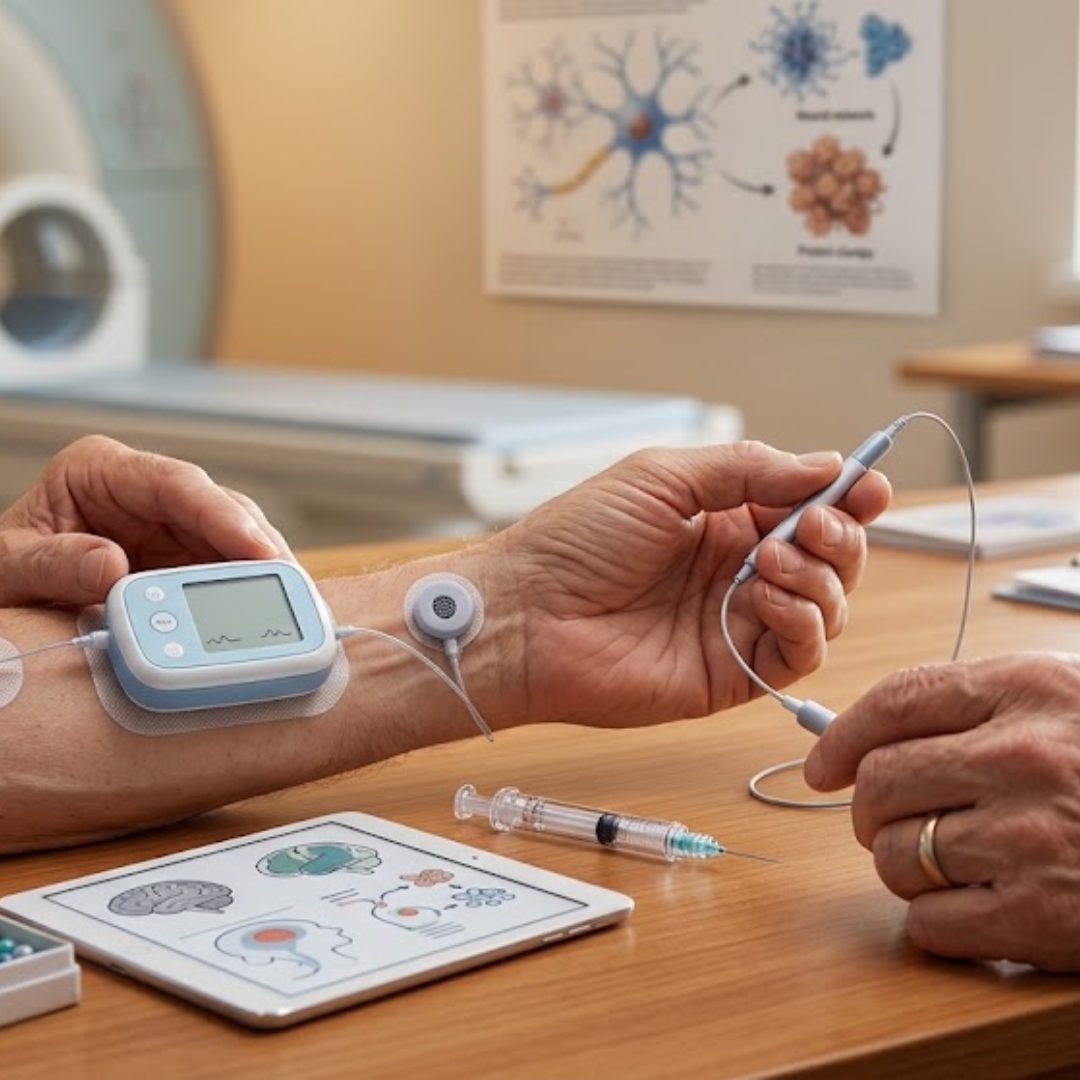
Instead of taking pills every few hours, people can use a small, wearable infusion pump connected to a tiny cannula placed just under the skin of the abdomen, very similar to an insulin pump. Continuous subcutaneous foslevodopa/foscarbidopa (known commercially as Produodopa) and continuous apomorphine infusions are now approved and prescribed in clinical practice across the UK and Europe. Because the medicine enters directly into the bloodstream under the skin, it bypasses the stomach entirely, keeping drug levels completely stable day and night and sharply cutting down both "off" time and troublesome dyskinesia.
Therapies targeting alpha synuclein clumps (In active clinical trials)
Parkinson's involves a normal protein called alpha synuclein that misfolds, tangles, and spreads through brain tissue as toxic Lewy bodies. These therapies aim to slow or stop cell death, but none are approved yet; they are currently moving through Phase 1 and Phase 2 clinical trials. Research focuses on two main tools:
Monoclonal antibodies (such as prasinezumab), which act like guided immune missiles infused into the bloodstream to attach to free floating, toxic protein clumps outside cells so the body can remove them before they infect neighbouring neurons.
Small molecules and aggregation inhibitors, currently tested in laboratories and early clinical trials, designed to cross the blood brain barrier, slip inside neurons, and physically prevent the loose protein strands from sticking together.
Precision drugs for genetic pathways (In laboratory and Phase 1 to 3 trials)
While genetic variations account for roughly ten percent of diagnoses, studying them reveals core disease mechanisms. These targeted therapies are still experimental and in clinical testing:
GBA targeted therapies: GBA gene alterations lower the activity of an essential enzyme called glucocerebrosidase, leading to clogged cellular waste bins (lysosomes) and toxic protein accumulation. Researchers are evaluating oral small molecule "chaperones" that help faulty enzymes fold correctly, as well as early stage gene therapies using viral vectors to insert healthy copies of the GBA gene straight into the brain.
LRRK2 kinase inhibitors: Faulty LRRK2 genes cause an enzyme to become constantly switched on, stressing cellular energy and transport pathways. Pharmaceutical trials (currently in Phase 2 and Phase 3, such as trials testing BIIB122/DNL151) use daily oral pills engineered to dial down this overactive enzyme back to a normal, healthy operating level.
Smart adaptive deep brain stimulation (Transitioning from trials to specialised centres)
Conventional deep brain stimulation has been routine surgery for decades, but it delivers an inflexible, continuous electrical current to movement centres like the subthalamic nucleus. Next generation closed loop or adaptive systems (such as Medtronic's Percept system with sensing technology) are now entering advanced clinics. These devices do not just shock tissue; they record real time brain wave signals, specifically abnormal brain oscillations called beta bursts that flare up when a person becomes rigid or slow. The stimulator automatically turns its voltage up only when the biomarker spikes, then dims down when natural movement returns, protecting speech, saving battery power, and preventing stimulation side effects.
Magnetic resonance guided focused ultrasound (Available for specific symptoms)
Focused ultrasound is already approved and clinically available for people with severe, medication resistant tremor. It requires no surgical cuts, burr holes, or implanted hardware. The person rests inside an MRI machine wearing a specialised helmet containing over one thousand sound wave emitters. Neurologists focus these acoustic beams onto a microscopic cluster of malfunctioning brain cells inside the thalamus. The convergent sound waves generate controlled heat to ablate the faulty circuit on the spot, permanently quenching the tremor while leaving the surrounding healthy brain untouched.
By categorising treatments into tools you can access today and disease modifying drugs working through the clinical trial pipeline, An and Kalia highlight a clear shift away from temporary symptom management toward long term protection of brain cells.
Comments (0)
Loading comments...