


Harvard researchers uncover brain sensor mix up that could impact Parkinson's research
August 6, 2026
 Beatrice
Learning how the brain works begins with understanding how its chemical messengers talk to each other. In Parkinson's, the brain loses the cells that produce dopamine, a key chemical that allows people to control their movements smoothly. To figure out how to protect these cells and restore smooth movement, scientists rely on microscopic glowing sensors to track these chemical messages in real time.
However, a study from Harvard Medical School reveals that two of the most popular sensors used in brain research frequently get their signals crossed.
The sensors are designed to detect dopamine and a closely related chemical called norepinephrine. While dopamine manages reward and smooth physical movement, norepinephrine handles alertness and the fight or flight response. Because the physical structure of these two chemicals is almost identical, telling them apart is extremely hard, even for advanced laboratory tools.
Researchers discovered the issue by accident while studying the dorsal striatum, a brain region that controls habit-based movements. When using a sensor meant to track norepinephrine, the readings unexpectedly matched dopamine activity instead.
To solve the puzzle, the team measured the amounts of both chemicals in different parts of the brain. They found that the dorsal striatum has roughly 500 times more dopamine than norepinephrine. In contrast, the motor cortex, which helps start voluntary movements, contains vastly more norepinephrine.
When a sensor is placed in an area overflowing with dopamine, such as the dorsal striatum, the sensor meant for norepinephrine mistakenly reacts to dopamine instead.
This mix up is a vital finding for Parkinson's research. Because dopamine levels drop significantly in Parkinson's, getting precise measurements of how chemical signals change is essential for developing better treatments. If a sensor misreads dopamine as norepinephrine, scientists could misinterpret how brain circuits are behaving.
The discovery also shows that these two chemical systems overlap more than previously thought. Dopamine can activate norepinephrine receptors, and norepinephrine can trigger dopamine receptors. Knowing this helps scientists build a more accurate picture of brain function while using these glowing sensors more carefully in future studies.
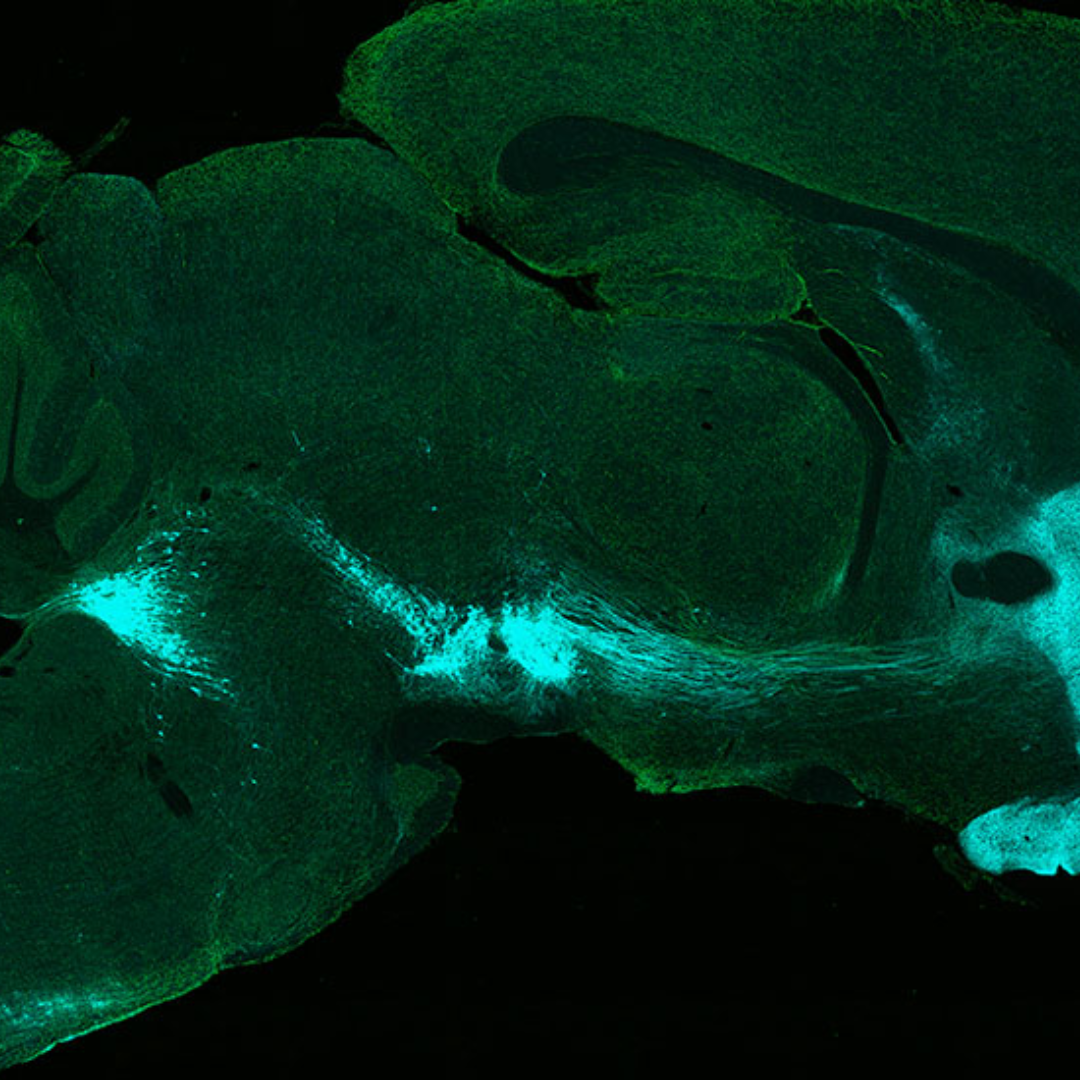
Photo: Norepinephrine- and dopamine-producing cells send broad projections through the brain. In this sample from a mouse brain, norepinephrine-producing cells and their axons are stained green, and those that express an enzyme involved in dopamine and norepinephrine production are stained cyan. Image: Ricardo López
Comments (0)
Loading comments...