


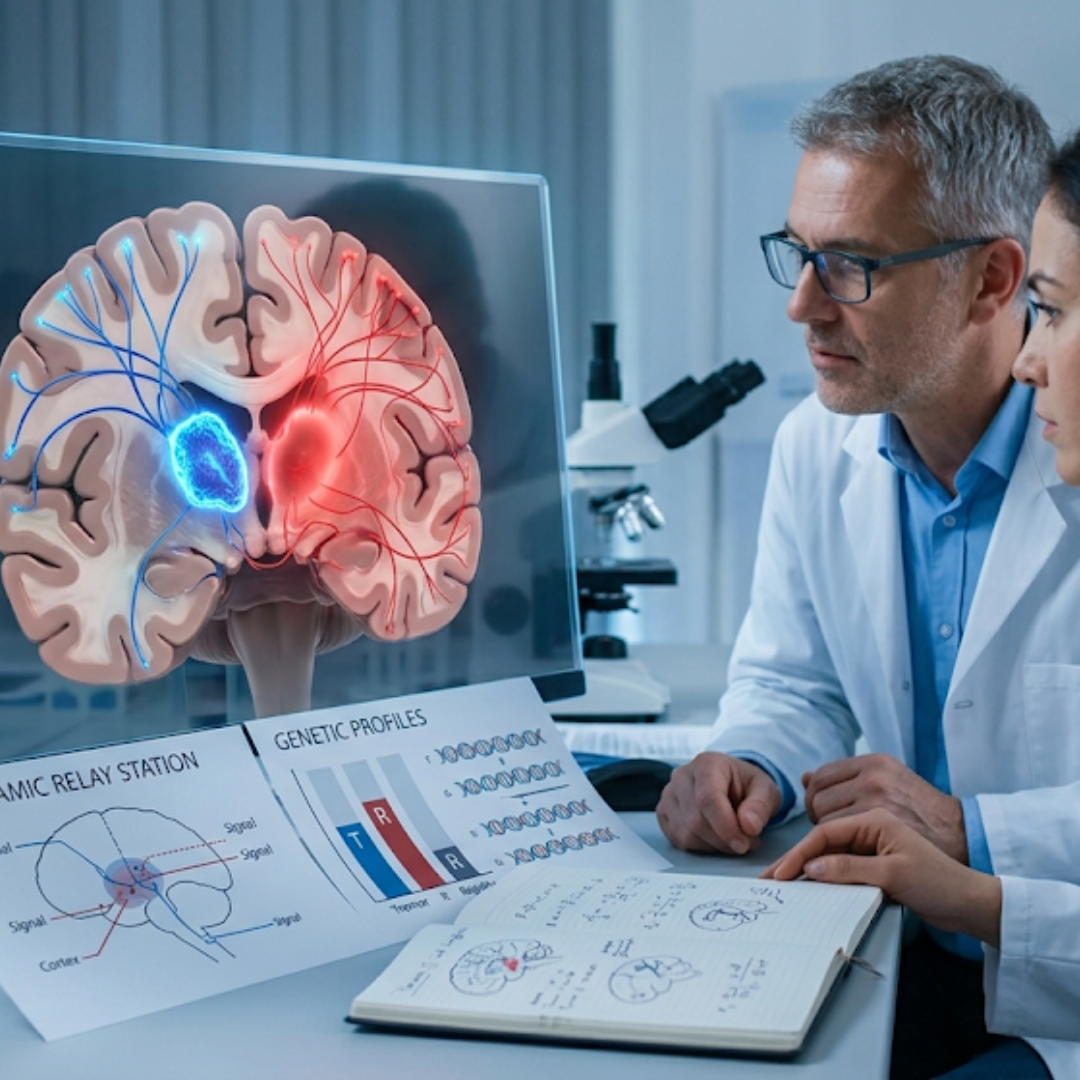
Brain scans and genetic mapping reveal why some people experience tremors while others experience muscle stiffness
June 4, 2026
Scientists have discovered that different physical symptoms are linked to distinct communication breakdowns deep inside the brain, and these breakdowns are driven by a person's unique genetic code. By combining advanced brain imaging with genetic mapping, the researchers have shown why some people experience tremors while others experience stiffness and slowness of movement.
The study focused on a vital structure deep inside the center of the brain called the thalamus. The thalamus acts like a busy central relay station or a main sorting office for the brain. Its main job is to take in movement and sensory signals from the body, sort them out, and then route them to the outer layer of the brain, known as the cerebral cortex, so the body can move smoothly.
By using advanced brain scans that look at how different brain regions talk to one another, the researchers found that this main sorting office breaks down in completely different ways depending on a person's specific symptoms.
In people who primarily experience tremors and shaking, the communication issues are tightly isolated. The breakdown happens almost exclusively within the tiny, specific sections of the thalamus that handle basic muscle coordination and sensory feedback. Because the problem is kept to this one specific area, it triggers the rhythmic, involuntary shaking characteristic of a tremor.
In contrast, for people with an akinetic rigid presentation, which causes severe muscle stiffness, rigidity, and slowness of movement rather than shaking, the brain scans showed a much more widespread problem. Instead of being isolated to one tiny spot, the communication lines are broken across a massive network. The thalamus struggles to talk to the broad outer regions of the brain that plan, prepare, and execute complex movements. This widespread network failure makes it incredibly difficult for the brain to initiate or smoothly carry out a physical action, leading to that distinct feeling of stiffness and slowness.
The breakthrough moment in the research came when the team mapped these distinct scanning patterns against the genetic profiles of the participants. They discovered that specific genes are active in different parts of this central sorting office.
This means that a person's genetic blueprint essentially dictates which parts of the thalamus are most vulnerable to cellular stress or rewiring issues. If a person's genetics make the isolated movement hub vulnerable, they develop a tremor. If their genetics impact the wider communication networks, they experience stiffness and rigidity.
Understanding this genetic and structural link changes how scientists view the condition. Instead of looking at it as a single, uniform issue, it can be seen as a collection of distinct sub types, each with its own physical map in the brain.
This discovery opens up major possibilities for highly personalised medical care, particularly for treatments like deep brain stimulation, which uses a small device to send electrical pulses to specific areas of the brain to improve movement. Currently, finding the exact right spot for stimulation can involve a bit of trial and error. In the future, doctors could use a quick, non invasive brain scan to see exactly which circuits are broken in an individual's brain and tailor the electrical settings to fix that specific pathway.
Furthermore, because the thalamus also routes signals related to mood, sleep, and memory, the researchers believe this same genetic mapping technique could soon be used to understand and treat non motor symptoms. While more long term studies are needed to see how these changes progress over several years, this piece of research provides a clear roadmap toward objective tests and highly individualised therapies.
Comments (0)
Loading comments...