


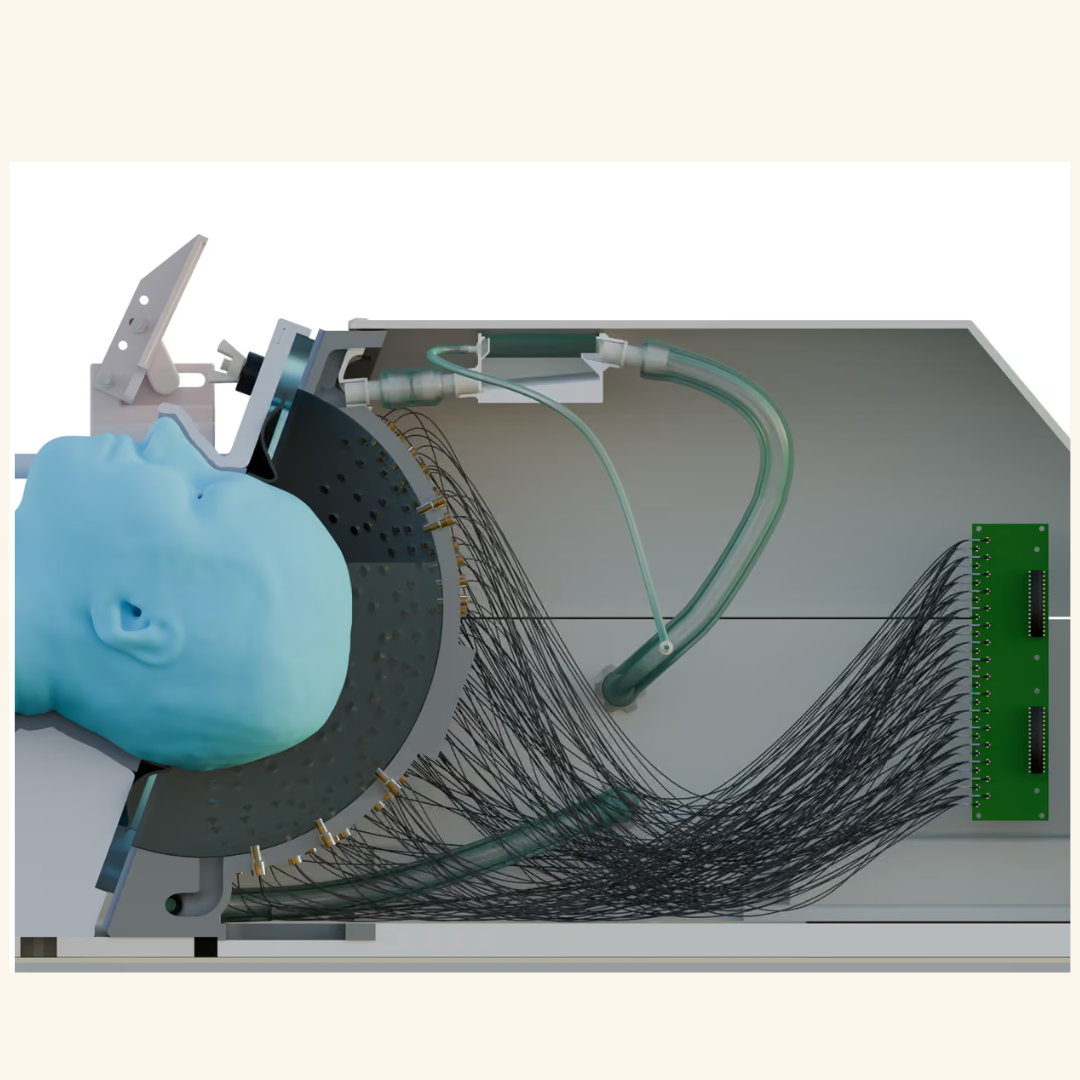
Ultrasound Helmet Lets Us “Talk to” Deep Brain
September 6, 2025
Researchers have developed a groundbreaking non-invasive device that can precisely stimulate tiny regions deep within the human brain—without surgery.
What’s new here?
Imagine wearing a helmet lined with 256 ultra-fine ultrasound speakers, nearly like a high-tech archer’s bow—but instead of arrows, it shoots focused waves into your brain. This system, designed to fit comfortably and positioned without surgery, can send tightly-focused ultrasound pulses to tiny deep-brain areas, while you're simultaneously inside an MRI machine. That creates a real-time “listen-and-respond” window into how the brain reacts.
Why that matters
Normal non-invasive methods—like magnetic or direct current stimulation—only reach the brain’s surface and are far too broad in their effects. Deep Brain Stimulation works better but demands brain surgery. This new ultrasound system bridges that gap. It targets deep brain circuits with surgical accuracy—without cutting you open.
How they tested it
The researchers aimed for the lateral geniculate nucleus (LGN)—a small relay in the thalamus that handles visual input on the way to your visual cortex. In human volunteers, they gave visual signals (a flashing checkerboard pattern) while delivering the ultrasound stimulation. MRI scans showed that the visual cortex lit up more than usual, but only when the ultrasound hit the correct deep-brain target. The effect was highly precise and repeatable across people.
Even more remarkable, after a brief “theta-burst” of ultrasound, visual cortex activity stayed quietly altered—for at least 40 minutes. That shows a sustained, predictable influence on brain circuits using nothing more than ultrasound.
Why this matters for brain science—and Parkinson’s
This level of precision, without surgery, opens doors for both research and treatment. Scientists can now explore how specific deep brain circuits work—or misfire. For Parkinson’s and other neurological or psychiatric diseases, it hints at non-invasive ways we might one day “tune” brain circuits—for tremor, mood, or movement—without surgery, drugs, or permanent effects.
Comments (0)
Loading comments...