


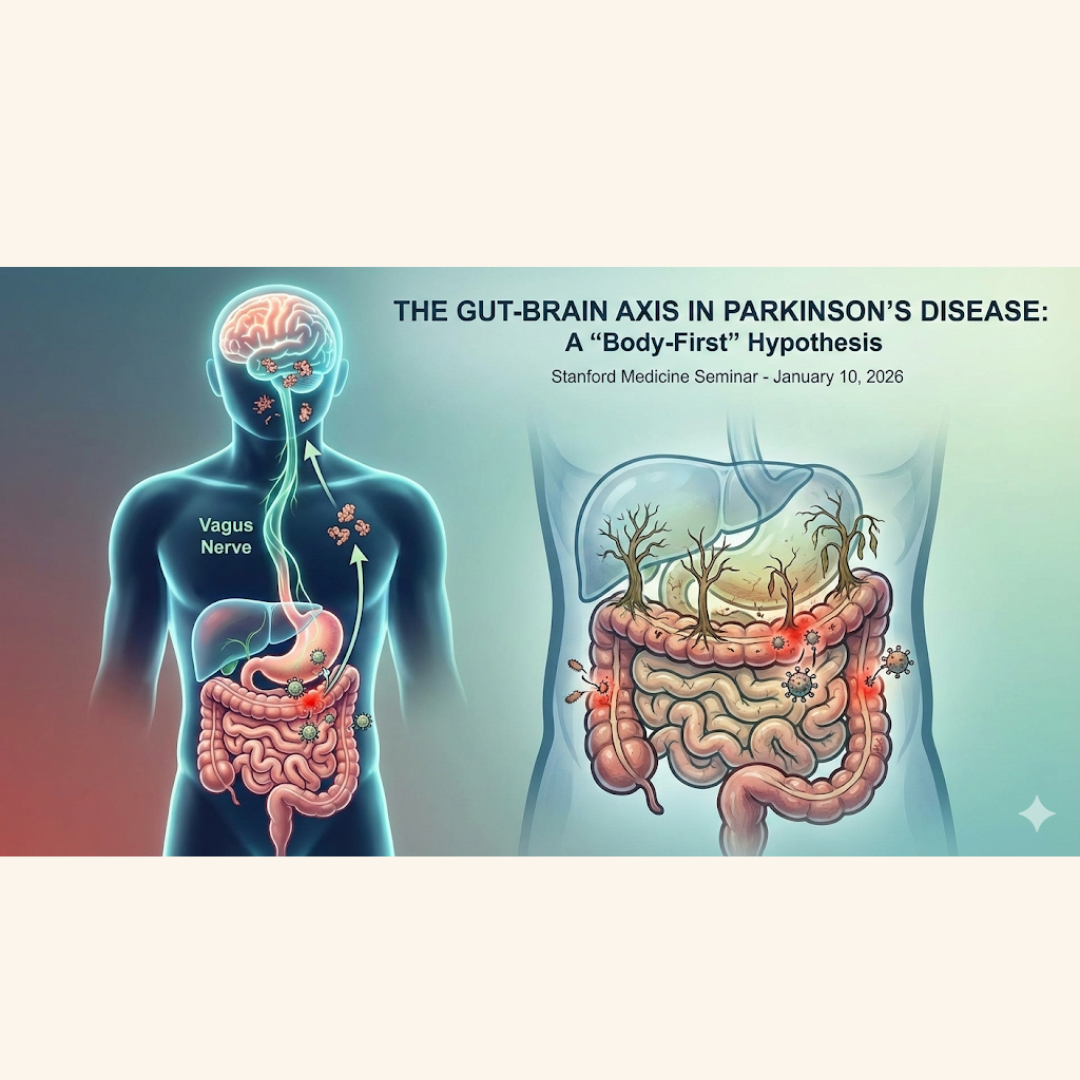
Is the Gut the "Crime Scene" of Parkinson’s? Notes from Stanford’s Latest Seminar
January 16, 2026
On January 10, 2026, a team of specialists at Stanford Medicine gathered to discuss a radical shift in how we understand Parkinson’s. For decades, medicine has looked up at the brain to find the source of the condition. However, the new "Body-First" hypothesis suggests we have been looking at the destination, not the origin. The seminar, titled "Gut-Brain & Parkinson’s Disease," presented a compelling case that the pathology may actually begin in the gastrointestinal tract—triggered by environmental factors—before travelling up to the brain.
The event featured a powerhouse lineup including neurologists Dr Kathleen Poston and Dr Bianca Palushaj, neurogastroenterologist Dr Leila Neshatian, and bioengineering researcher Yasmine Kehnemouyi. They moved the spotlight from the head to the stomach, explaining why symptoms like constipation are not merely annoying side effects, but central clues to the disease process itself.
The Body-First Hypothesis
Dr Kathleen Poston opened the discussion by explaining why the medical community is rethinking the timeline of Parkinson's. We know that non-motor symptoms, particularly constipation, can appear up to twenty years before the first tremor or stiffness. The "Body-First" hypothesis suggests that environmental toxins—such as pesticides or pollutants—might be swallowed, interacting with the lining of the gut.
This interaction causes inflammation and cellular changes in the digestive system. Dr Poston explained that these changes could act like lighting a fuse. The resulting damage, specifically clumps of misfolded proteins, may then travel up the vagus nerve—the superhighway connecting the gut to the brain—eventually reaching the brainstem and causing the motor symptoms we recognise as Parkinson’s. Because of this, researchers are now looking at whether routine colon biopsies could help detect the condition years before a clinical diagnosis is usually made.
The "Pre-Digestion" Failure
While dopamine gets all the headlines, PhD candidate Yasmine Kehnemouyi highlighted another chemical messenger that fails much earlier: acetylcholine. This chemical is responsible for the "rest and digest" system.
Kehnemouyi introduced the concept of the "cephalic phase" of digestion. This is your body’s preparation phase—when you smell dinner cooking and your mouth waters and your stomach starts to rumble. In people with Parkinson’s, this automatic "pre-game" warmup is often broken because the nerves in the stomach are degenerating. Stanford is currently developing clever, non-invasive technology involving stomach sensors (similar to an ECG for the heart) to measure these electrical signals. The hope is that by identifying this "silent stomach" early, we might spot the condition long before movement issues arise.
An Empty Rainforest, Not an Overgrown Garden
We often hear about "bad bacteria" in the gut, but Dr Bianca Palushaj’s research paints a different picture. Using a new counting method called "Absolute Abundance," her team discovered that the gut of someone with Parkinson’s isn't necessarily overrun with bad bugs. Instead, it is like a depleted rainforest.
The data shows that people with the condition have significantly fewer bacteria overall. Crucially, they are missing the "good guys"—the beneficial microbes that produce short-chain fatty acids which protect the gut lining. This implies that simply taking a probiotic might not work. Dropping a few seeds into a desert won't grow a forest; you need to restore the soil and the ecosystem first.
Rethinking Constipation
Dr Leila Neshatian, a specialist in neurogastroenterology, tackled the most common gut complaint. She noted that over 80% of people with Parkinson’s struggle with bowel issues, but it is rarely just a case of a "slow system."
For many, the issue is actually a coordination failure. The muscles in the pelvic floor and the anal sphincter may not relax when they are supposed to, creating a blockage. In these cases, drinking more water or taking standard laxatives won't help because the plumbing isn't clogged; the tap just won't open. This specific type of dysfunction often requires specialised biofeedback physical therapy.
Dr Neshatian also touched on SIBO (Small Intestinal Bacterial Overgrowth), which is common in Parkinson’s. This is where bacteria grow in the small intestine where they shouldn't be. These bacteria can be greedy—they actually "eat" Levodopa medication before it can be absorbed into the blood. This explains why some people feel their medication suddenly stops working or works inconsistently.
Practical Takeaways
The seminar concluded with a panel moderated by bioengineer Dr Todd Coleman, offering some practical advice. Regarding the "protein effect"—where dietary protein blocks medication absorption—the experts advised not to cut protein out, as it is vital for keeping muscles strong. Instead, simply leave a gap of one to two hours between a high-protein meal and taking medication.
Finally, while gut science is complex, the best way to build resilience in both the brain and the body remains simple: daily exercise. It is the single most proven factor in helping the brain find workarounds for damaged pathways.
For those interested in the full scientific details, slides and notes are available on the Stanford Parkinson’s Blog.
Comments (0)
Loading comments...