


Light Therapy for Parkinson’s: A Ray of Hope or Just an Expensive Flashlight?
December 20, 2025
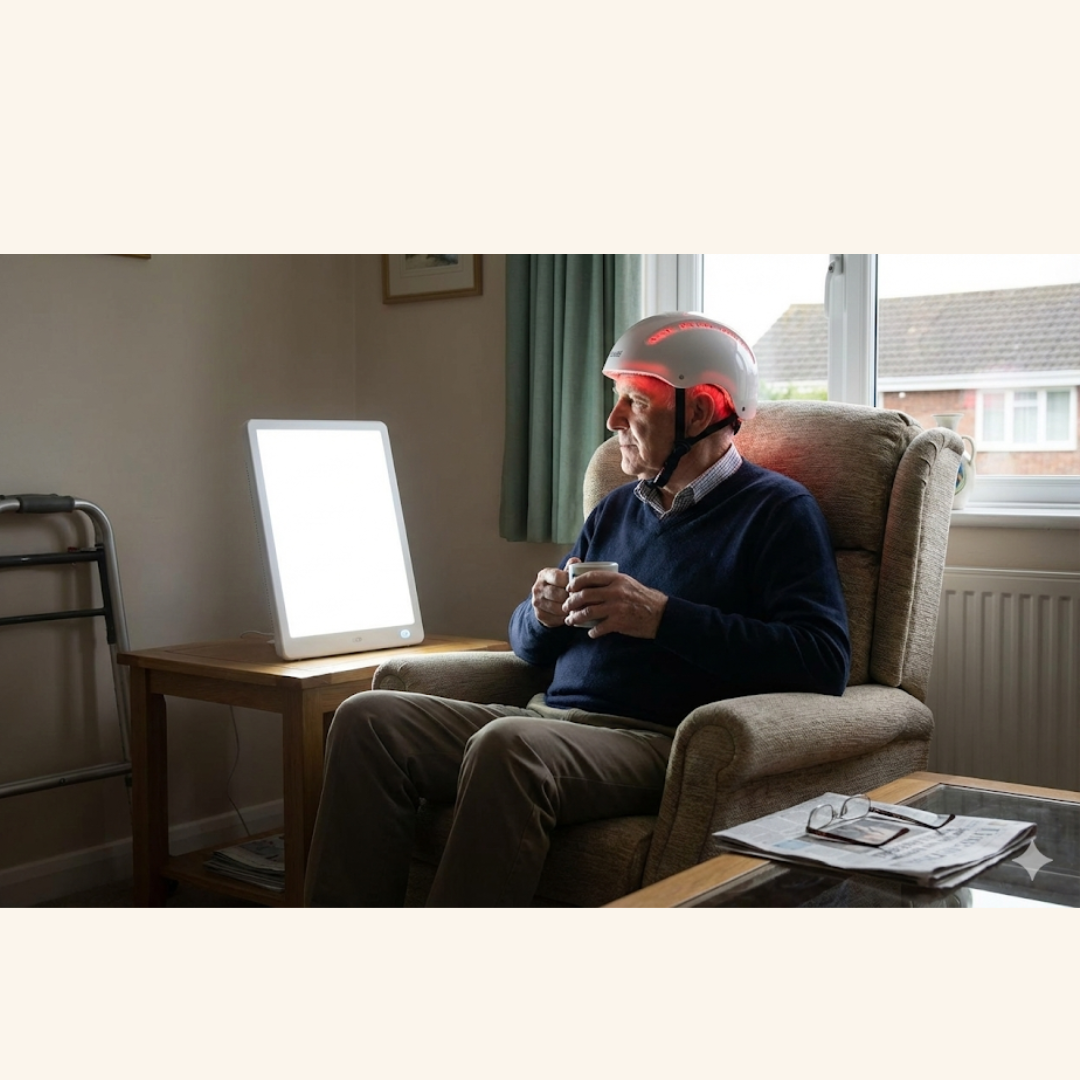
For many in the Parkinson’s community, a light therapy device sits at the very top of the wish list. Whether it is a headset that looks like it belongs in a sci-fi film or a panel designed to be placed on the abdomen, the promise is undeniably seductive. Manufacturers suggest these devices can recharge dying neurons, repair the gut-brain axis, and restore movement. However, with price tags often running into the thousands, and a market flooded with aggressive marketing, a critical question remains: does the science actually back the investment, or is this the placebo effect wrapped in high-tech plastic?
To answer this, we must look beyond the brochures and analyse the rigorous clinical data published recently in major journals like The Lancet’s eClinicalMedicine, Neurology, and Journal of Clinical Medicine. The results paint a picture that is fascinating, complex, and significantly more nuanced than the headlines suggest.
Defining the Beam: Not All Light is Equal:
First, it is vital to distinguish between the two technologies often lumped together, as they work in completely different ways.
- Bright Light Therapy (BLT): This involves sitting in front of a very bright box (10,000 lux) to stimulate the eyes and reset the body clock (circadian rhythm).
- Photobiomodulation (PBM): This involves using lasers or LEDs (usually red or near-infrared) on the head or gut to penetrate tissues and stimulate cells directly.
The "Red Light" (PBM) Trials: The Exercise Dilemma:
The most discussed research recently surrounds Photobiomodulation (PBM), particularly the trials associated with the Symbyx protocol (often using red light on the gut and head). The theory is scientifically sound: red light stimulates mitochondria—the batteries within our cells—to produce more energy (ATP), theoretically protecting vulnerable dopamine neurons.
A major recent trial published in The Lancet’s eClinicalMedicine and further analysed in MDPI put this to the test. The study design was rigorous, involving a double-blind phase where participants used either a real laser or a "sham" (fake) device, combined with a vigorous exercise programme.
The results of this blinded phase were revealing. Both the group receiving the real laser therapy and the group receiving the placebo improved significantly. Crucially, statistical analysis showed no significant difference between the two groups.
This points to a massive "confounder" in the study: Exercise. We already know that rigorous exercise is arguably the most powerful medication available for slowing Parkinson’s progression. When a trial mandates that participants exercise alongside the therapy, everyone improves. The data suggests that for the first few months, the "heavy lifting" was likely done by the treadmill, not the laser.
The "Responder" Trap Proponents of the technology often point to the study’s long-term data (up to 48 weeks), where a percentage of people continued to show improvements. However, this phase was "open-label," meaning participants knew what they were taking. In medical science, this introduces bias. The people who choose to keep going are often those who are highly motivated or simply believe it is working. While anecdotal success stories are powerful, from a strict data perspective, the device struggled to outperform the placebo when the blindfold was on.
Bright Light Therapy: Good for Sleep, Not for Mood:
The story is different, though equally nuanced, for Bright Light Therapy (BLT) targeting the eyes. A pivotal Class I randomised controlled trial published in Neurology (Rutten et al.) investigated whether this therapy could treat depression and insomnia in Parkinson’s.
The findings were a mixed bag. On its primary goal—treating depression—the therapy failed; it was no more effective than a dim control light. However, it did score a victory in "secondary outcomes." The study found that BLT significantly improved subjective sleep quality and lowered cortisol levels.
Given that sleep fragmentation is a major non-motor symptom of Parkinson’s, this is a tangible benefit. However, it raises a question of value: if the primary benefit is circadian regulation, this can often be achieved with a standard, affordable SAD (Seasonal Affective Disorder) lamp, rather than a specialist neurological device.
The Verdict:
The current body of evidence suggests that while light therapy is safe, its efficacy is often overstated.
Safety: The good news is that these therapies appear very safe, with few reported side effects.
Efficacy: The "miracle" results often disappear when rigorous placebo controls are applied. The profound benefits seen in PBM trials are heavily intertwined with the benefits of the accompanying exercise.
For now, the science indicates that while light therapy may offer a modest "boost" or help with specific issues like sleep, it is not a replacement for standard medication or exercise. In fact, the data inadvertently proves that a pair of running shoes might still be the most effective piece of technology a person with Parkinson’s can buy.
Comments (0)
Loading comments...