


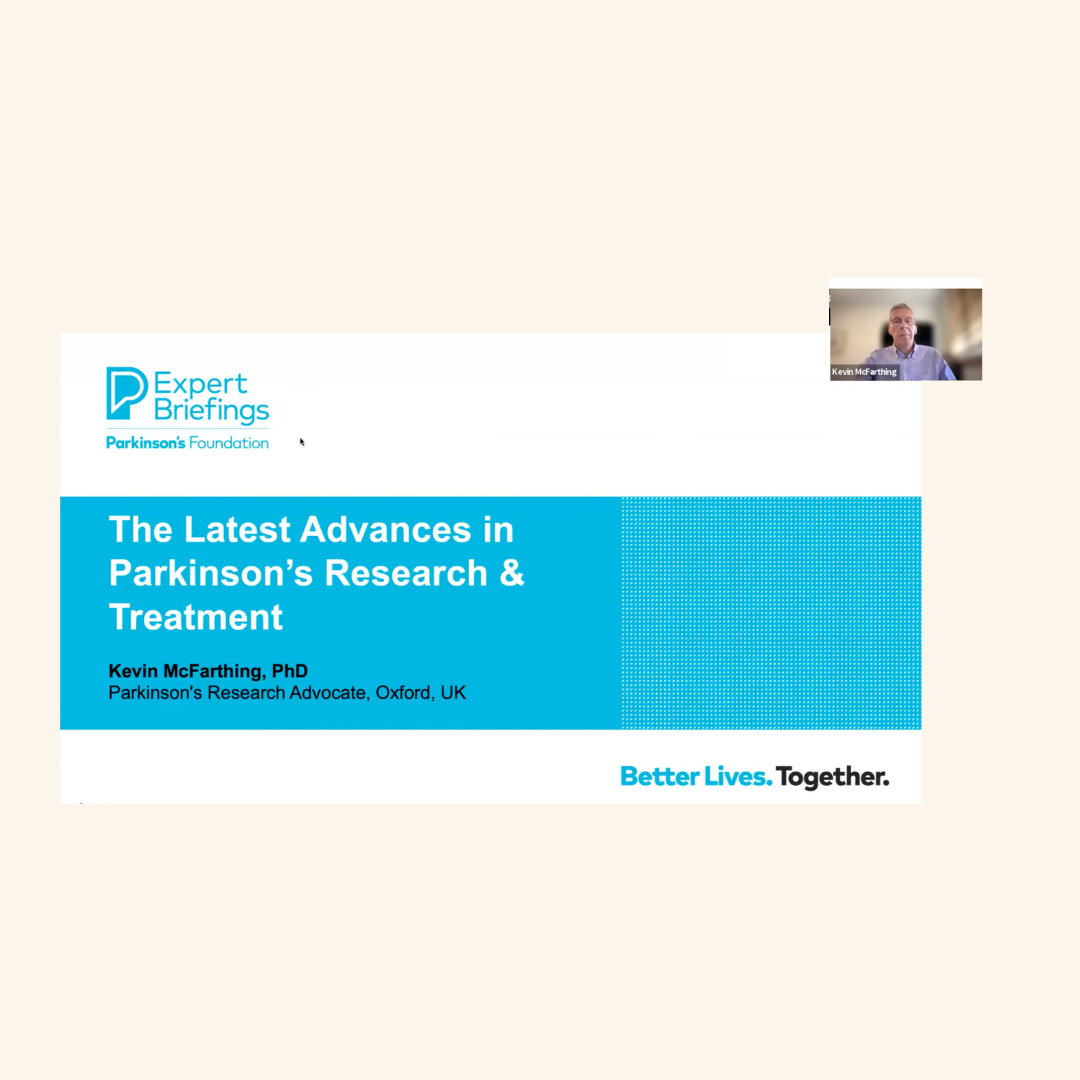
Expert Briefing: The Latest Advances in Parkinson’s Research and Treatment
April 14, 2025
 mistergreen3003
In-depth look at the latest advancements in Parkinson’s disease research and the emerging treatments. This webinar covers the current medication pipeline, highlighting new therapies and their potential impact on symptom management. Speaker: Kevin McFarthing, PhD, Parkinson's Research Advocate, Oxford, UK
Here are summary of that webinar:
A Brighter Horizon: Breakthroughs in Parkinson’s Research and Emerging Treatments
If you’re living with Parkinson’s—or supporting someone who is—you’ve likely heard that finding effective treatments is no easy feat. But here's some good news: the research pipeline is absolutely buzzing, and more than 350 active projects are currently underway aiming either to relieve symptoms or modify the disease itself.
Let’s take a stroll through the latest updates in Parkinson’s R&D, what they could mean for quality of life, and how you might even get involved in upcoming clinical trials.
Why Is Drug Development So Tough?
Developing new treatments for the brain is notoriously difficult and expensive. In fact, research shows it costs a jaw-dropping $2.6 billion to bring a single successful drug to market—mostly because so many others fail along the way.
Central nervous system conditions like Parkinson’s also take longer than average to develop treatments for, have a lower chance of success, and rarely benefit from fast-track regulatory processes. So you might think big pharmaceutical companies would give Parkinson’s a wide berth.
But surprisingly, they’re not. And here’s why.
Parkinson’s Is on the Rise
A 2018 paper predicted that by 2050, 25 million people worldwide could be living with Parkinson’s. It’s a chronic condition—meaning people live with it for years or decades—so there’s a strong, growing demand for ongoing symptom management and (hopefully) disease-modifying options.
And what’s more, Parkinson’s now ranks in the top 3 most-targeted diseases for drug development, just behind type 2 diabetes and Alzheimer’s. That’s no small thing.
355 Research Projects—and Counting
Since 2013, one determined patient-advocate has been building a “Parkinson’s Hope List” of every known project in development. It now includes over 350 therapies—102 focused on symptom relief and 253 aiming to slow, stop, or reverse the disease. These span everything from brand-new compounds to reformulations of existing drugs, repurposed medications, and even cell and gene therapies.
That’s a lot of hope on the horizon.
Symptom Relief: More Than Just Dopamine
We all know Parkinson’s is more than just tremor and slowness. The “Parkinson’s iceberg” highlights what’s visible above the surface (like rigidity or balance issues) and what’s lurking below (pain, anxiety, sleep issues, constipation… the list goes on).
Researchers are now designing treatments to target specific symptoms, rather than relying solely on general dopamine-replacement therapies.
Here are just a few:
CPL-36 (Poland): Targeting dyskinesia with a new mechanism.
MetoPam (Sweden): A dopamine receptor antagonist showing promise.
Vistagen (USA): Targeting NMDA receptors, again for dyskinesia.
What’s exciting? These drugs aren’t just tweaking dopamine—they’re going after entirely different biological targets, giving us a bigger toolkit to work with.
Valevo™: A Goldilocks Approach to Levodopa
As Parkinson’s progresses, that “just right” therapeutic window for Levodopa narrows. Too much, and you risk dyskinesia. Too little, and symptoms return.
Enter Valevo (also known as Produodopa), a clever infusion pump that delivers a steady, subcutaneous stream of Levodopa and Carbidopa. The secret sauce? A more soluble version of the drug that allows lower volumes to be delivered under the skin—neatly bypassing the erratic absorption from tablets.
Studies show it’s improving motor function, reducing night-time trips to the loo, and even helping some patients go off oral meds entirely. There are still skin reaction concerns, but it’s a major leap forward.
Tavapadon: A New-Gen Dopamine Agonist
Dopamine agonists can be a double-edged sword—offering symptom relief but often coming with nasty side effects like impulse control disorders.
Tavapadon, from a company called Cerevel, is an agonist that’s trying to do better. It targets specific dopamine receptors and has shown strong results in three large trials, both alone and in combination with Levodopa. It’s now heading toward FDA submission, and big players like AbbVie are backing it with serious cash—$7 billion, to be exact.
First-Ever Phase 3 Cell Therapy Trial
Stem cell therapy has long been a holy grail for Parkinson’s, but getting there is tricky. Each data point requires brain surgery and takes time to show results.
But for the first time, a company called BlueRock (a Bayer subsidiary) has received FDA approval to launch a Phase 3 trial using a cell therapy called BRT-DA01. Early studies showed it was safe, and now 80 patients will be enrolled in the final stretch.
Fingers crossed—this is a big moment.
Slowing Progression: GLP-1 Agonists Step In
You’ve probably heard of Ozempic or Wegovy—those diabetes and weight-loss drugs sweeping the headlines. Well, the class they belong to (GLP-1 agonists) was inspired by the venom of the slow-moving but venomous Gila monster.
Now, researchers are looking at these drugs for Parkinson’s too.
In a French trial, a GLP-1 agonist called Lixisenatide slowed motor symptom progression by around 3 points on the UPDRS scale over 12 months, while the placebo group continued to decline. Another trial with Exenatide didn’t show a difference, but researchers believe formulation and dosing could be key.
More GLP-1 trials are in progress, so this avenue is very much alive and kicking.
🔬 The Genetics Angle: Big Focus, Small Numbers
Let’s start with genetics. Certain genetic targets—like GBA and LRRK2—account for about 10–15% of Parkinson’s cases. That’s a small slice of the pie, but drug developers are hopeful that therapies targeting these genes might also help those of us with “idiopathic” Parkinson’s (aka the mysterious, non-genetic kind).
A few key players:
Ambroxol (yes, the old cough medicine!) is heading into a Phase 3 trial. It helps boost activity of the GBA enzyme, which is lower in some people with Parkinson’s.
Prothena’s antibody treatment for alpha-synuclein has had mixed results but is still marching on.
Anovis Bio’s therapy is trying to reduce alpha-synuclein production. It flopped in Phase 3—but the company still sees “signals” worth chasing.
🧗♀️ The Phase 3 Problem
Here’s the catch: most promising therapies stall at Phase 3—the final test before a drug can be approved. Why? Several reasons:
Parkinson’s varies wildly between people, making it hard to measure whether a treatment works.
The tests we use (like UPDRS) are a bit wobbly and not always reliable.
Trials don’t always run long enough to show a clear benefit.
Oh, and did we mention? Clinical trials are expensive and time-consuming.
🧠 A Smarter Way to Test New Drugs: The EJS ACT-PD Trial
Enter a new hero: the multi-arm, multi-stage (MAMS) trial design. Instead of testing one drug at a time in a long, linear sequence (test → dismantle → repeat), MAMS allows multiple treatments to be tested against one placebo at once, keeping the trial infrastructure in place. If a drug doesn’t show promise early on, it gets swapped out—no time wasted.
Inspired by successful trials in cancer and ALS, this model is being adopted by the EJS ACT-PD initiative (funded by the late Parkinson’s philanthropist Edmond J. Safra). The goal? Accelerate the path from lab to life.
💊 What’s Being Tested?
Three repurposed drugs are starting the EJS ACT-PD trial:
Telmisartan (for blood pressure)
Tadalafil (for enlarged prostates)
UDCA (a liver drug)
Meanwhile:
Hydra and SLEEP trials are underway in Norway and France to fast-track early-stage treatments.
Australian Parkinson’s Mission is planning combo therapies.
P2P (Path to Prevention) is exploring early intervention.
And Ambroxol (yep, again!) is gearing up for its major moment in Phase 3.
🧬 Why GLP-1 Agonists Still Have Everyone Talking
There’s a lot of buzz around diabetes drugs like liraglutide and semaglutide (GLP-1 agonists). They might help by:
Reducing brain inflammation
Boosting energy production in neurons
Tackling insulin resistance in the brain Some researchers even joke that Parkinson’s and Alzheimer’s might be “type 3 diabetes.” (Only sort of a joke.)
😬 So Why Do So Many Phase 3 Trials Fail?
Good question. In short:
Parkinson’s is messy—we’re all different.
The tools we use to measure progress aren’t perfect.
And sometimes, unfortunately, the drugs just don’t work.
Oh, and let’s not forget the elephant in the room: money. Longer trials cost more. Keeping the infrastructure going is expensive. And there’s always pressure to move fast.
🙋♀️ Want to Help?
None of these trials happen without people. If you’re curious about joining a study:
Check out Fox Trial Finder
Or visit clinicaltrials.gov
Or try Sue Buff’s easy-to-navigate PD Trial Tracker (just Google it!)
🧠 Final Thought
Despite the setbacks, the takeaway is clear: There is hope. Parkinson’s is attracting serious brainpower, funding, and creativity. The road is bumpy—but it’s far from empty. As Dr. McFarthing said: we’re not short of effort. And with smarter trials and more people stepping up, we’re getting closer.
So keep the faith, and keep your eyes on those Phase 2 trials. They’re the next batch of potential breakthroughs—and they need you to succeed.
Comments (0)
Loading comments...