


Brain adapts by reorganising dopamine networks in early stages of Parkinson's
July 16, 2026
 Beatrice
A new study has revealed that the brain reorganises its dopamine signalling in the earliest stages of Parkinson’s. Led by researchers at the Djavad Mowafaghian Centre for Brain Health, the investigation used advanced imaging technology to map how the brain attempts to adapt when dopamine-producing cells begin to decline. The findings provide a much clearer picture of how the brain compensates for these losses, whilst also showing why these very adaptations might eventually lead to movement and thinking difficulties.
In a healthy brain, different regions of the striatum—a key area of the brain involved in both movement and thinking—work like a well-organised office. Each department has its own highly specialised job. One circuit handles hand movements, another coordinates foot movements, whilst entirely separate networks manage thinking tasks and reward processing. This clear division of labor is known as functional segregation, and it allows the brain to fine-tune discrete actions and multitask efficiently without different signals getting crossed.
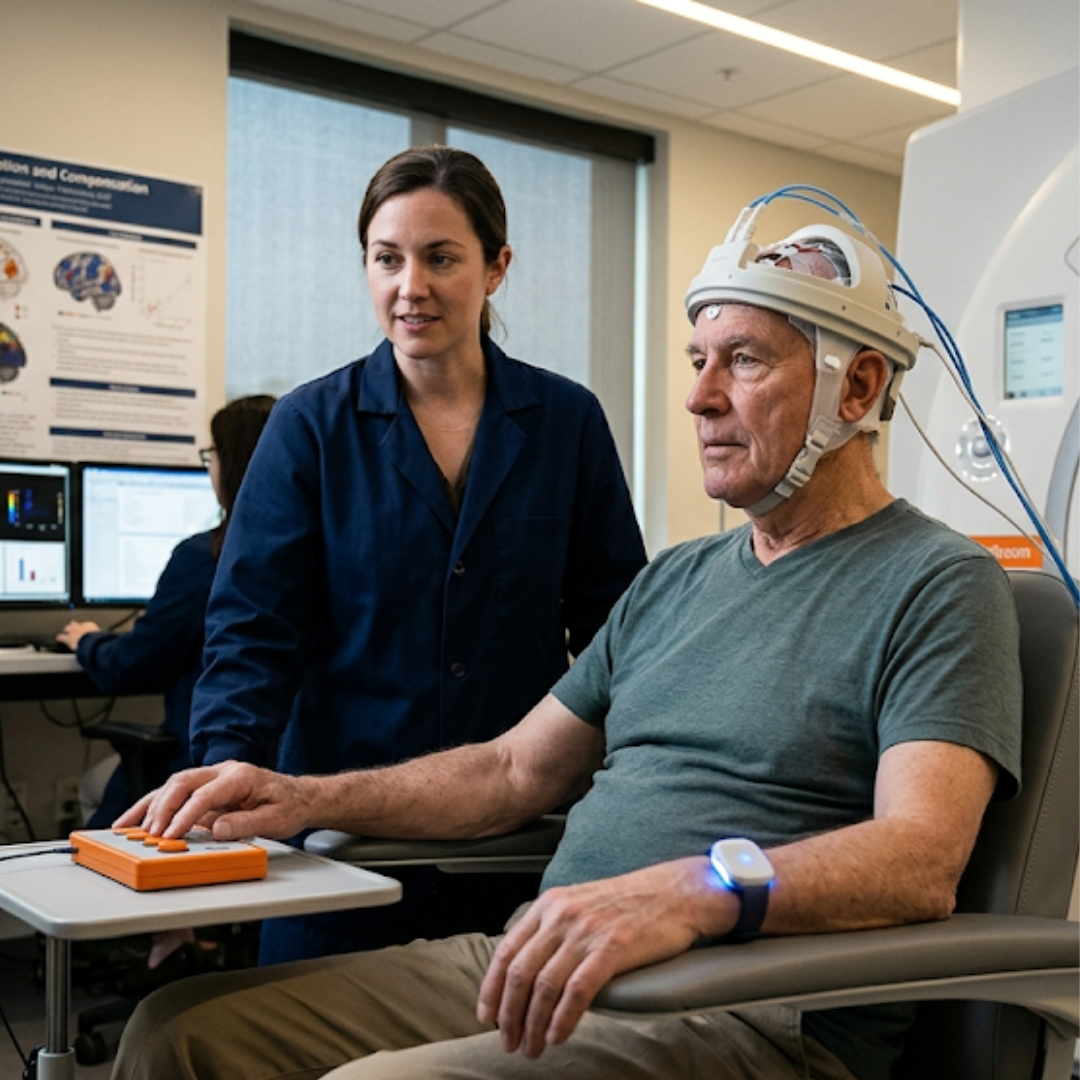
Using a state-of-the-art hybrid scanner that combines Positron Emission Tomography (PET) and Magnetic Resonance Imaging (MRI), researchers monitored dopamine release and brain network activity in real time. They observed healthy volunteers and individuals in the early stages of Parkinson's as they performed simple physical actions, such as finger tapping and foot tapping, alongside cognitive tasks.
In healthy individuals, the scanner showed sharp boundaries between the active circuits. However, in those with early Parkinson’s, these functional boundaries began to blur. As dopamine levels start to fall, the brain responds by calling in backup. Instead of keeping tasks strictly separated, the brain recruits neighbouring networks to step in and help out.
While this adaptability is a remarkable display of resilience that helps maintain daily physical functions early on, this sharing of resources comes at a cost. When different networks are forced to share the same space and use the same pathways, the brain loses its ability to keep functions separate. This loss of segregation explains why people may eventually experience difficulties with precise movements, or find it increasingly hard to manage physical and mental tasks at the same time.
Understanding this early reorganisational process gives researchers a brand new target for treatment. Rather than solely focusing on replacing lost dopamine, future therapies could be designed to protect the brain's natural boundaries or guide these compensatory changes more effectively. Researchers are already looking into whether specific lifestyle interventions, including targeted exercise, can help preserve this crucial brain organisation.
Comments (0)
Loading comments...