


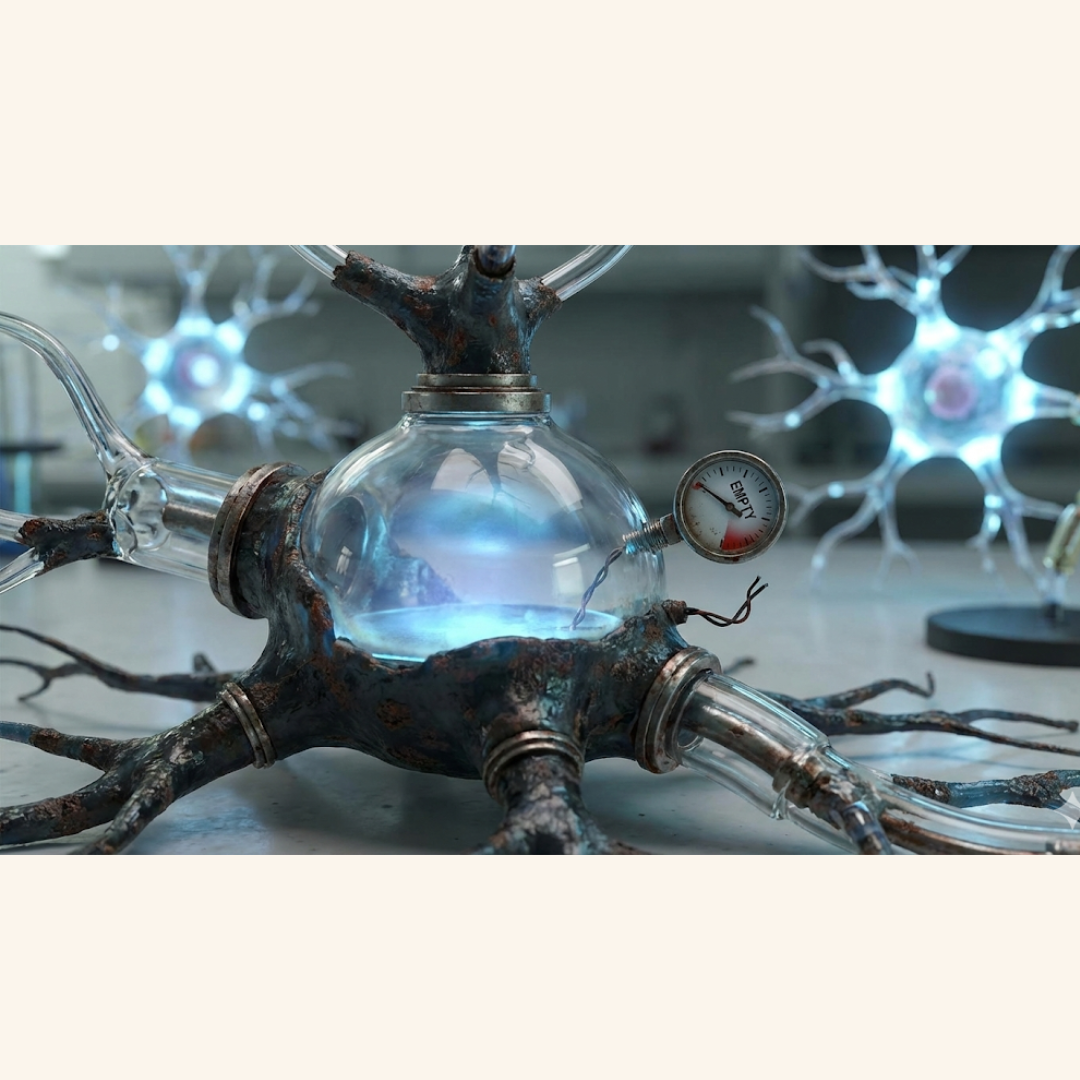
The Hidden "Fuel Crisis" Driving Parkinson’s: Why Dopamine Neurons Run Out of Gas
December 13, 2025
For decades, scientists have puzzled over a fundamental question in Parkinson’s research: why does the condition specifically target the dopamine-producing neurons in the midbrain while sparing others nearby? A groundbreaking new study published in The Proceedings of the National Academy of Sciences (PNAS) by researchers at Weill Cornell Medicine has offered a compelling new answer. It appears these cells do not just die from toxic proteins or oxidative stress; they may simply be running out of fuel due to a broken gauge.
The Myth of the Glucose-Hungry Neuron
To understand the breakthrough, we have to revisit a long-held biological dogma. For years, textbooks stated that neurons do not store their own energy. Unlike muscle cells, which keep vast reserves of glycogen (a stored form of sugar) ready for a marathon, brain cells were thought to rely entirely on a constant stream of glucose from the blood.
The team at Weill Cornell, led by Dr. Timothy Ryan, challenged this assumption. Using new detection methods, they discovered that midbrain dopamine neurons—the exact cells lost in Parkinson’s—do, in fact, maintain their own private fuel tanks of glycogen. These reserves are critical, acting as an emergency backup generator that keeps the cell alive when energy demands spike or glucose supplies dip.
The Broken Fuel Gauge
The most fascinating part of the discovery is not just that the tanks exist, but how they are controlled. The study revealed that these neurons use their own dopamine as a signal to regulate their fuel reserves.
It works like a feedback loop: when the neuron is healthy and pumping out plenty of dopamine, the chemical binds to "D2 autoreceptors" on the cell's surface. This signal essentially tells the cell, "Business is booming, top up the tanks."
However, this system creates a dangerous vulnerability. As we age, or in the very early stages of the condition, dopamine output naturally begins to drop. The study found that when dopamine levels fall, the D2 "refill" signal fades. The neuron stops banking glycogen, leaving it with no emergency reserve.
A Vicious Metabolic Spiral
This creates a metabolic catch-22. A stressed neuron produces less dopamine. Less dopamine means smaller fuel reserves. Smaller fuel reserves make the neuron even more vulnerable to stress, leading to further dysfunction and eventually, cell death.
It explains why these specific neurons are so fragile. They are biologically programmed to shut down their life-support systems exactly when they need them the most. It also casts a new light on certain medications; drugs that block D2 receptors (often used for psychiatric conditions) might inadvertently be starving these neurons of their ability to store energy, mimicking this destructive cycle.
A New Road for Treatment
This "energy crisis" model shifts our perspective from looking at Parkinson’s purely as a protein problem to viewing it as a metabolic failure. If the root cause of the die-off is a lack of resilience to energy stress, then the solution might lie in fixing the fuel line.
The researchers suggest that future therapies could focus on bypassing the broken dopamine signal and directly stimulating these metabolic pathways. If we can trick the neurons into keeping their tanks full, we might be able to make them resilient enough to survive the aging process, effectively braking the progression of the condition before the damage becomes irreversible.
Comments (0)
Loading comments...