


Muscle Activity May Signal Impulse Control Issues in Parkinson’s
December 25, 2025
To understand this new research from the University of Houston, it helps to first look at one of the most common challenges in treating Parkinson’s. The medication used to restore movement—specifically dopamine agonists—works by stimulating the brain’s dopamine receptors. While this is excellent for loosening stiff limbs, it can sometimes have an unintended ripple effect on the part of the brain that handles reward and risk.
For some people, this leads to an "Impulse Control Disorder." It is not a matter of willpower; it is a chemical change that makes it incredibly difficult to say "no" to urges, leading to compulsive behaviours like gambling, shopping, or excessive eating. The problem has always been that we cannot see this chemical change happening until the behaviour actually starts.
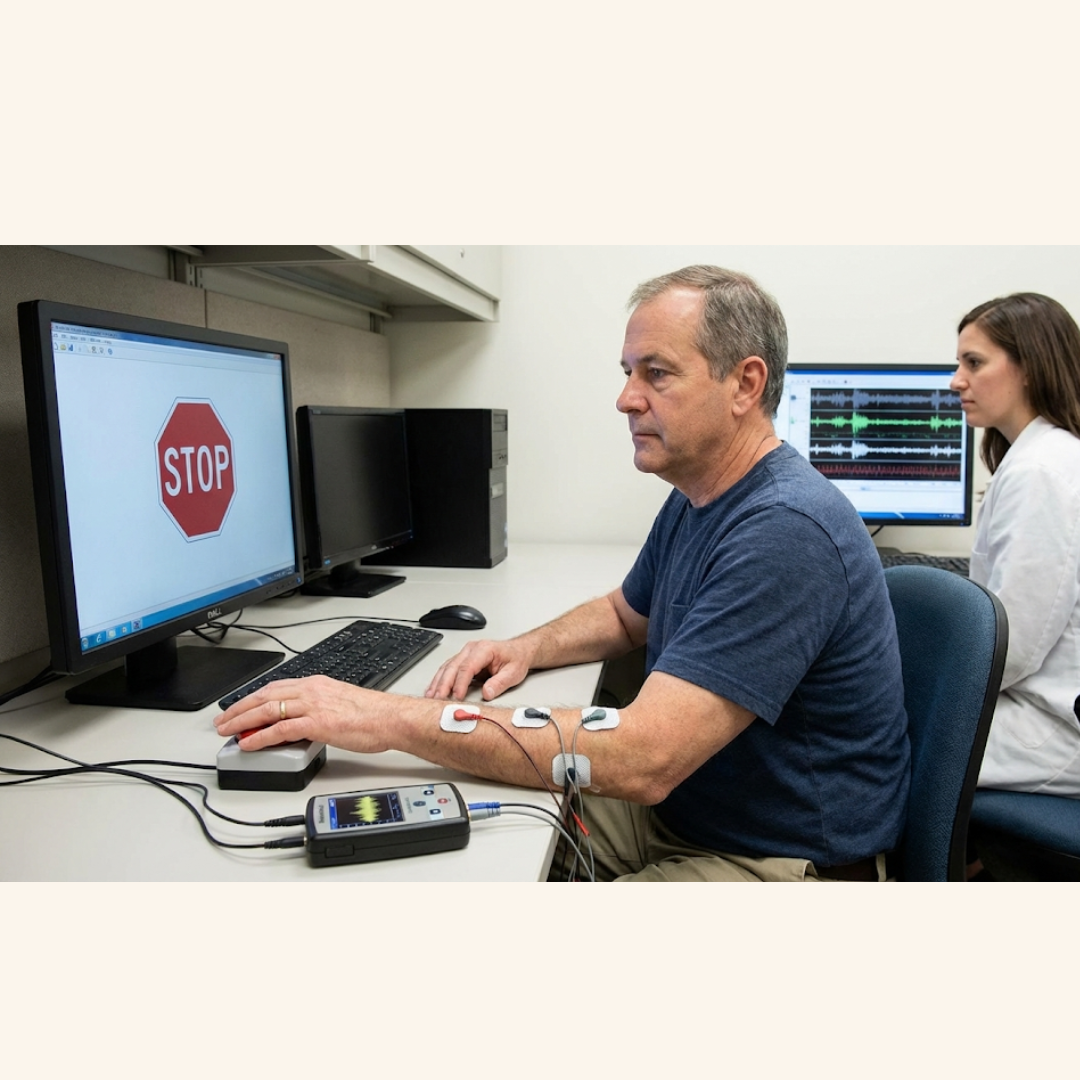
The "Red Light, Green Light" Experiment The researchers wanted to find a physical signal—a biomarker—that shows this loss of control is happening before it becomes a problem. To do this, they set up a computer test that functions a bit like the childhood game of "Red Light, Green Light," known scientifically as a "Stop Signal Task."
Participants were asked to press a button when they saw a specific symbol (the Go signal). However, occasionally and unpredictably, a beep would sound right after the symbol appeared (the Stop signal), telling them to cancel the movement they were just about to make.
Finding the "Ghost" Movement In people without impulse control issues, when the Stop signal happens, the brain successfully sends a "cancel" command to the hand. The hand stays still, and the muscles remain relaxed.
However, in the group with Impulse Control Disorders, the researchers saw something different. Even though these participants often managed to stop their hand from pressing the button, their muscles told a different story. Using sensitive sensors on the skin, the team detected a "burst" of electrical activity in the muscle.
Think of it like a car waiting at a red light. The car isn't moving forward, but the driver is revving the engine. The brain had tried to hit the brakes, but the impulse to move was so strong that a signal "leaked" through to the muscles anyway.
The Brain is "Over-Ready" The study combined this muscle tracking with electroencephalography (EEG) to watch the brainwaves. They found that in these individuals, the brain’s motor cortex was in a state of "high excitability." It was too eager to move. The "brake pads" in the brain were worn thin, meaning it took much more effort to stop an action once it was thought of.
Why This is a Breakthrough Currently, a doctor usually only knows a person has an impulse control problem when the person (or their partner) mentions that they have been spending too much money or acting out of character. By then, the social and financial damage might already be done.
This research suggests that long before those behaviours become obvious, the body is already giving clues. A simple, non-invasive test could spot these "muscle bursts" in a clinic. If a doctor sees that a person’s "braking system" is weakening, they could adjust the medication dose or switch therapies early, preventing the impulse control disorder from ever fully developing. It turns a reactive diagnosis into a proactive safety measure.
Comments (0)
Loading comments...