


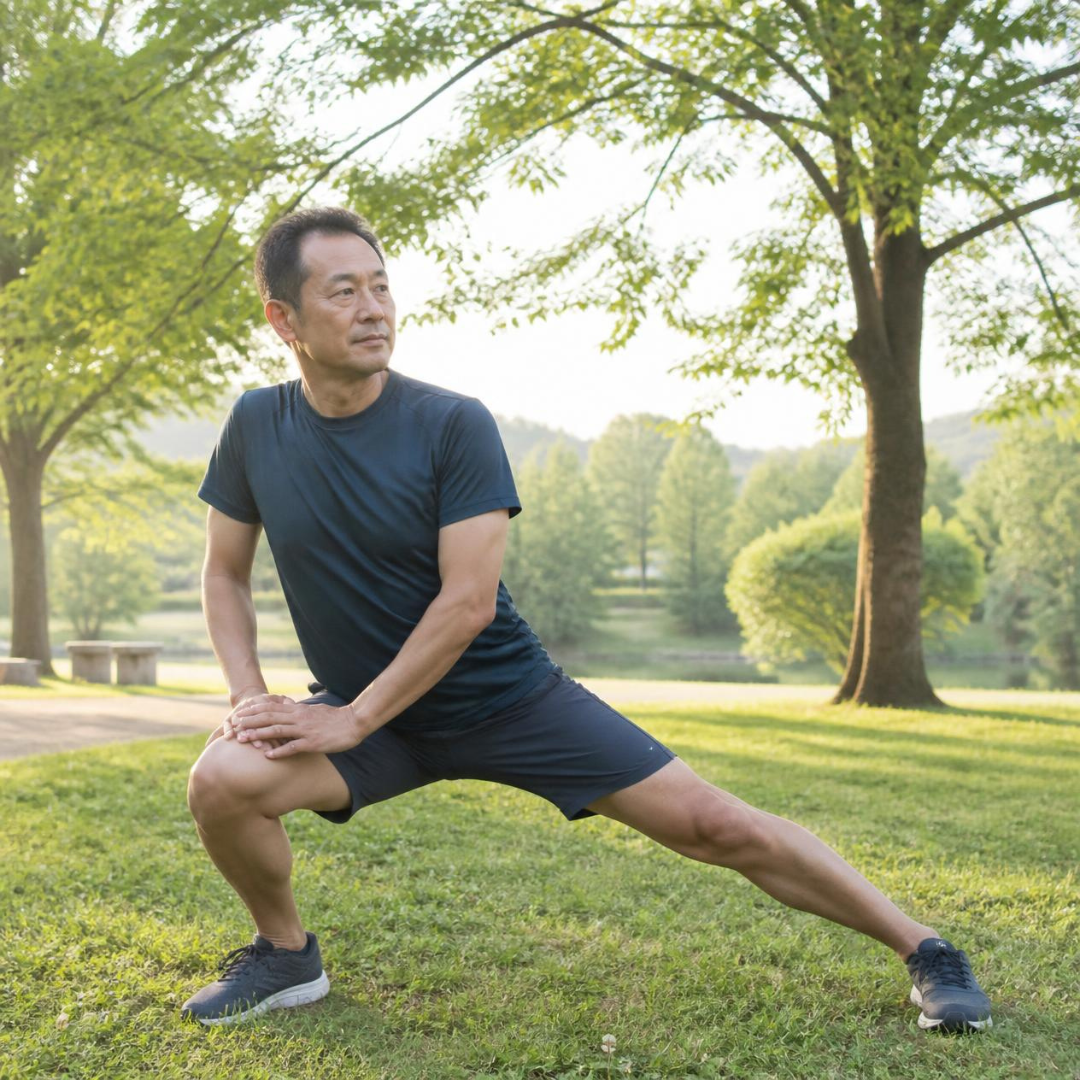
Simple ankle stretching immediately improves balance and walking for people with Parkinson's
August 12, 2026
 Beatrice
We do not talk nearly enough about stretching, yet feedback from the community so often highlights just how much of a difference it makes in everyday life. For years, people have shared how a quick session of lengthening tight muscles helps them feel lighter, steadier, and more in control of their movement. It is time to give this underrated activity the spotlight it truly deserves, especially now that fresh scientific evidence explains precisely why it works so well.
A new study led by Dr Taylor Gauss alongside Professor Jan Hondzinski at the Louisiana State University School of Kinesiology offers clear, objective proof that simple stretching directly improves balance and walking speed. Dr Gauss had a deeply personal motivation for this work, as her own father lived with Parkinson's for many years. Her research set out to test whether targeted stretching could deliver immediate, practical benefits for movement.
To understand why this research focused heavily on the ankles, it helps to consider how the body maintains upright balance. While movement challenges originate in the brain, muscle rigidity in the legs creates a physical bottleneck at ground level. The ankle joints act as the primary suspension system for human posture, making constant micro adjustments to keep us upright. Think of a skyscraper built to withstand strong winds. A building that sways slightly in the breeze remains stable, whereas a completely rigid structure is far more vulnerable to collapsing. In a similar way, when muscle stiffness locks the ankles, the body loses its natural ability to make those tiny, automatic corrections, which increases postural sway and elevates fall risks.
By measuring the movement of healthy young adults, healthy older adults, and people living with Parkinson's, the researchers discovered that a single session of targeted ankle stretching produced immediate gains. Participants demonstrated less postural sway while standing still, along with noticeable improvements in step length, cadence, and overall walking speed. Crucially, people with Parkinson's experienced greater relative gains than healthy participants. Because baseline muscle rigidity is higher in Parkinson's, relieving that stiffness creates far more room for immediate functional improvement.These findings align with a growing body of biomechanical evidence explaining how stretching impacts the nervous system and muscle tissue. When muscles remain shortened for extended periods, sensory receptors called muscle spindles become hypersensitive, sending signals that maintain high muscle tone and stiffness. Stretching gently resets these receptor thresholds, reducing involuntary resistance in the lower limbs. Beyond relieving physical tension, stretching improves joint range of motion and sharpens proprioception, which is the internal map the brain uses to sense where the body is in space.
While international guidelines from organisations such as the American College of Sports Medicine have long encouraged regular flexibility training, practical details on which muscles to focus on have often been vague. This new research provides a clear target by demonstrating that lower limb flexibility directly influences walking confidence. Stretching also offers an accessible, low energy movement option for days when strenuous physical exercise feels overwhelming, giving people a safe and reliable tool to maintain mobility at home.Having solid scientific data to back up what the community has known for years is a hugely encouraging step forward. While stretching is not a substitute for prescribed medication, it is a powerful, cost free addition to the daily toolkit that empowers people to walk more smoothly and live with greater confidence.
Comments (0)
Loading comments...