


The Danish Way to Age Well: Lessons in Living Longer and Better
November 10, 2025
This article is about healthy ageing — and how the Danish way of life may hold the key not just to living longer, but to living better, even with conditions like Parkinson’s. It begins with the story of Professor Morten Scheibye-Knudsen, a Danish medical doctor who watched his father battle Parkinson’s and his mother fade with Alzheimer’s. Determined not only to extend his life but to stay well in older age, he set out to understand what truly keeps us healthy.
For me, the Danish lifestyle is something I absorbed as a child at boarding school in Helsingør, a small town of cobbled streets, bicycles and sea air. Cycling everywhere, eating real food, and belonging to a community that valued balance over ambition shaped my idea of wellbeing. I can truly vouch for the Danish approach — it works, and I’m grateful I picked up those habits early on.
This balance between living well and living long sits at the heart of Danish longevity. Professor Morten Scheibye-Knudsen, a Danish medical doctor and longevity researcher, embodies this philosophy. His mission to understand ageing began when he watched his grandparents die from Parkinson’s and Alzheimer’s disease. That personal loss set him on a lifelong quest to explore why we age — and how to slow it down. After training at the University of Copenhagen and working in the United States for eight years at the National Institute on Ageing, he returned home to Denmark to lead his own research laboratory.
Morten’s work shows how deeply lifestyle is tied to longevity. His experiments — many conducted on himself — combine the best of medical science with the best of Danish living. Statistically, a Danish man can expect to live a year longer than a British man, and he’ll spend more of that time in good health. Danish obesity rates are lower, cancer survival rates are higher, and the national health system invests heavily in prevention rather than cure. Compare that to the United States, where life expectancy for men now lags behind most of Europe, dragged down by chronic disease, obesity, and stress.
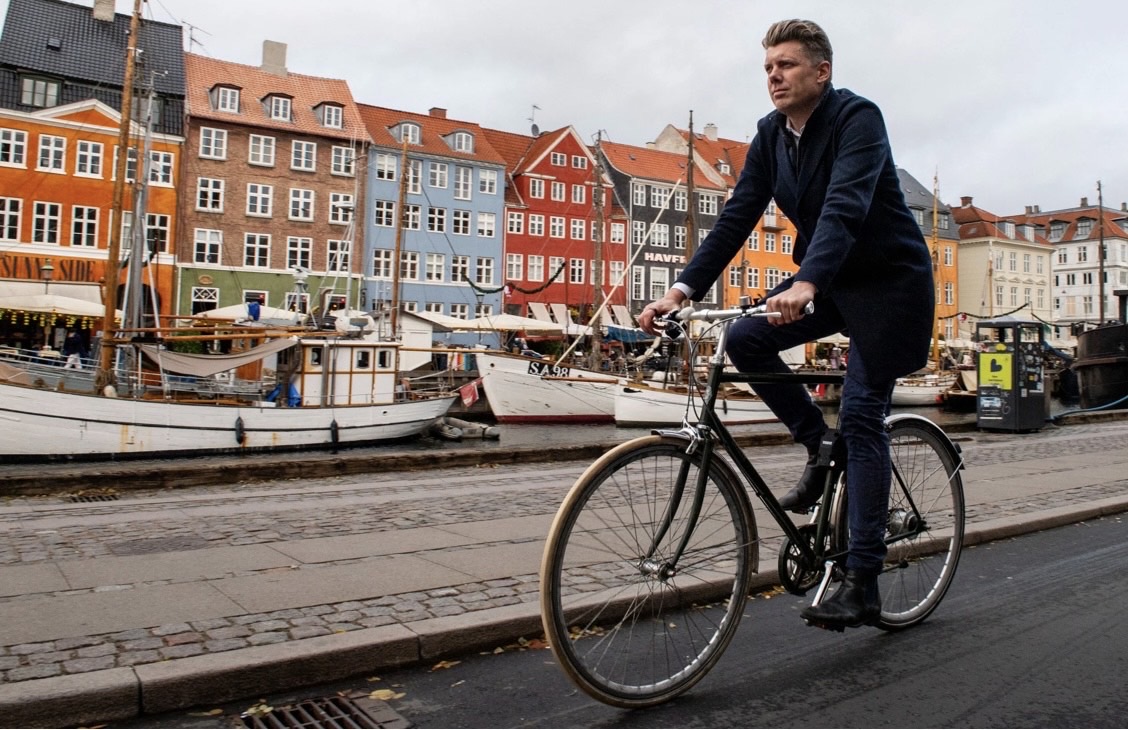
One of the simplest Danish secrets to good health is movement. In Copenhagen, nine out of ten people own a bike, and nearly everyone uses it. Cycling isn’t an exercise routine — it’s a way of life. Morten cycles 10 kilometres each day to his lab and back. He admits he should add more strength training, but his daily rides keep his heart and muscles strong. By contrast, in Britain, around 70 per cent of adults don’t cycle in a typical week. In the US, cycling is so rare that most cities don’t even have proper bike lanes. Yet research repeatedly shows that everyday physical activity — not gym sessions, but small, consistent movement — is one of the strongest predictors of a longer, healthier life.
Diet tells a similar story. Where British and American diets are dominated by ultra-processed foods, Danes eat far fewer of them. In the UK, processed foods make up almost 60 per cent of the average adult’s diet. In Denmark, it’s closer to 25 per cent. The difference lies in habits: whole grains, fish, seasonal vegetables, and a respect for quality ingredients. Morten’s own diet includes plenty of coffee and dark chocolate — both packed with antioxidants that protect against ageing. He drinks four or five cups of coffee a day, sometimes with milk to improve the absorption of beneficial compounds. The Danes drink the most coffee per capita in the world, and studies show that moderate coffee consumption is linked to reduced risk of heart disease, Parkinson’s, and even some cancers.
Then there’s work-life balance — the quiet backbone of the Danish system. Denmark’s labour laws limit working hours to about forty per week, and most people take five or six weeks of paid holiday every year. In Britain, only about a third of workers take their full holiday allowance, and in the United States, the culture of overwork is so deeply ingrained that some employees feel guilty even asking for time off. The result? Chronic stress. Around 75 per cent of British adults report feeling overwhelmed by stress in the past year, compared to just 26 per cent of Danes. In America, burnout is so widespread that it’s been labelled a public health crisis.
Chronic stress accelerates ageing at the cellular level, increasing inflammation, heart disease, and cognitive decline. Morten makes time for friends and family every day, knowing that strong social ties can add up to four years to one’s life expectancy. It’s a value that resonates deeply with my own upbringing in Helsingør — where community wasn’t a concept, but a rhythm of daily life.
Beyond lifestyle, Morten also tests medical interventions on himself. He takes nicotinamide riboside (NR), a supplement that raises NAD levels in the body — a molecule vital for DNA repair. His lab found that NR reduced inflammation in people with chronic lung disease, and although long-term safety data is still emerging, he’s willing to take the risk. He also takes metformin, a diabetes drug known to trigger a process called autophagy — the body’s way of recycling damaged cells. It’s thought to help slow some aspects of ageing. Morten’s biological age, measured by cellular markers, is around 36 — ten years younger than his actual age.
He’s the first to admit that these aren’t miracle cures. The real magic lies in the basics: daily movement, unprocessed food, social connection, and stress control. These habits form the invisible infrastructure of health that Danes practise without preaching. The supplements may add a few years, but the lifestyle adds decades of vitality.
When I think of my own life — the ease of cycling through Danish streets, the smell of dark rye bread, the long evenings with friends — it’s clear why this way of living endures. I’ve worked in countries where health is treated as a hobby or a luxury, something to be squeezed into a packed schedule. But in Denmark, health is woven into the fabric of every day. It’s the rhythm of life itself.
That rhythm, more than any pill or supplement, may be the real secret to longevity. Because the Danish way doesn’t just help you live longer — it helps you live better.
Photo: The Telegraph
Comments (0)
Loading comments...