


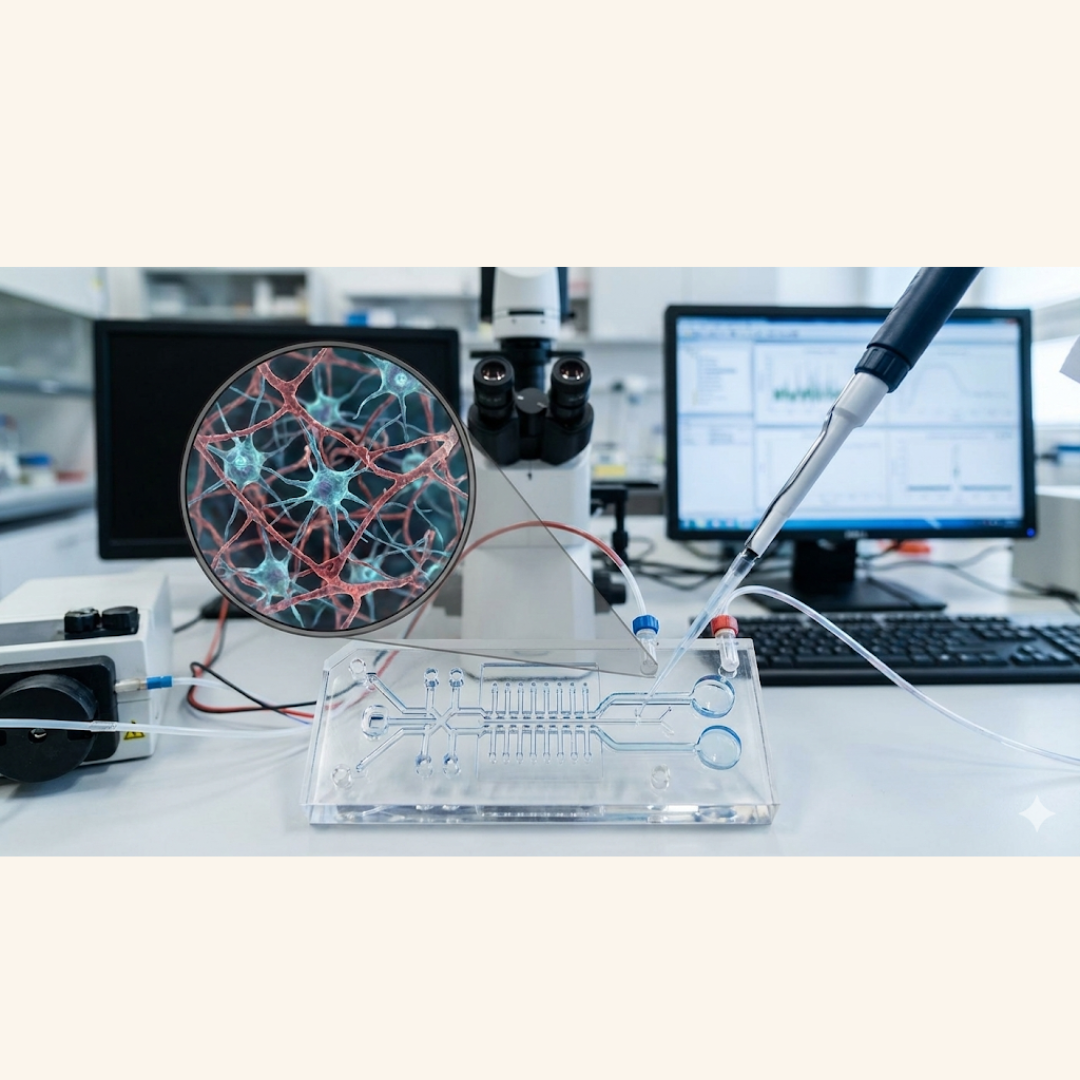
Tiny Chips Reveal the Hidden Vascular Damage in Parkinson’s
January 12, 2026
For decades, the spotlight in Parkinson’s research has been firmly fixed on a single tragedy: the death of dopaminergic neurons. These are the brain cells responsible for movement, and when they fade, the tremors and stiffness begin. However, a new study published in Communications Engineering suggests we might have been overlooking a critical accomplice in this decline—the brain’s plumbing.
Researchers have long suspected that the dense network of capillaries supplying the midbrain might play a role in the condition, but studying these microscopic vessels in a living human brain is nearly impossible. To solve this, a team from Binghamton University and Drexel University took a futuristic approach. Instead of relying on animal models, they built a "midbrain-on-a-chip".
Using advanced microengineering, the team constructed a 3D model that replicates the precise architecture of the substantia nigra—the specific region affected by Parkinson’s. They didn’t just grow neurons; they rebuilt the complex interface where these neurons meet the blood vessels. This "neurovascular unit" is the critical checkpoint where nutrients enter and waste is cleared.
When the researchers introduced toxic alpha-synuclein fibrils—the sticky proteins known to clump together in Parkinson’s—into this tiny system, the results were telling. As expected, the neurons began to struggle and show signs of degeneration. But significantly, the blood vessels failed too. The model revealed that the capillaries became "leaky", their walls breaking down and failing to regulate flow properly. This vascular regression effectively starved the neurons, creating a vicious cycle where poor blood supply accelerated the cell death.
This is a pivotal finding because it shifts the narrative. It implies that neurodegeneration is not just an isolated event within the brain cells, but a systemic failure involving the blood vessels that support them. If the supply lines are cut, the troops cannot survive.
The implications for treatment are profound. Current therapies focus almost exclusively on replacing dopamine or protecting neurons. This study suggests that if we want to slow or stop the condition, we may also need to treat the blood vessels. By using this new micro-engineered platform, scientists can now test drugs that specifically aim to repair and strengthen these capillaries, offering a two-pronged attack that has never been possible before.
Comments (0)
Loading comments...