


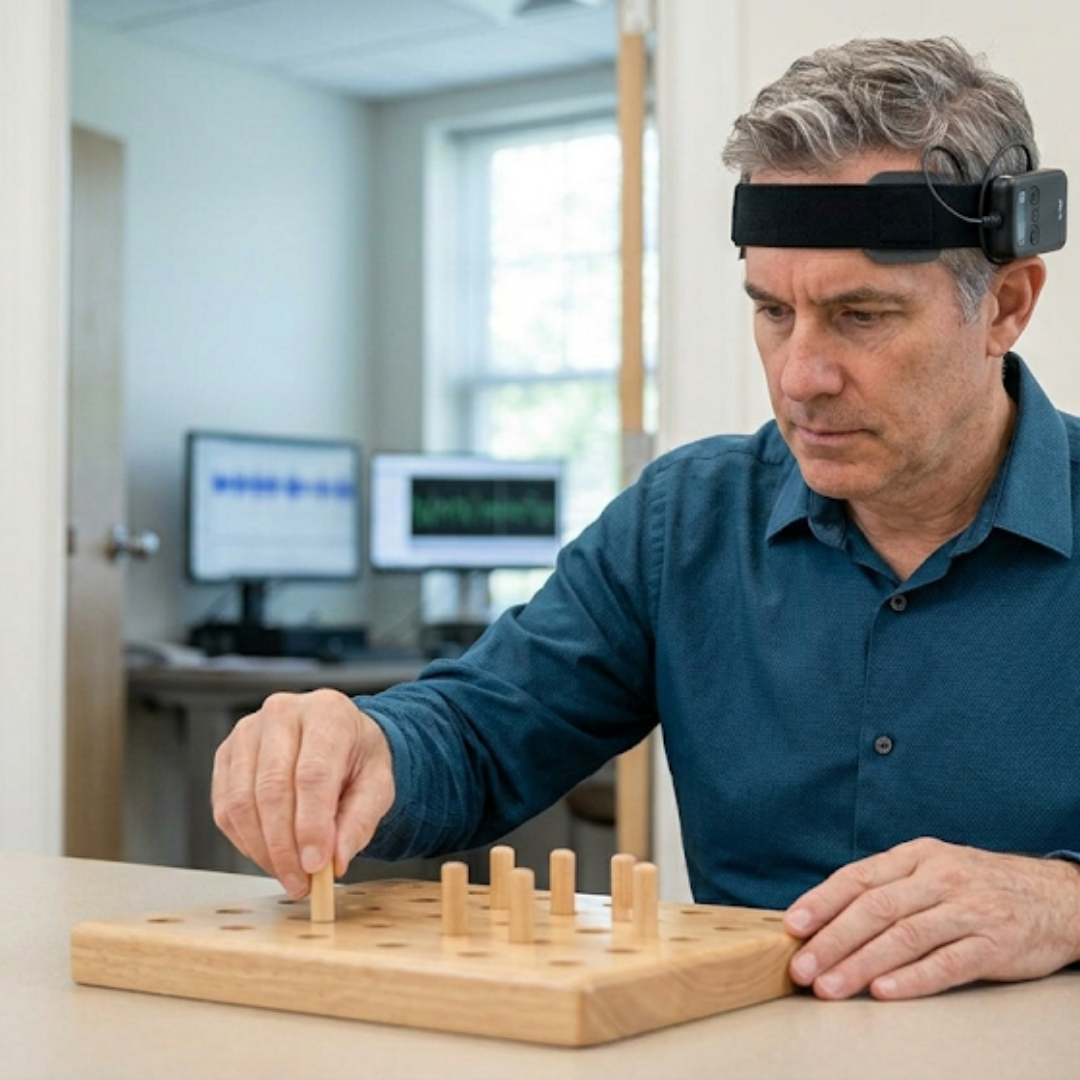
Improving bradykinesia in Parkinson's with non-invasive electrical pulses
May 13, 2026
A team of researchers in Italy recently published a fascinating study in the journal Nature exploring how tiny electrical currents might help people with Parkinson's move more easily. They focused on a common challenge called bradykinesia, which is the medical term for slowness of movement that often makes daily tasks feel like they are happening in slow motion.
The research centered on the motor cortex, the part of the brain that acts like a control tower for our muscles. In a healthy brain, this area is highly "plastic," meaning it can adapt and change its signals to keep movements smooth. In Parkinson's, this flexibility often becomes stuck, and the brain waves responsible for coordinating movement—specifically high-frequency "gamma" waves—can become disrupted.
To tackle this, the scientists used a non-invasive technique called transcranial alternating current stimulation. This involves placing sensors on the scalp to deliver a very gentle, rhythmic electrical pulse designed to "tune" the brain's natural frequencies. They specifically targeted those gamma waves to see if they could kickstart the brain's ability to reorganise and control movement better.
Forty people took part in the study, including twenty with Parkinson's. The participants received two types of sessions: one with the active electrical tuning and another "sham" session that felt the same but didn't deliver the specific current. The results were quite remarkable. When the participants received the active treatment, their brain plasticity improved significantly, and their movements became noticeably faster and wider.
Interestingly, these improvements weren't just a flash in the pan. The benefits to movement speed and coordination lasted for at least thirty minutes after the stimulation ended. The researchers found that the treatment helped restore a specific type of brain chemical activity that usually helps quieten down "noisy" or unhelpful signals in the motor cortex.
While this was a small, controlled study, it offers a very hopeful glimpse into the future of how we might manage movement symptoms without relying solely on traditional medication. By using technology to gently nudge the brain back into its natural rhythm, science is finding new ways to help people keep moving with more confidence and ease.
Comments (0)
Loading comments...