


The Search for a Precision Shield: New Insights into Alzheimer’s Research
March 26, 2026
The quest to slow the progression of Alzheimer’s has long been a journey of both scientific breakthroughs and challenging setbacks. Two recent developments from the 2026 International Conference on AD/PD (Alzheimer’s and Parkinson’s Diseases) highlight this delicate balance: while we are gaining more precise tools to measure the condition, some highly anticipated treatments are still falling short of their goals.
A Significant Setback: The Posdinemab Trial
One of the most talked-about stories from the conference was the failure of Johnson & Johnson’s anti-tau drug, posdinemab. This medication was designed to target "tau," the protein that forms destructive tangles inside the brain cells of those with Alzheimer’s.
The Phase 2 study focused on people in the very early stages of the condition. Unfortunately, the drug failed to meet its primary goal of slowing cognitive decline compared to a placebo. This result is a blow to the "anti-tau" theory, which many hoped would be the next big step after the recent successes of amyloid-clearing drugs. Analysts suggest that by the time symptoms appear, the tau tangles might already be too widespread for this specific drug to make a significant difference.
A New Tool for Precision: The eMTBR-tau243 Assay
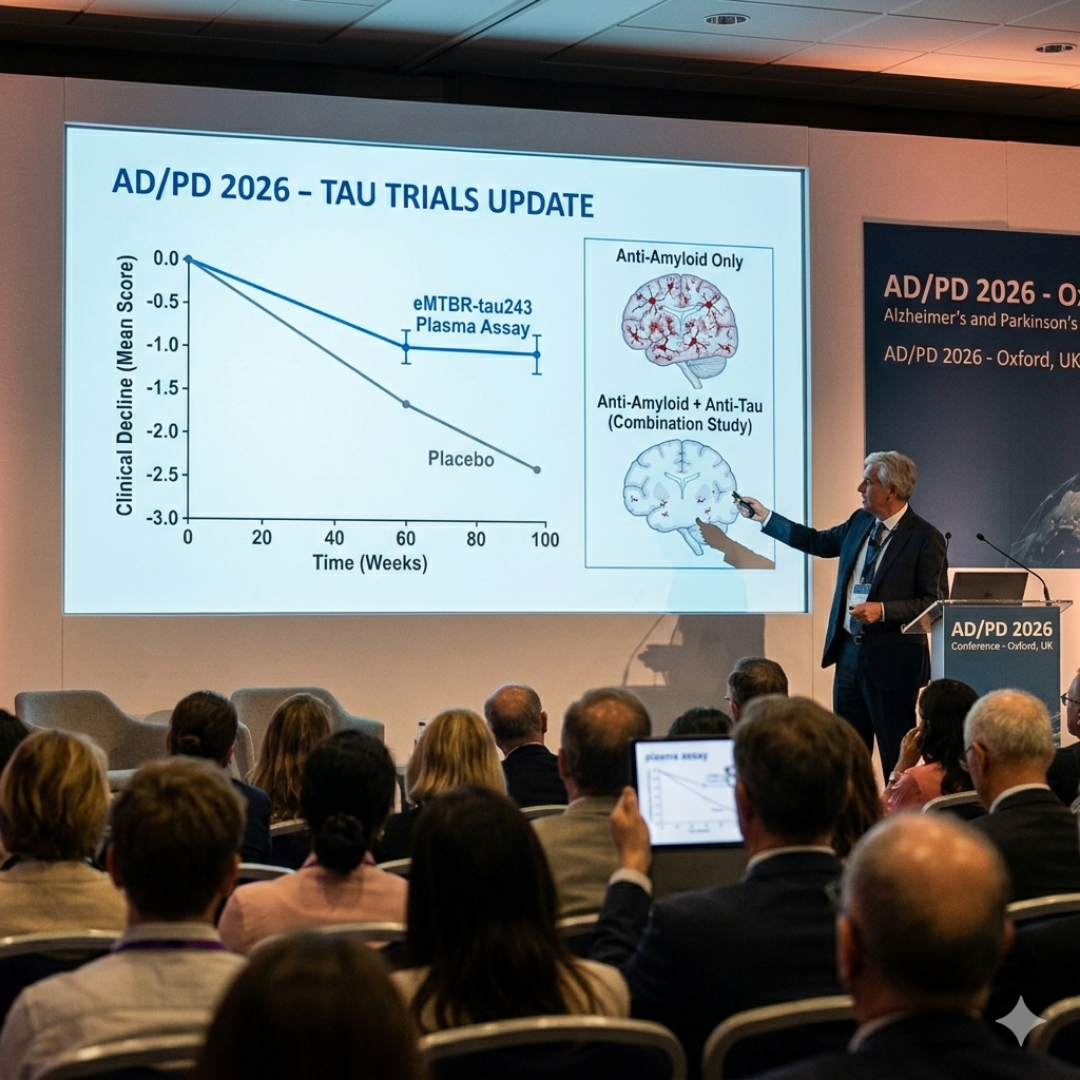
While the drug trial was disappointing, another announcement offered a reason for optimism regarding how we measure the condition. C2N Diagnostics revealed that their new blood test, the eMTBR-tau243 plasma assay, was successfully used in a major Phase 3 trial.
This is not a treatment, but a highly sophisticated diagnostic tool. For years, the only way to track tau build-up was through expensive PET scans or invasive lumbar punctures. This new blood test is designed to identify specific fragments of the tau protein that are most closely linked to the active spread of the condition in the brain.
The success of this assay in a clinical trial setting is a major win for the community. It means that future research will be faster, cheaper, and much less invasive for participants. More importantly, it allows doctors to identify the "right" people for clinical trials—those who are at the exact stage of the condition where a specific treatment might actually work.
The Path Forward
These two stories are two sides of the same coin. The failure of posdinemab shows how difficult it is to stop the damage once it has started, while the success of the C2N blood test provides the "radar" we need to find and treat the condition earlier.
The focus of the research community is now shifting toward "combination therapies"—using one drug to clear the "plaques" (amyloid) and another to stop the "tangles" (tau)—and using these new blood tests to ensure treatment starts at the earliest possible moment. While the setback with posdinemab is difficult, the improved ability to see what is happening inside the brain with a simple blood test brings us one step closer to more effective, personalised care.
Comments (0)
Loading comments...