


Beyond Just Alpha-Synuclein in Parkinson’s Disease
August 6, 2024
Parkinson’s disease involves the loss of certain brain cells called dopaminergic neurons in a region called the substantia nigra, which controls movement. This leads to movement problems, memory issues, and depression.
At a microscopic level, Parkinson’s is marked by clumps of a protein called alpha-synuclein (α-syn), forming Lewy bodies. This clumping is related to fat (lipid) metabolism. Research shows that factors causing Parkinson’s also lead to fat buildup. Aging is the biggest risk for Parkinson’s, but genetics play a part too. For instance, a mutation in the GBA gene, which produces an enzyme to break down certain fats, is linked to the disease.
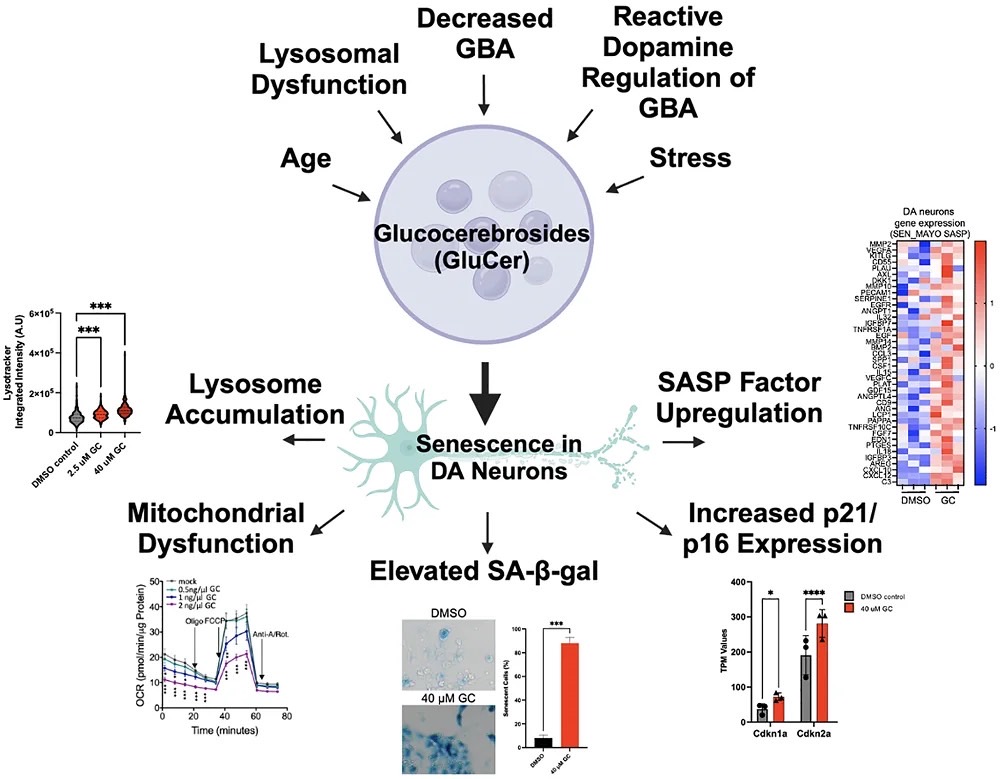
Higher levels of these fats (glucosylceramides or GluCer) are associated with severe cognitive decline in Parkinson’s patients, and a lack of the enzyme GCase seems to cause this. Problems with cell structures that break down proteins (lysosomes) and reactions with dopamine may also increase GluCer levels.
### The Genetic Connection
Researchers found that this fat buildup is also linked to aging cells. A gene called SATB1, which is a risk factor for Parkinson’s, normally suppresses another gene (miR-22-3p) that reduces GBA activity. Less SATB1 means more GluCer and aging brain cells. When researchers treated human neurons with GluCer, the cells aged and α-syn clumped together. Another study linked fat droplet buildup to aging cells.
This fat buildup also seems to promote α-syn production, and α-syn itself can make cells age. However, this effect depends on the cell type: reduced SATB1 specifically ages dopaminergic neurons, which are primarily affected in Parkinson’s. These neurons rely heavily on lysosomes.
This specific targeting explains why Parkinson’s affects a small, critical group of neurons. Importantly, it suggests new potential treatments. By targeting GBA or fat buildup along with α-syn, we might better treat Parkinson’s disease.
### Support Independent Journalism
We are a non-profit foundation dedicated to responsible, unbiased journalism. Our content is free for everyone, but we rely on donations to sustain our work. Every contribution, no matter the size, helps. You can support us by donating or through other cost-free ways.
Comments (0)
Loading comments...