


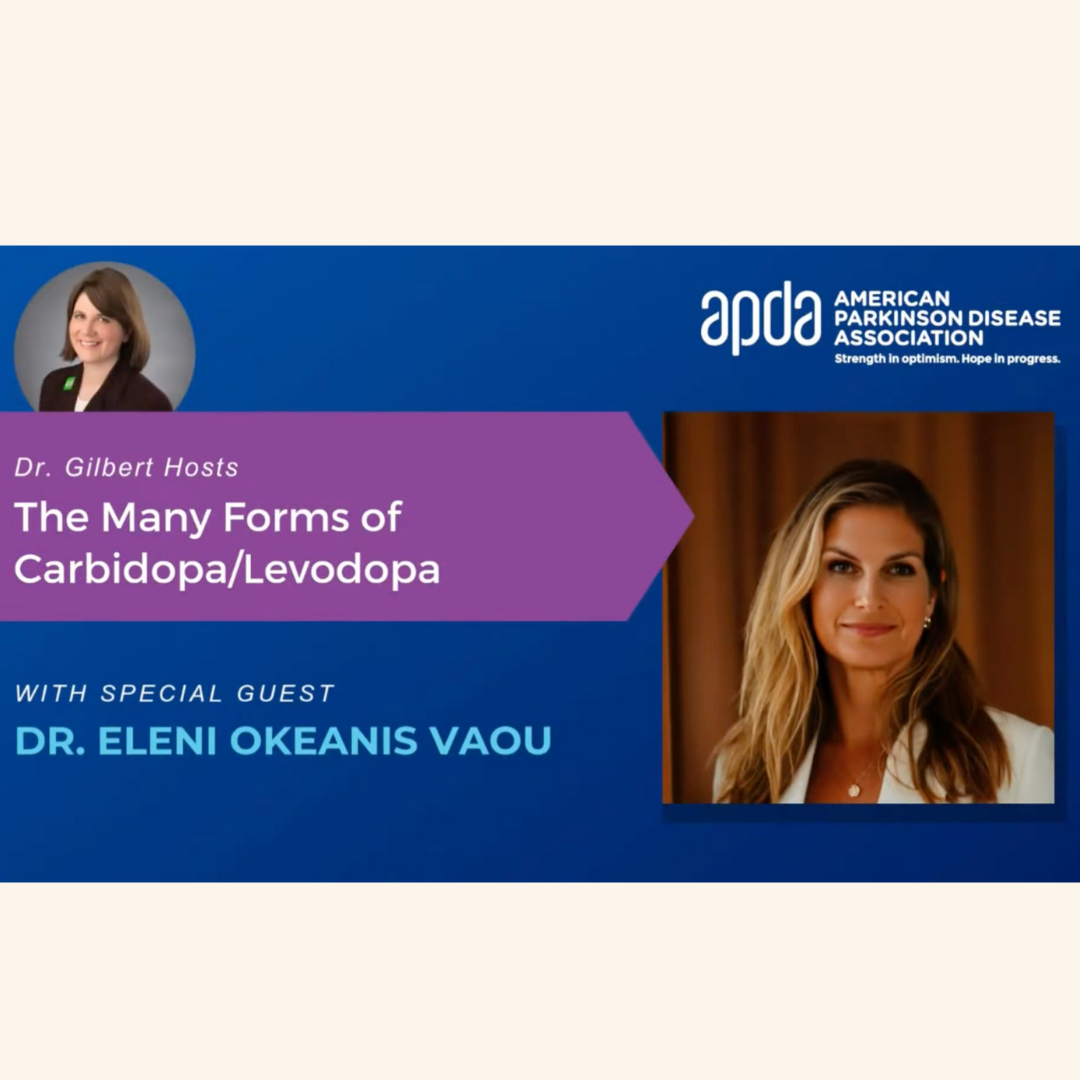
The Many Forms of Carbidopa/Levodopa: A Comprehensive Overview
March 8, 2025
In January 2025, the American Parkinson Disease Association (APDA) hosted a webinar featuring movement disorder specialist Dr. Eleni Okeanis Vaou. The focus of the discussion was the various formulations of carbidopa/levodopa available, a medication that remains the gold standard for treating motor symptoms in Parkinson’s disease (PD). Understanding the differences between these formulations is crucial for patients to navigate treatment options effectively. This webinar was part of the APDA’s “Dr. Gilbert Hosts” series.
Understanding Carbidopa/Levodopa Formulations
Carbidopa/levodopa is a key treatment for PD, helping to control stiffness and slowness of movement. With an increasing number of formulations available, physicians can now tailor treatment to individual patient needs. Dr. Vaou’s presentation delved into the characteristics of each type:
- Oral Immediate Release (IR) Carbidopa/Levodopa
- Fast-acting but short duration (2.5-4 hours).
- Oral Controlled Release (CR) Carbidopa/Levodopa
Longer duration than IR.
- Oral Extended Release (ER) Carbidopa/Levodopa - Rytary®
Introduced in 2016, lasts 5-6 hours, with a faster peak than CR.
- Oral Extended Release (ER) Carbidopa/Levodopa - Crexont®
A newer formulation with longer duration than Rytary®.
- Inhaled Levodopa (Inbrija®)
Powder form for rapid relief of "off" episodes, works within 10 minutes and lasts 30 minutes to an hour.
Subcutaneous Continuous Foscarbidopa/Foslevodopa (Vyalev®)
Recently FDA-approved, delivered via a pump, bypassing the GI tract for continuous drug delivery.
Intestinal Gel Carbidopa/Levodopa (Duopa™)
Continuous infusion via a surgically placed tube, bypassing the GI tract.
Key Takeaways
There is no one-size-fits-all treatment for Parkinson’s disease. Physicians consider multiple factors such as disease stage, lifestyle, side effects, and dosing preferences when prescribing medication. It is crucial for patients to collaborate closely with their doctors to determine the most suitable approach.
FDA-Approved Formulations
Oral Levodopa: Includes IR, CR, and ER formulations.
Inhaled Levodopa
Subcutaneous Continuous Levodopa
Intestinal Gel Levodopa
Comparing Oral Formulations
Dr. Vaou illustrated the differences between IR, CR, ER, and carbidopa/levodopa/entacapone (Stalevo®) using a graph comparing drug concentration levels over time. Notable findings included:
IR has a rapid peak but wears off quickly (2.5-3 hours).
ER/Rytary® lasts longer (5-6 hours) and reduces "off" time by approximately 1.17 hours compared to IR.
Crexont® demonstrated improved "on" time and longer-lasting effects compared to other formulations.
Infusion Systems and Upcoming Treatments
Duopa® (Levodopa-Carbidopa Intestinal Gel):
Continuous infusion via PEG tube, increases "on" time by 2 hours.
LECIG (Levodopa/Entacapone/Carbidopa Intestinal Gel):
Used in some European countries.
Vyalev® (Subcutaneous Foscarbidopa/Foslevodopa Pump):
Recently FDA-approved, showed improvements in "on" time (2.72 hours better than IR) and "off" time reduction.
Neuroderm/Mitsubishi Tanabe BeyoND Study (Subcutaneous Carbidopa/Levodopa Pump):
Not yet FDA-approved but promising results in phase three trials.
Continuous Subcutaneous Apomorphine Infusion:
A dopamine agonist, awaiting FDA approval.
Question-and-Answer Highlights
Understanding "On" and "Off" Time
"On time": When medication is working effectively, reducing symptoms.
"Off time": When medication wears off, symptoms return.
Patients should communicate the duration and quality of these phases to their doctors for better medication adjustments.
Choosing the Right Medication
Early stages: IR is often sufficient.
Advanced stages: Longer-acting formulations or non-oral options may be required.
Additional considerations: Lifestyle, side effects, blood pressure, sleep, and caregiver support.
Effect of Protein on Medication Absorption
Protein can interfere with oral carbidopa/levodopa absorption.
Best to take medication 30-60 minutes before or 1-2 hours after a meal.
Infusion therapies and inhaled levodopa bypass this issue.
Common Side Effects of Carbidopa/Levodopa
Nausea (can be managed by dose adjustments or increasing carbidopa content).
Orthostatic hypotension (lightheadedness when standing).
Sleepiness and fatigue.
Dyskinesia (involuntary movements).
Motor fluctuations (wearing off effects).
Medication Effect on Tremors
Some patients have "tremor-resistant" PD.
Alternative options: Higher doses, infusion therapies, or advanced treatments like Deep Brain Stimulation (DBS).
When to Start Medication?
No universal rule; it depends on how symptoms impact daily life.
Carbidopa/levodopa treats symptoms but does not slow disease progression.
Exercise remains a critical component of Parkinson’s management.
Managing Muscle Cramps
Often due to medication "wearing off" at night.
Optimising medication timing can help reduce nighttime cramps.
Use of Mucuna (Natural Levodopa Source)
Mucuna contains levodopa but is less potent than standard medications.
More suitable for early-stage PD but requires large quantities to match pharmaceutical effectiveness.
Conclusion
Dr. Vaou’s presentation provided an in-depth overview of the various carbidopa/levodopa formulations available, emphasizing the importance of a personalised treatment approach. Patients should work closely with their healthcare providers to determine the best medication regimen suited to their specific needs and lifestyle. The evolving landscape of Parkinson’s treatments offers promising options to enhance quality of life and symptom management.
Watch the full video by clicking on the link attached.
Comments (0)
Loading comments...