


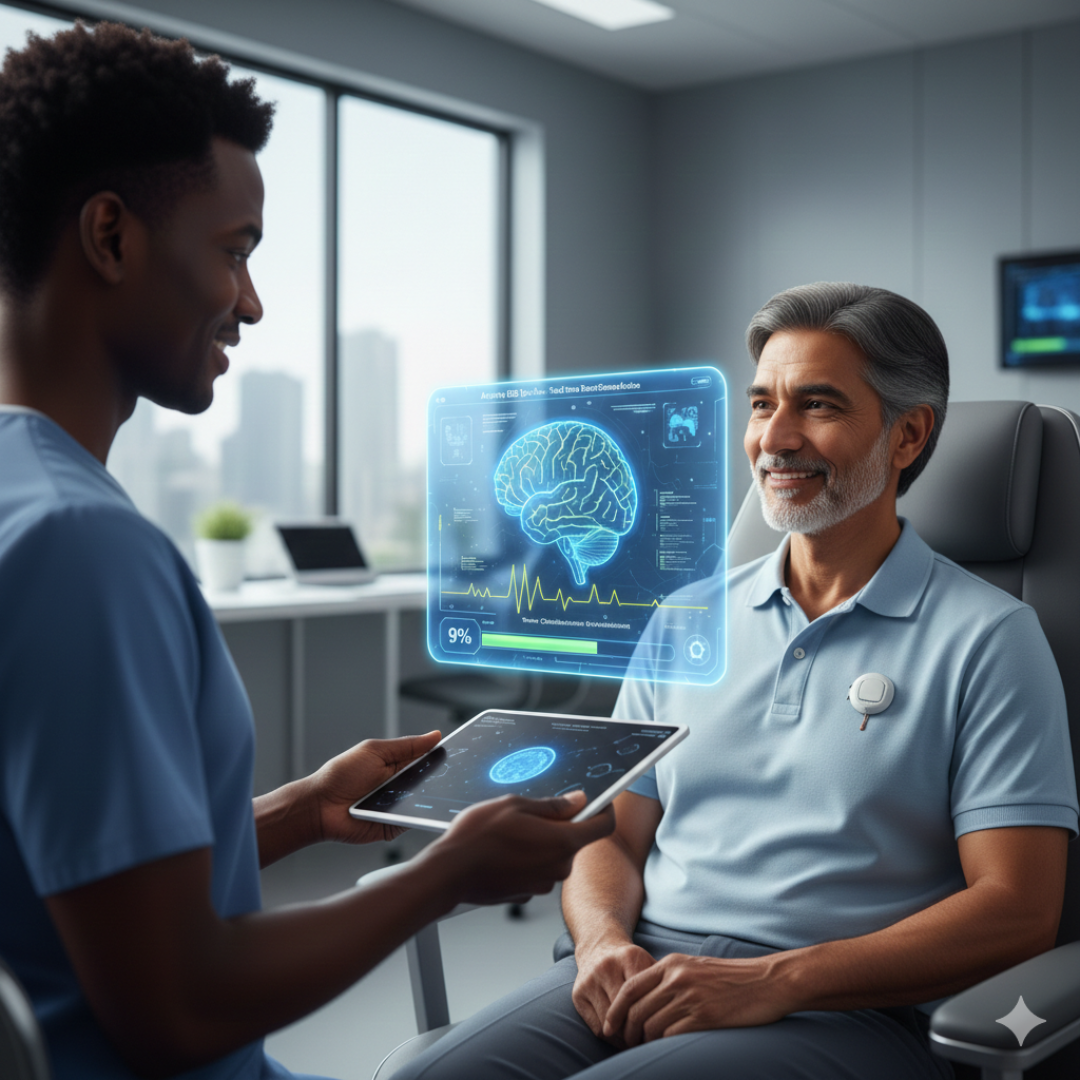
Listening to the Brain: The Breakthrough of Adaptive Deep Brain Stimulation
February 20, 2026
A significant clinical trial recently published in The Lancet has confirmed a major leap forward in surgical treatment for the condition. While traditional Deep Brain Stimulation (DBS) has been a "gold standard" for years, this new study focuses on Adaptive Deep Brain Stimulation (aDBS)—a "smart" version of the technology that adjusts itself in real-time to meet the brain's changing needs.
The results of this trial suggest that we are moving away from "one-size-fits-all" settings toward a truly personalised, responsive therapy.
The Problem with "Always-On" Stimulation
Standard DBS works much like a cardiac pacemaker. A surgeon implants thin wires into specific areas of the brain, and a small device in the chest sends a constant, steady stream of electrical pulses. This is incredibly effective at reducing tremors and stiffness, but it has a limitation: it stays at the same level of intensity all day and night.
The brain of a person living with the condition is not static. Throughout the day, as medication levels rise and fall or as a person moves from resting to walking, the amount of stimulation needed changes. If the stimulation is too low, symptoms like "off-time" return. If it is too high, it can cause "over-stimulation" side effects, such as involuntary movements (dyskinesia) or speech difficulties.
How Adaptive DBS "Listens"
The breakthrough of aDBS, as highlighted in The Lancet, is that the device does more than just talk to the brain; it listens.
Scientists have identified specific brain waves, known as "beta oscillations," that act as a signal for Parkinson’s symptoms. When these beta waves are too strong, a person usually feels stiff or slow. The aDBS system uses its electrodes to monitor these signals constantly. When it "hears" the beta waves increasing, it automatically turns the stimulation up. When the signals quieten down—perhaps because medication has kicked in—the device scales back.
This "closed-loop" system ensures the person receives exactly the amount of help they need at any given moment, and not a micro-volt more.
Key Findings from the Trial
The clinical trial compared traditional, constant stimulation with this new adaptive approach. The results were impressive and point to a better quality of life for those with advanced symptoms:
Reduction in "Off" Time: Participants experienced significantly less time when their symptoms were poorly controlled, as the device caught the fluctuations before the person even felt them.
Fewer Side Effects: Because the device avoids over-stimulating the brain when it doesn't need to, many participants reported fewer issues with dyskinesia and better speech clarity compared to traditional DBS.
Longer Battery Life: By only using the necessary amount of power rather than running at full tilt 24/7, the devices are more efficient, which could mean fewer surgeries to replace batteries in the future.
Moving from Research to Reality: Is it Available?
Crucially, adaptive DBS is no longer just a theoretical concept in a paper; it is a live technology that has already begun its rollout to patients in the UK, Europe, and the United States.
In January 2025, the technology—specifically Medtronic’s BrainSense Adaptive DBS—received its CE Mark approval for use across the European Union and the UK. This was followed shortly by FDA approval in the United States in February 2025. This means that for many people, the technology is already "unlocked" or becoming available at specialist centres.
Where is it currently offered?
United Kingdom: The Royal Victoria Infirmary in Newcastle was one of the first four hospitals in the world to offer this high-tech treatment. Other specialist NHS neuroscience centres, such as those in Bristol and London, are also at the forefront of this rollout.
Europe: Amsterdam University Medical Center performed the first European reprogramming for a patient on the day the technology was approved.
United States: Institutions like UCHealth University of Colorado, Duke Health, and Massachusetts General Hospital were among the first 23 centres in the US to go live with the system in March 2025.
How do patients get it?
One of the most remarkable aspects of this advancement is that it is often delivered as a software update. For the approximately 40,000 people worldwide who already have the "Percept" family of neurostimulators (PC or RC models) implanted, the adaptive features can frequently be enabled by their clinical team without the need for further surgery.
For new patients, this "smart" capability is becoming the new standard for DBS. It streamlines the initial programming process significantly—reducing the time spent in the clinic by up to 85%—because the device helps the doctor identify the most effective stimulation spots by recording the brain's signals directly.
Why This Matters for the Future
This study is a landmark because it proves that "smart" stimulation is a practical reality that works in everyday life. It represents the ultimate form of personalised medicine; the treatment is being adjusted second-by-second by the person's own brain activity.
As this technology becomes more widely available, it promises to make surgical intervention safer, more effective, and more precisely tuned to the unique rhythm of each individual's life.
Comments (0)
Loading comments...