


The Brain’s Internal Metronome: How Acetylcholine Directs the Power of Dopamine
March 26, 2026
For years, dopamine has been the undisputed star of the Parkinson’s narrative. We know it as the chemical messenger responsible for both the reward we feel when we succeed and the fluid coordination of our physical movements. However, groundbreaking research from NYU Grossman School of Medicine, recently published in Nature Neuroscience, has revealed that dopamine doesn’t act alone. It has a "conductor" named acetylcholine, and the precise timing between these two chemicals is what actually determines whether the brain learns a new skill or executes a known movement.
The Chemical Handshake
The study focused on the striatum, the brain's command centre for action and learning. Researchers discovered that dopamine and acetylcholine are constantly engaged in a high-stakes chemical "handshake." While dopamine provides the signal for "go," acetylcholine acts as the gatekeeper that defines what that signal means.
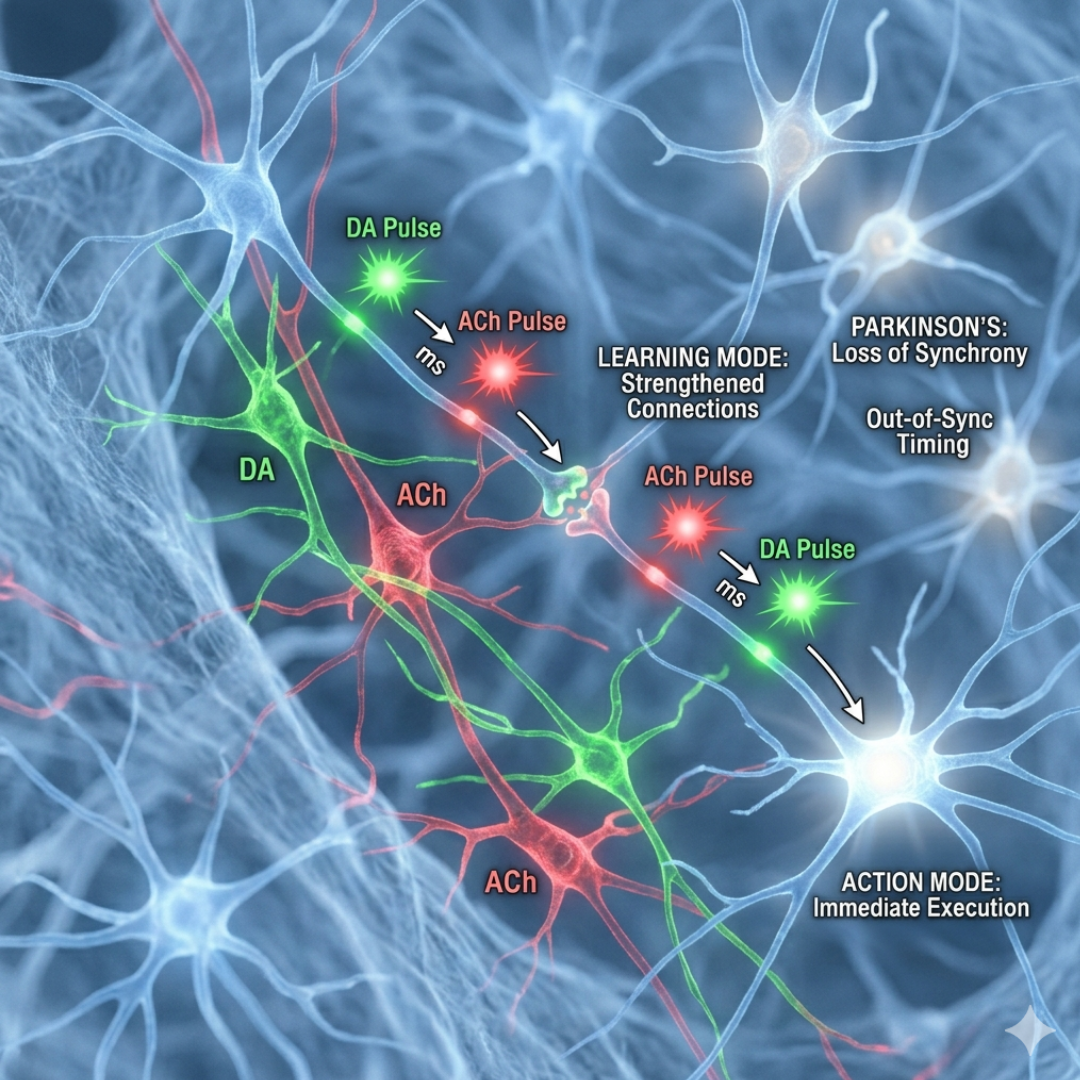
Using a sophisticated "dual-sensor" imaging technique, the research team was able to watch these chemicals in real-time. They found that these two neurotransmitters pulse in a rhythmic cycle, roughly twice every second. Most importantly, it is the order of these pulses—measured in milliseconds—that dictates the brain's state:
Learning Mode: If a pulse of dopamine occurs just slightly before a pulse of acetylcholine, the brain enters a state of "reinforcement learning." This sequence strengthens the connections between neurons, allowing us to encode new memories or master a new physical task.
Action Mode: If the order is reversed—with acetylcholine pulsing just before dopamine—the brain shifts into "Action Mode." This sequence focuses on the immediate execution of a known movement rather than learning a new one.
Why This Matters for Parkinson’s
In Parkinson’s, the primary issue is the loss of dopamine-producing cells, but this new research suggests the problem is more complex than a simple "shortage." The condition disrupts the delicate balance and rhythmic timing of this internal metronome.
When the synchronisation between dopamine and acetylcholine is lost, the brain's ability to switch between "learning" and "doing" becomes blurred. This might explain why some people find it difficult to initiate a movement (the "go" signal) or why learning new physical therapies can feel particularly taxing. The study found that even minor fluctuations in the timing of this chemical handshake could lead to significant errors in movement or a total failure to learn from a reward.
Shifting the Focus of Treatment
Historically, treatments have focused almost exclusively on replacing lost dopamine through medications like levodopa. While this helps manage symptoms like stiffness and slowness, it doesn't necessarily restore the complex, millisecond-perfect timing required for fine motor control.
By understanding that acetylcholine is the "decider" of dopamine's role, scientists can look toward a new generation of "rhythmic" therapies. Instead of just "flooding" the brain with dopamine, future treatments might aim to restore the precise coordination of both chemicals. This could lead to more tailored medications that not only improve movement but also help the brain maintain its vital ability to adapt and learn through exercise and therapy.
Comments (0)
Loading comments...