


New Wearable Tech Could Help People with Parkinson’s Regain Confidence in Movement
February 13, 2025
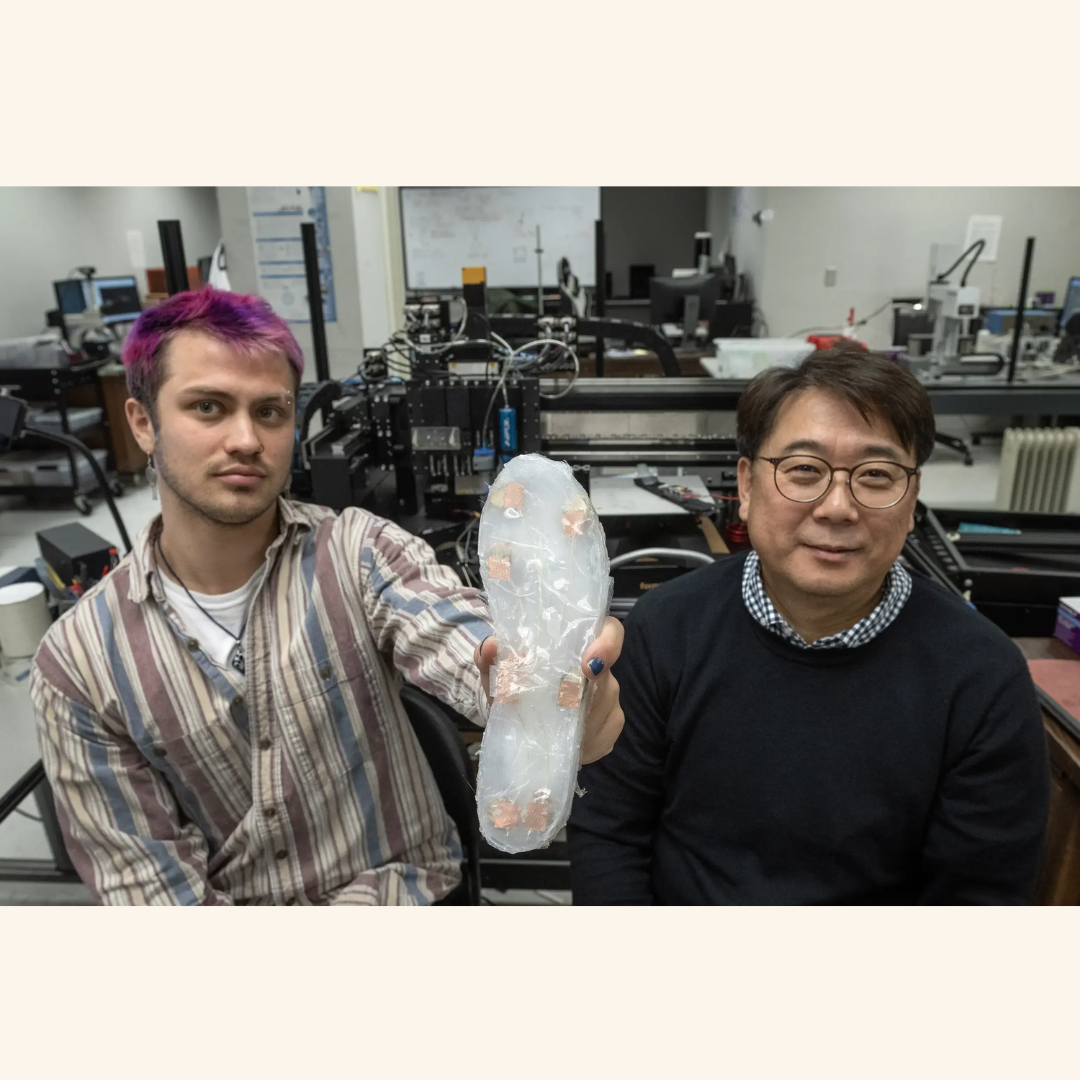
A team of researchers from Virginia Commonwealth University (VCU) is developing an innovative solution to help people with Parkinson’s disease (PD) regain mobility and confidence. Their breakthrough? A lightweight, flexible glove and a 3D-printed shoe sole embedded with tiny vibrating devices that could restore the brain-body feedback loop, which Parkinson’s and other mobility disorders disrupt.
How Does It Work?
The technology relies on small, fingernail-sized vibrating devices similar to those in mobile phones. These devices are integrated into wearable accessories and work by stimulating the nervous system through vibrations.
“There’s this feedback loop between the central nervous system and the peripheral nervous system,” explains Phillip Glass, the study’s lead researcher and a Ph.D. candidate in the Department of Physics at VCU. “The brain is constantly talking to the peripheral nervous system, including the sensors in the fingertips and feet.”
Parkinson’s disease can disrupt this feedback loop, making it difficult for people to coordinate their movements. One of the most frustrating symptoms of PD is ‘freezing of gait’—a sudden inability to move one’s feet, which affects nearly 60% of patients. The researchers hope their wearable devices will help restore this vital connection.
A Simple Yet Effective Concept
The system consists of pressure sensors embedded in a shoe sole or glove, connected wirelessly via Bluetooth. When a user steps down or grips an object, the pressure sensors detect movement and trigger small vibration devices in another part of the body. These vibrations, in turn, provide sensory feedback, helping the brain recognize movement and regain control over it.
“It could be that if it vibrates, the patient knows, ‘OK, I’m having trouble walking, so I’ll take bigger steps, slow down, or turn a different direction,’” says Dr. Ingrid Pretzer-Aboff, a professor in VCU’s School of Nursing and co-author of the study. “If it’s having a neurostimulation effect, it could be activating the receptors in the skin and sending signals to the brain.”
Designed for Comfort and Ease of Use
One of the major improvements in this design is its focus on user comfort. Previous vibrating devices for Parkinson’s patients were bulky and cumbersome. This new technology, developed by Glass and his advisor Dr. Daeha Joung, uses 3D printing to make the devices lightweight and flexible.
“Patients felt that the old vibrators were bulky, heavy, and not comfortable,” explains Joung, an assistant professor of physics. “Patients want to have something subtle, flexible, and small.”
Beyond Parkinson’s: A Versatile Innovation
While this technology was designed with Parkinson’s patients in mind, it has potential applications for other conditions as well. People who use prosthetic legs could benefit from an adapted version of this system, where pressure sensors detect balance issues and send an alert via vibrations to the upper leg before a fall occurs.
The system is also highly customizable. The intensity and frequency of the vibrations can be adjusted based on individual needs, ensuring that each user gets the right level of feedback to support their mobility.
What’s Next?
The VCU research team is working toward commercializing their innovation. They are in the process of patenting their technology and hope to bring it to market soon. Their next step? Testing the devices with real Parkinson’s patients at VCU Health to refine and improve the technology.
“We tried to understand what the problem was, and we tried to resolve the problem,” says Joung. “How can we, as scientists and engineers, contribute to help the patients?”
With ongoing research and development, this wearable tech could offer people with Parkinson’s and other mobility disorders a simple yet powerful tool to improve their movement and independence.
Photo: The shoe sole that Glass and his advisor, Daeha Joung, Ph.D., developed delivers vibration to the top of the foot. (Kevin Morley, Enterprise Marketing and Communications)
Comments (0)
Loading comments...