


The Old Dog with a New Trick: Could Levodopa Be Protecting Your Liver?
January 5, 2026
For most of us living with this condition, Levodopa is the "old reliable" in the medicine cabinet. It is the gold standard, the heavy lifter that tops up our dopamine levels and keeps us moving. We tend to think of it purely as brain fuel—a chemical key that fits a specific lock in our nervous system.
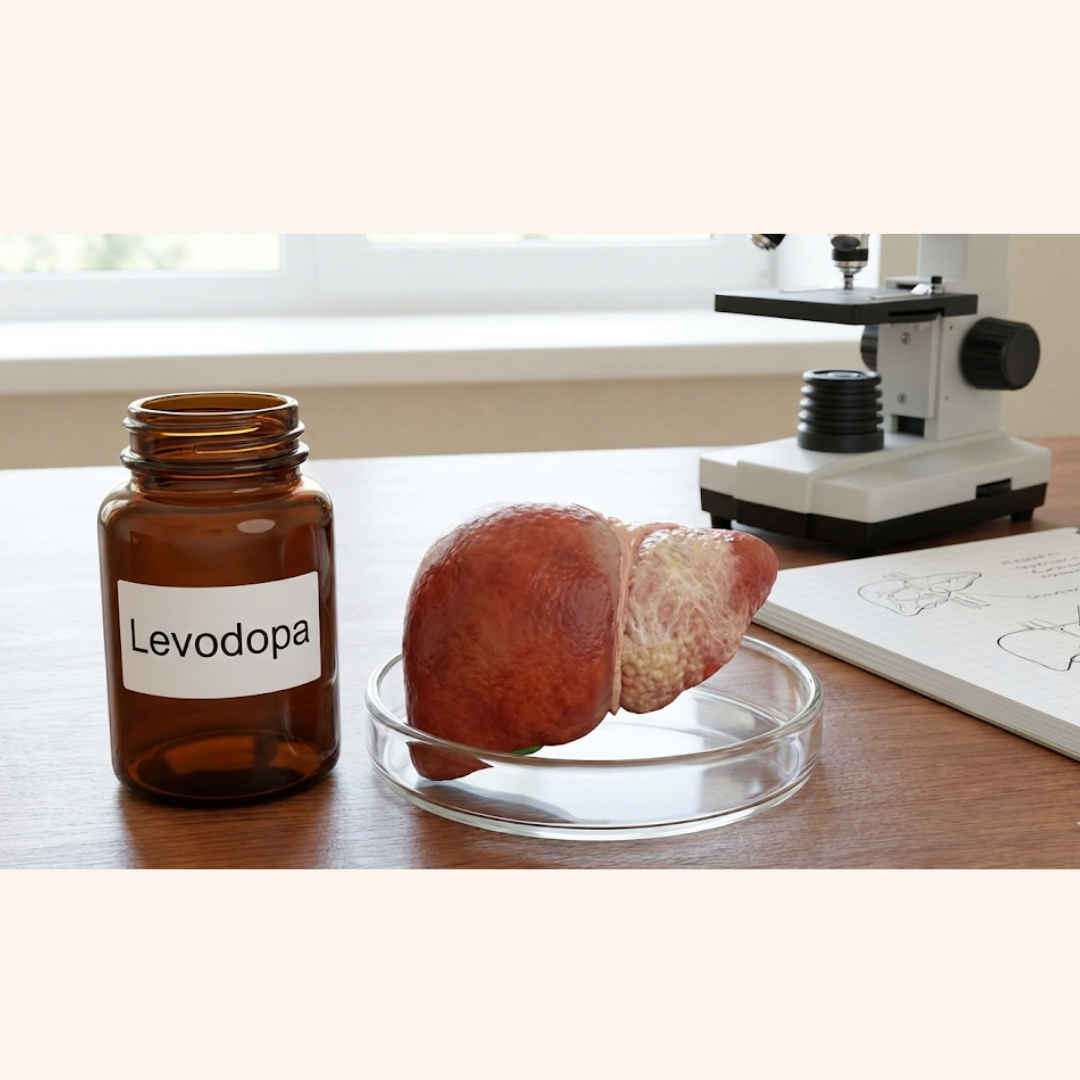
But a fascinating new study published in the World Journal of Gastroenterology suggests that this familiar medication might have a surprising "moonlighting" job: it could be fighting fibrosis in the liver.
The Body-Wide Network
We often forget that dopamine isn't just a brain chemical. It is a messenger used by cells all over the body, from your gut to your kidneys. Researchers in China wanted to see what happens when you stimulate dopamine receptors in the liver, specifically to address liver fibrosis—a condition where the liver becomes scarred and stiff (think of it like the internal equivalent of "freezing").
They took a group of rats with liver scarring and treated them with Levodopa. The results were unexpected and impressive.
Turning Off the "Scarring Switch"
The study found that Levodopa didn't just sit there; it got to work. It activated a specific docking station on the liver cells called the D1 receptor.
When this receptor was triggered, it set off a chain reaction (known as the "Hippo signaling pathway," if you want to impress your neurologist) that effectively told the liver's scar-making cells to calm down. It stopped the accumulation of collagen, which is the stuff that makes tissue stiff and fibrous. In simple terms, the Levodopa acted like a soothing balm, reducing the damage and keeping the liver tissue healthy.
Why This Matters
Now, before you worry—this doesn't mean you have liver disease, nor is it a prescription to change your dose. But it is a brilliant reminder of two things:
The "Drug Repurposing" Revolution: Science is increasingly finding that old drugs have new powers. Because Levodopa has been used safely for decades, we don't have to wait 20 years to prove it is safe for humans. If this liver benefit holds up in people, we are already halfway to a new treatment.
The Connected Body: It highlights that treating this condition isn't just about fixing the brain. The dopamine you take affects your whole system, often in ways we are only just beginning to understand.
So, the next time you swallow that tablet, give a little nod of respect. It might be doing a shift in your liver that you never even asked it to do.
Comments (0)
Loading comments...