


London researchers reveal why movement slows down in Parkinson’s
September 29, 2026
 Beatrice
A research team led by scientists at Imperial College London, University College London, and King’s College London has uncovered a vital clue about why movement becomes slow and small in Parkinson’s.
For a long time, researchers have debated what actually happens between the brain and the muscles to cause slowness. One possibility was that the wiring itself was failing, meaning the brain simply could not generate or send a strong enough electrical message down to the muscles. The alternative idea was that the communication line is completely intact, but the brain has set the volume dial too low, an idea scientists call reduced motor vigour.
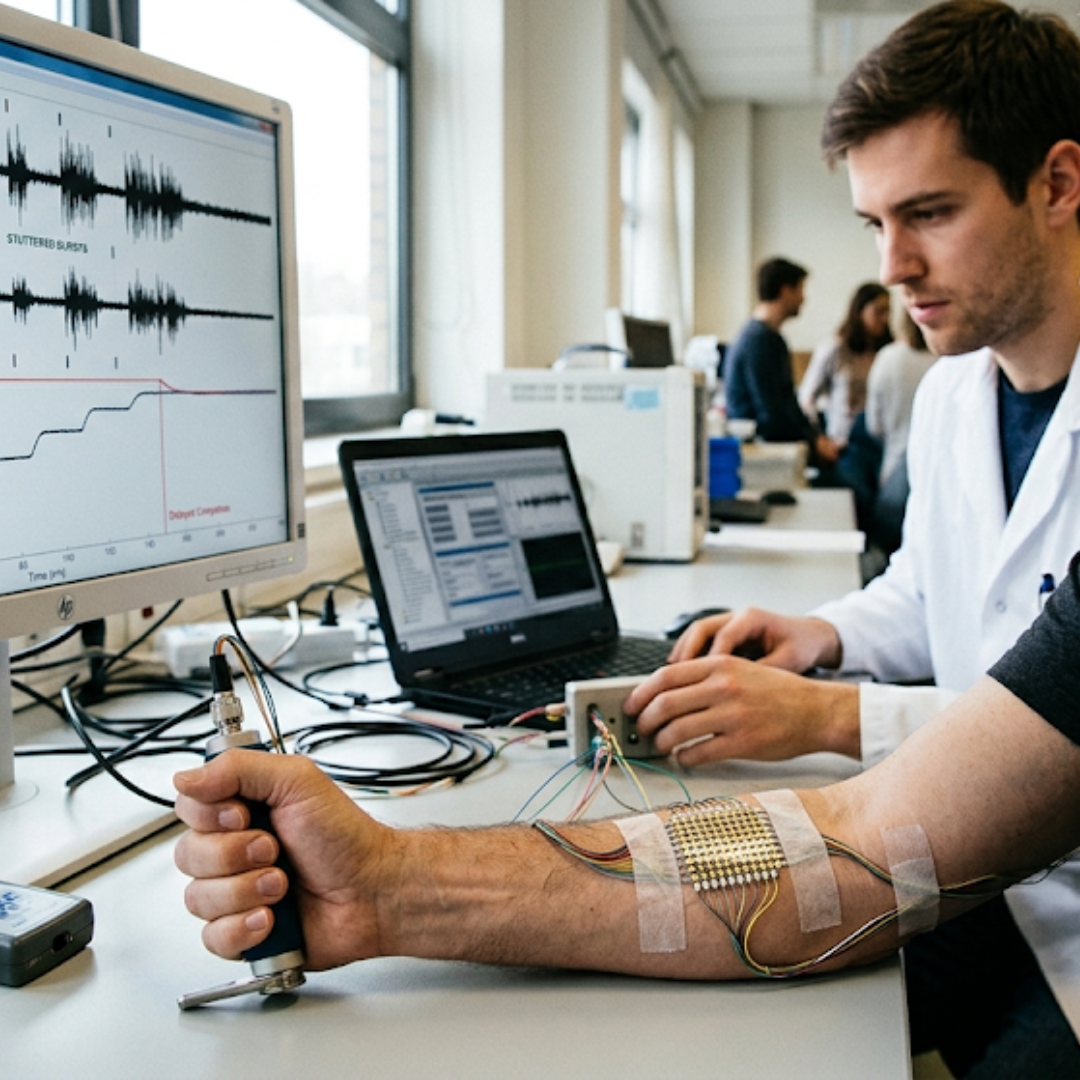
To solve this puzzle, the researchers looked directly at how muscles receive signals from the nervous system. They used advanced sensors called high density surface electromyography to record the activity of individual motor units, which are the tiny bundles of muscle fibres controlled by single nerve cells. The team compared twelve people with the condition who had deep brain stimulation against ten people without it. Each person carried out rapid bursts of muscle contractions, aiming to produce different levels of force.
The recordings showed something remarkable. In people without the condition, reaching a target force happened almost instantly with a single, sharp burst of muscle activity. In people with Parkinson’s, the body took a very different path. Instead of one solid push, the nervous system sent several smaller, stuttered bursts. Because each burst had a brief pause in between, reaching the target force took around a quarter of a second longer. When deep brain stimulation was turned off, these bursts became even smaller and more fragmented.
Crucially, the wiring was not broken at all. The very first burst delivered by people with Parkinson’s during a heavier effort was more than large enough to have reached a lighter target in one go. Furthermore, the firing rate and steady rhythm of the muscle nerves were completely normal. The machinery needed to send powerful signals is working perfectly, but the brain misjudges how much initial effort to invest in the movement.
Rather than a transmission failure, slowness turns out to be an issue of calibration. The brain hesitates and underscales the opening burst, forcing the nervous system to send several follow up signals to finish the job. Proving that the underlying neural pathway to the muscles remains fully functional gives researchers a much clearer target, shifting the therapeutic focus towards recalibrating how the brain chooses to spend its movement energy.
Comments (0)
Loading comments...