


The Salt Switch: Using Light to "Reset" Rogue Brain Cells
December 13, 2025
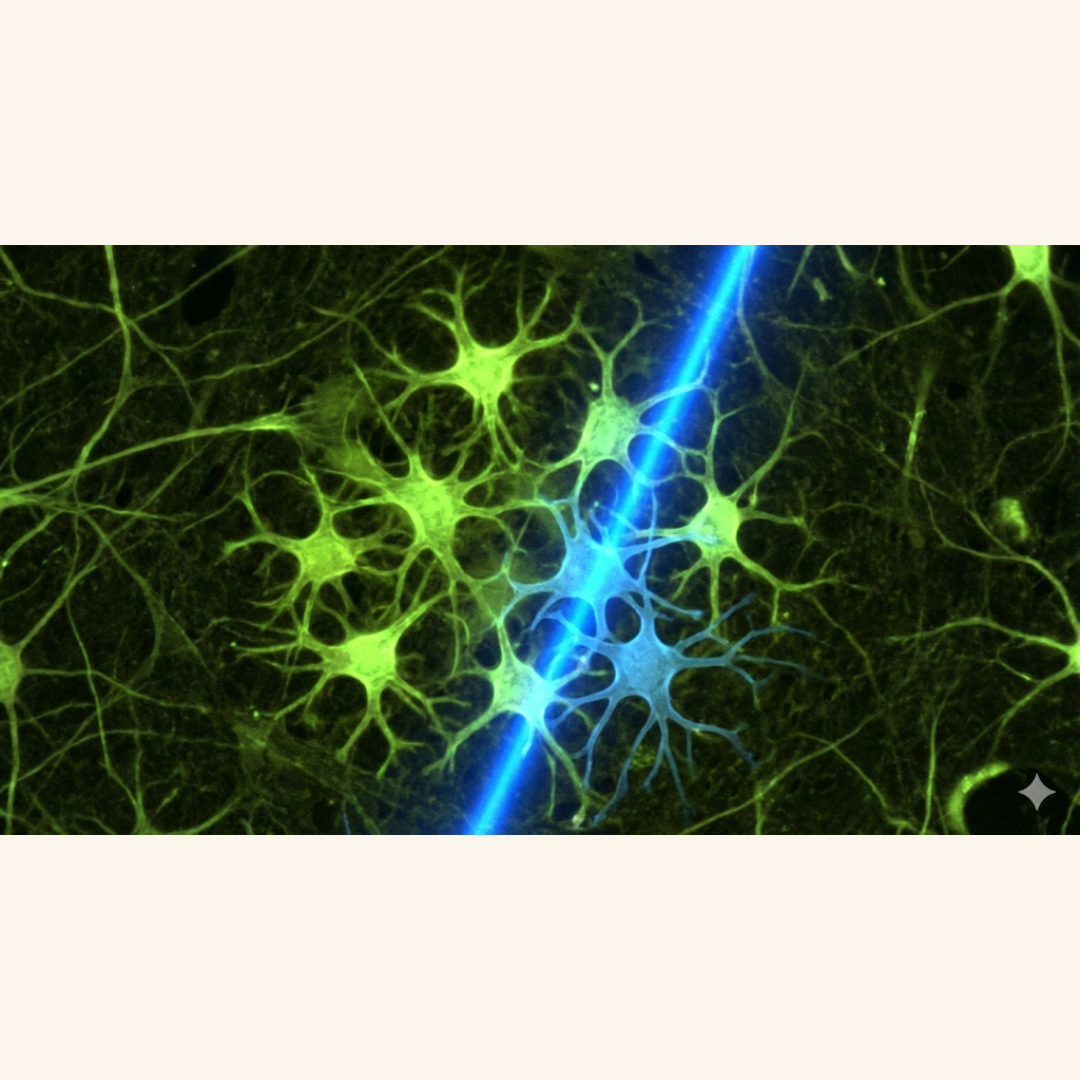
We usually think of the brain as a complex web of neurons, but they are actually outnumbered by a support crew called astrocytes. Normally, these star-shaped cells are the caretakers, mopping up waste and keeping neurons healthy. But in Parkinson’s, something goes wrong. They turn "reactive," abandoning their cleaning duties and instead pumping out toxic signals that harm the very cells they are meant to protect.
A new study published in Scientific Reports has identified the chemical trigger behind this Jekyll-and-Hyde transformation—and, remarkably, used light beams to switch it off.
The Chloride Imbalance
The researchers found that the problem lies in the salt balance inside these support cells. Specifically, reactive astrocytes become overloaded with chloride ions. In the microscopic world of the brain, chloride acts like a directional valve for chemical messages.
When chloride levels inside the astrocyte get too high, the "valve" breaks. Instead of absorbing inhibitory chemicals (like GABA) to keep the environment clean, the astrocyte starts spewing them out. This flood of inhibitory signals effectively suffocates the nearby dopamine neurons, silencing them and eventually driving them to degeneration.
The Optogenetic "Reset"
This is where the science fiction comes in. To prove this mechanism, the team used a technique called optogenetics. They genetically modified the astrocytes to carry a tiny, light-sensitive pump—essentially a biological switch that opens or closes based on light exposure.
By shining a specific colour of laser light into the brain tissue, they were able to manually pump the excess chloride out of the reactive astrocytes, instantly resetting their internal salt balance.
The Result: Protection
The effect was striking. Once the chloride levels were normalised, the astrocytes stopped their toxic behaviour. They ceased releasing the suffocating signals and returned to their supportive role. Crucially, this "reset" significantly reduced the pathology associated with the condition, protecting the dopamine neurons from the damage that usually defines Parkinson's.
Why This Matters
We obviously cannot go around implanting lasers in people's heads to treat the condition. However, this study is a proof-of-concept that is incredibly valuable. It tells us that the "enemy" isn't just the loss of dopamine neurons, but the toxic environment created by their support crew.
Now that we know chloride is the culprit, pharmaceutical companies can start looking for drugs that target the chloride channels directly. If we can develop a pill that flushes chloride from astrocytes—mimicking what the laser did—we might be able to halt the "reactive" cycle and protect the neurons we have left. It is a completely new angle of attack, moving the focus from the dying neurons to the salt imbalance that is killing them.
Comments (0)
Loading comments...