


How a Single Protein Could Halt Parkinson’s Damage
February 20, 2026
One of the greatest challenges in treating Parkinson’s is dealing with neuroinflammation—a state where the brain's own immune system starts to cause more harm than good. A groundbreaking study published in CNS Neuroscience & Therapeutics in February 2026 has identified a master switch called SIX2 that could help turn this inflammation around and protect vital brain cells.
The research suggests that by "retuning" the brain’s immune cells, we can create a protective environment that rescues neurons from damage.
The Two Faces of Microglia
To understand this breakthrough, we have to look at microglia. These are the brain's resident immune cells. In a healthy brain, they act like gardeners, cleaning up debris and keeping everything tidy. However, in the Parkinson’s brain, they often get stuck in a "pro-inflammatory" state known as M1 polarization.
When microglia are in the M1 state, they release toxic chemicals that inadvertently kill dopaminergic neurons—the very cells responsible for movement and coordination. The goal of many researchers is to find a way to flip these cells into their "protective" state, known as M2 polarization. In this state, microglia release healing factors and help the brain repair itself.
SIX2: The Master Switch
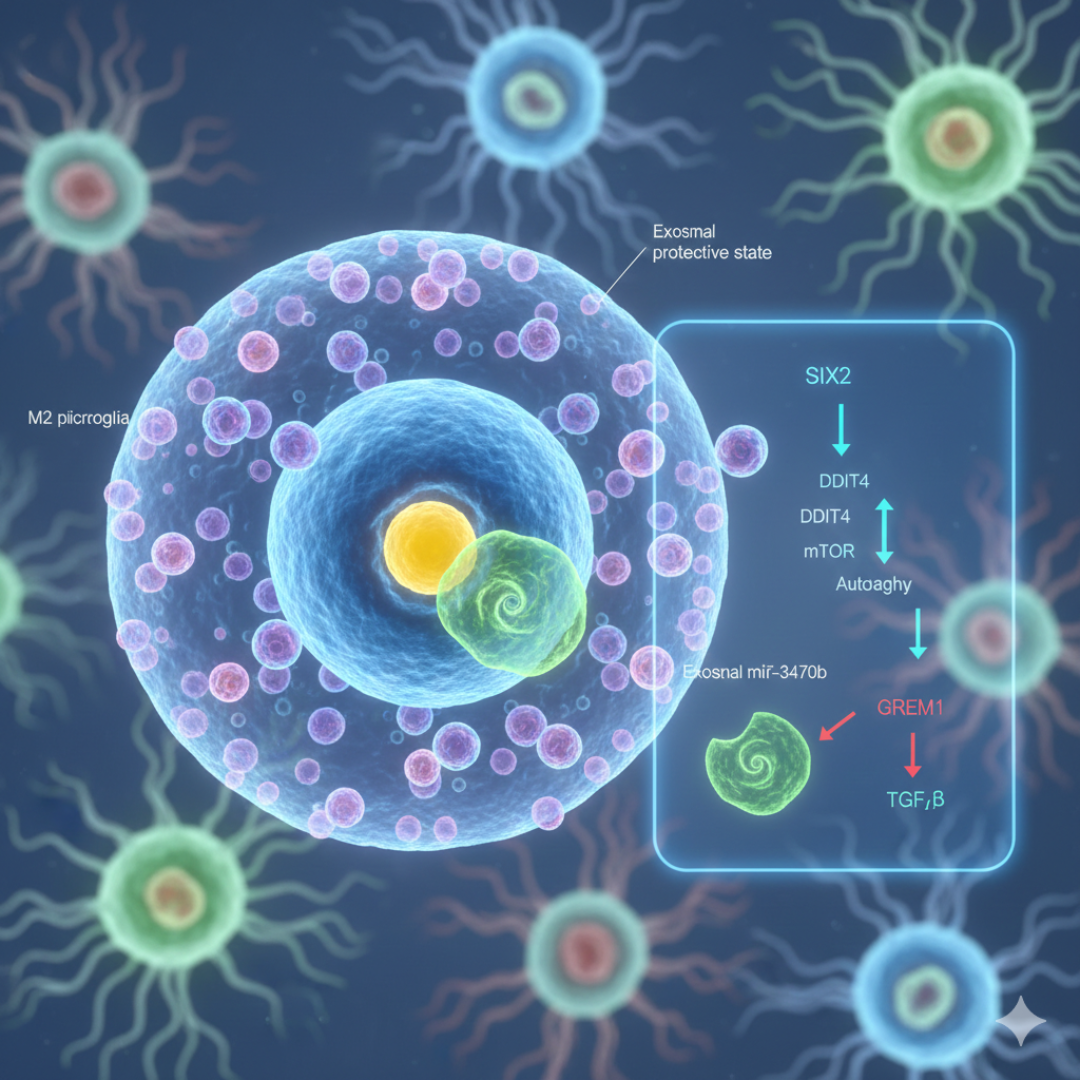
The study, led by researchers at Xuzhou Medical University, discovered that a transcription factor called SIX2 is the key to this transformation. When SIX2 levels are high, it activates a specific pathway (the DDIT4/mTOR/autophagy axis) that forces microglia to switch from the aggressive M1 state to the protective M2 state.
But the protection doesn't stop there. Once these microglia are "retuned" to the M2 state, they start sending out tiny "message bottles" called exosomes.
The Message in a Bottle: Exosomal miR-3470b
These exosomes are packed with a specific microRNA called miR-3470b. The study found that M2 microglia release these exosomes, which then travel to nearby dopaminergic neurons.
Once the neurons "swallow" these messages, the miR-3470b goes to work. It shuts down a protein called GREM1, which in turn boosts a survival signal called TGF-β. This chain reaction effectively shields the neurons from apoptosis (cell death) and prevents the motor coordination issues typically seen in the condition.
Why This Research is a Game-Changer
What makes this study so exciting is that it provides a double layer of protection:
Stops the Attack: It flips the brain’s immune cells from "attack" mode to "repair" mode.
Sends a Shield: It uses the brain's own communication system (exosomes) to deliver a protective shield directly to the most vulnerable neurons.
By identifying the SIX2-DDIT4-autophagy axis and the exosomal miR-3470b pathway, scientists now have concrete targets for new immunotherapies.
While this research was conducted in cellular and animal models, the results were highly consistent. The mice treated with these pathways showed significantly restored motor function and a much higher survival rate of dopamine-producing cells. This opens the door for future treatments that could potentially slow or even stop the progression of the condition by working with the brain's immune system rather than just trying to suppress it.
Comments (0)
Loading comments...