


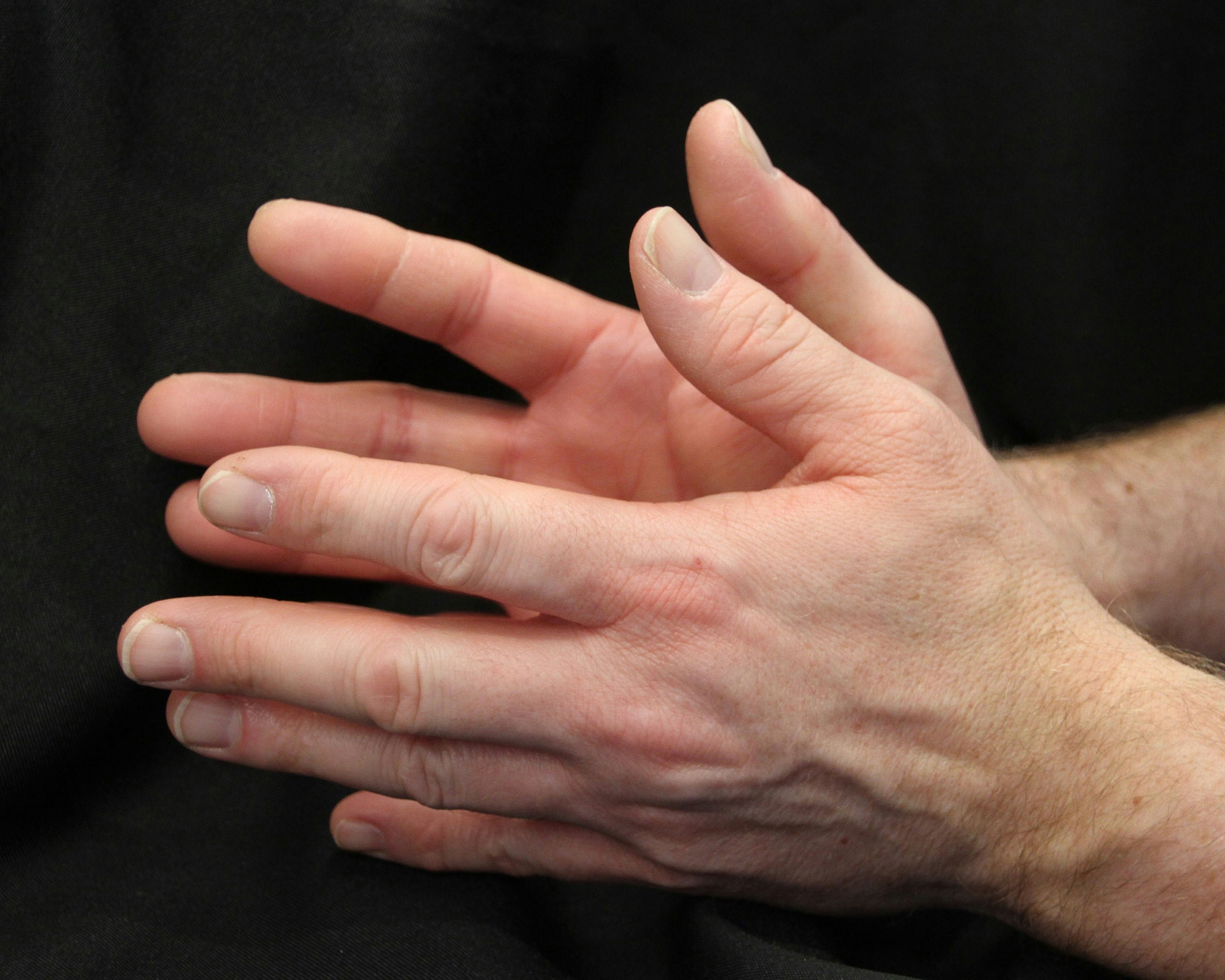
Parkinson’s disease tremor explained by reflex loop changes
July 3, 2025
What did the researchers explore?
They investigated why tremors in Parkinson’s Disease often appear in certain situations (like when holding a posture) and disappear during voluntary movement. The team used control engineering tools (like those used to stabilize robots and machinery) to rethink how the brain and muscles work together—and where things go awry in PD. 
🔄 How does the normal system work?
1. Stretch reflex loop: When a muscle stretches unexpectedly, sensors trigger a feedback response to correct it (like your arm twitching back when you catch a falling object).
2. Basal ganglia (BG): This deeper brain area acts as a “gain scheduler”—it adjusts how strong that reflex should be depending on what you’re doing:
• For holding a position (e.g., carrying a tray), it increases reflex “gain” and muscle co‑tension to keep things stable.
• For moving voluntarily, it decreases that gain so the movement isn’t overly stiff.  
🧩 What goes wrong in Parkinson’s Disease?
• In PD, the basal ganglia’s control gets miscalibrated—especially when trying to hold still.
• It may set the reflex gain too high, causing the system to transform from stable control into a resonance loop—like a feedback loop that oscillates. That’s the tremor. 
✋ Why hands tremor first—and why wearing weights helps
• Small mass limbs, like hands, reach the unstable reflex threshold faster—explaining why tremor typically begins there. 
• Adding weight increases mass, stabilising the loop and often reducing tremor. ()
⏱️ Why tremor frequency is around 4–9 Hz
• The model assumes nerve signal delays (~50–100 ms), which mathematically produce oscillations at ~6 Hz—matching clinical observations of resting tremor (4–9 Hz). 
🔁 “Switch‑and‑dimmer” model in the body
• Think of movement control like controlling lights:
• The “switch” (the BG) decides whether you’re holding still or moving.
• The “dimmer” (the reflex loop) determines how strong the response is.
• In PD, the switch sets the reflex too bright during holding, triggering an unstable dimmer—our tremor. 
💡 Why this matters
1. Better understanding: Offers a simpler and more unified explanation for many puzzling tremor features.
2. Treatment implications: Suggests therapies should focus on reducing reflex gain—whether via drugs, targeted stimulation, or neurological feedback systems.
3. Improving Deep Brain Stimulation (DBS): DBS could be fine-tuned by monitoring BG signals that control reflex gain, not just by suppressing tremor signals.  
4. Non-invasive therapies: Techniques like vibration gloves may work by stabilizing this reflex system, reducing tremor. 
✅ In summary
• Parkinson’s tremor may stem from an over‑turned reflex gain during posture holding.
• It’s not directly generated by tremor‑frequency brainwaves in the basal ganglia, but rather an unstable muscle‑nerve loop triggered by BG mis‑setting.
• This fresh, engineering‑rooted view opens doors to more precise, targeted treatments—whether through stimulation, medication, or even wearable devices.
Comments (0)
Loading comments...