


Can We Repair the Brain? The Reality of Stem Cell Therapy for Parkinson’s
December 10, 2025
The idea of repairing the brain sounds like something from science fiction. But for people living with Parkinson’s, it represents the ultimate hope: replacing what has been lost.
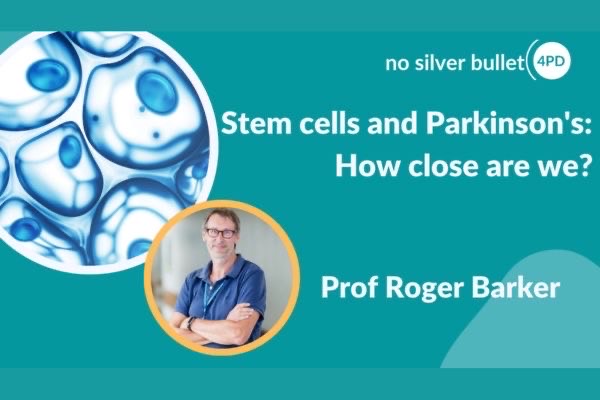
In a recent webinar for No Silver Bullet 4 PD, Professor Roger Barker, a world-leading expert in cell-based therapies from the University of Cambridge, tackled this exact question. His message was grounded but optimistic: we are no longer just talking about the possibility of brain repair; we are actively testing it in clinical trials.
The Core Problem: A Broken Circuit
Professor Barker began by stripping the problem down to its basics. Parkinson’s is complex, affecting the gut, sleep, and mood, but its hallmark motor symptoms—tremor, stiffness, and slowness—are driven by the death of a specific group of cells.
These are the dopamine-producing cells in the substantia nigra, a small area at the top of the brainstem. We start life with about half a million of them. By the time someone is diagnosed with Parkinson’s, they have lost around 50%—roughly 250,000 cells.
The current gold standard treatment, levodopa, works by flooding the brain with dopamine to replace what’s missing. It’s effective, but it’s a "sledgehammer" approach. It stimulates the whole brain, often leading to off-target side effects like confusion or impulsive behavior. Over time, its effectiveness wanes, leading to the "on-off" fluctuations and dyskinesia (involuntary movements) that plague many living with the condition.
The Logic of Repair
Professor Barker’s argument for cell therapy is simple: instead of flooding the brain with drugs, why not just put the cells back?
If we could transplant 250,000 healthy dopamine cells directly into the putamen (the area where dopamine is needed), we could theoretically restore the circuit. This would be a one-off treatment that provides a natural, regulated supply of dopamine, potentially allowing patients to reduce or even stop their medication entirely.
Lessons from History: The Fetal Tissue Era
This isn’t a new idea. In the 1980s and 90s, researchers trialed transplants using human fetal tissue. The results were a mixed bag, but they proved the concept works.
Professor Barker shared incredible case studies of patients who, after successful transplants, came off their medication and stayed off it for decades. Post-mortem exams of these patients years later showed the transplanted cells were still alive and functioning.
However, fetal tissue transplants had major flaws:
Inconsistency: Results varied wildly between patients.
Supply: It required tissue from multiple aborted fetuses, making it ethically complex and impossible to scale.
Side Effects: Some patients developed graft-induced dyskinesia—uncontrollable movements caused by the transplant itself.
The New Era: Stem Cells
This is where stem cells change the game. Unlike fetal tissue, stem cells can be grown in a lab in limitless quantities.
Professor Barker highlighted that we can now take a single vial of embryonic stem cells and, in just over two weeks, produce enough dopamine cells to treat hundreds of patients. This solves the supply problem and allows for a standardized, high-quality "product."
Currently, there are major clinical trials underway globally, including:
BlueRock Therapeutics (USA): Recently published 18-month data showing safety and signs of clinical improvement, now moving to a large Phase 3 trial.
Kyoto University (Japan): Using Induced Pluripotent Stem Cells (iPSCs)—adult cells reprogrammed back into stem cells—showing promising safety and survival data.
STEM-PD (Europe): Led by Professor Barker himself, this trial has just completed dosing its first cohort of patients.
The Reality Check: "We Are Close, But..."
Despite the excitement, Professor Barker offered a crucial reality check.
It’s Not a Cure: These transplants only replace dopamine cells. They won’t fix non-motor symptoms like dementia, balance issues, or loss of smell, which involve different brain circuits.
Dosing is a Guess: We still don’t know exactly how many cells to inject to get the "perfect" result. Current trials are likely underdosing to ensure safety.
The "5-Year" Window: When pushed for a timeline, Professor Barker noted that if current Phase 3 trials (like BlueRock’s) are successful, we could see a licensed therapy within 3–5 years.
Conclusion
The takeaway from the session was clear: we are entering a new chapter. The question is no longer if we can repair the brain, but how to do it consistently and safely.
For the Parkinson’s community, this research offers a tangible glimpse of a future where a diagnosis doesn’t just mean managing decline, but potentially reversing the damage.
Comments (0)
Loading comments...