


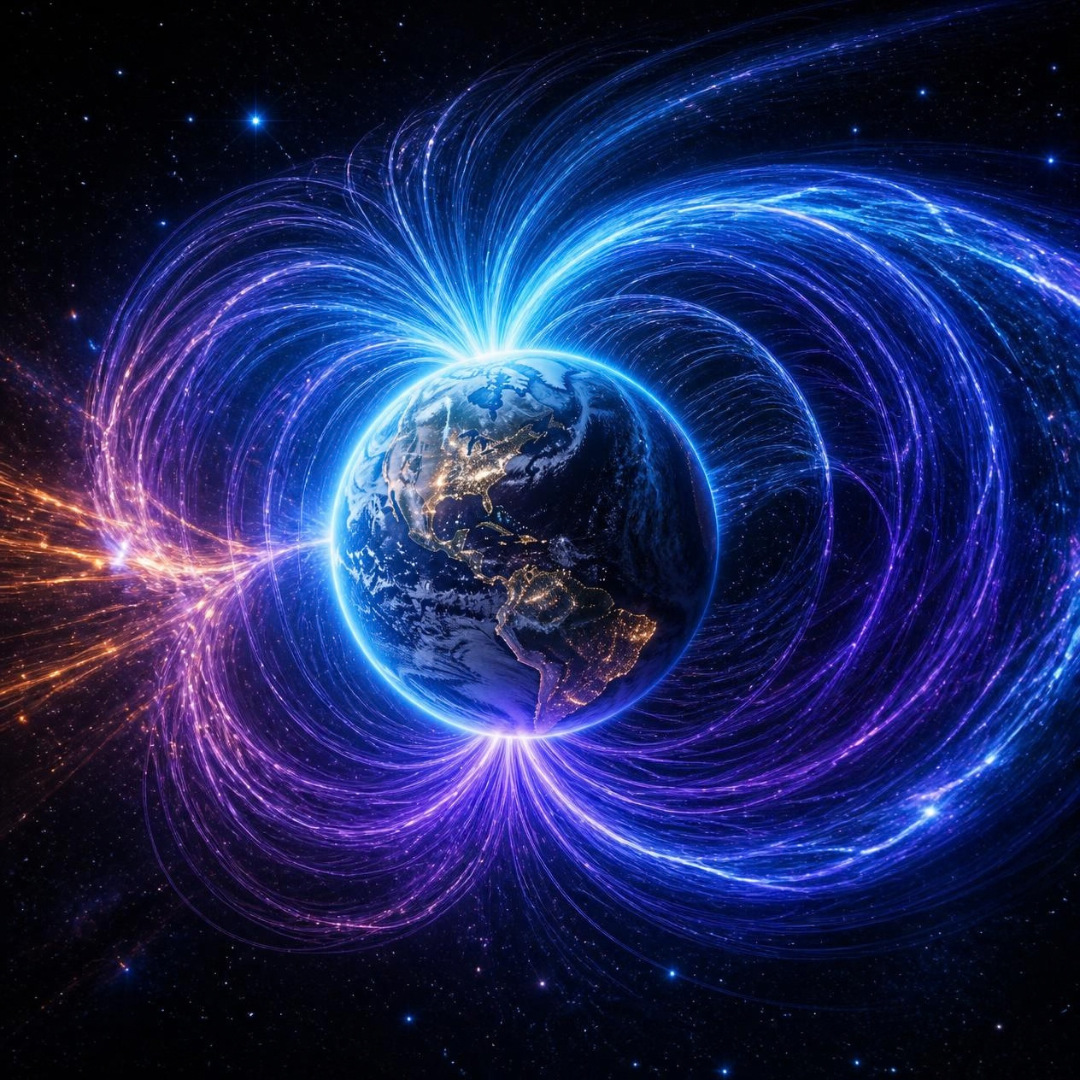
Earth's magnetic field reveals surprising clues for Parkinson's
September 26, 2026
 Beatrice
I never thought space science would get involved in Parkinson's research, yet here we are looking at Earth's magnetic bubble to understand cellular health.
Every second of our lives, the planet's magnetic field passes straight through our bodies. We know it steers birds and shields us from cosmic radiation, but a bioscience team at the University of Nottingham decided to ask a bizarre question: what happens to our cells if you switch it off?
To find out, researchers built a special chamber that cancelled out the magnetic field entirely, creating a near zero environment similar to deep space. Then they introduced fruit flies, the tiny workhorses of genetics whose cellular wiring looks remarkably like our own.
Half of the flies were healthy, while the other half carried a defect in the Pink1 gene, a genetic flaw linked to inherited early onset Parkinson's.
The results were completely unexpected.
Living without the magnetic field gave the flies with the Parkinson's gene a twenty per cent longer lifespan. Their physical climbing speed dropped, but they stayed alive far longer than expected. Curiously, the ordinary flies showed the exact opposite reaction, sprinting through life with great movement but dying significantly earlier.
The secret lies in the mitochondria, the tiny power stations generating energy inside every living cell. Inside these powerhouses sits an engine part called Complex II. Without the magnetic field, Complex II kicked into overdrive.
For the healthy flies, this revved the engine too hard, churning out excess toxic byproducts that wore the cells down. But for the flies carrying the Parkinson's gene, whose cellular batteries were already sluggish, that extra kick worked like a vital jump start. It made up for their deficit and kept their systems running.
Laboratory flies in zero magnetic chambers are a long way from the clinic, of course. Still, uncovering this hidden switch suggests that gentle, non invasive magnetic tweaks could one day help scientists tune cell batteries and rethink therapies for Parkinson's. So, is it time to book a ticket to Mars?
Comments (0)
Loading comments...