


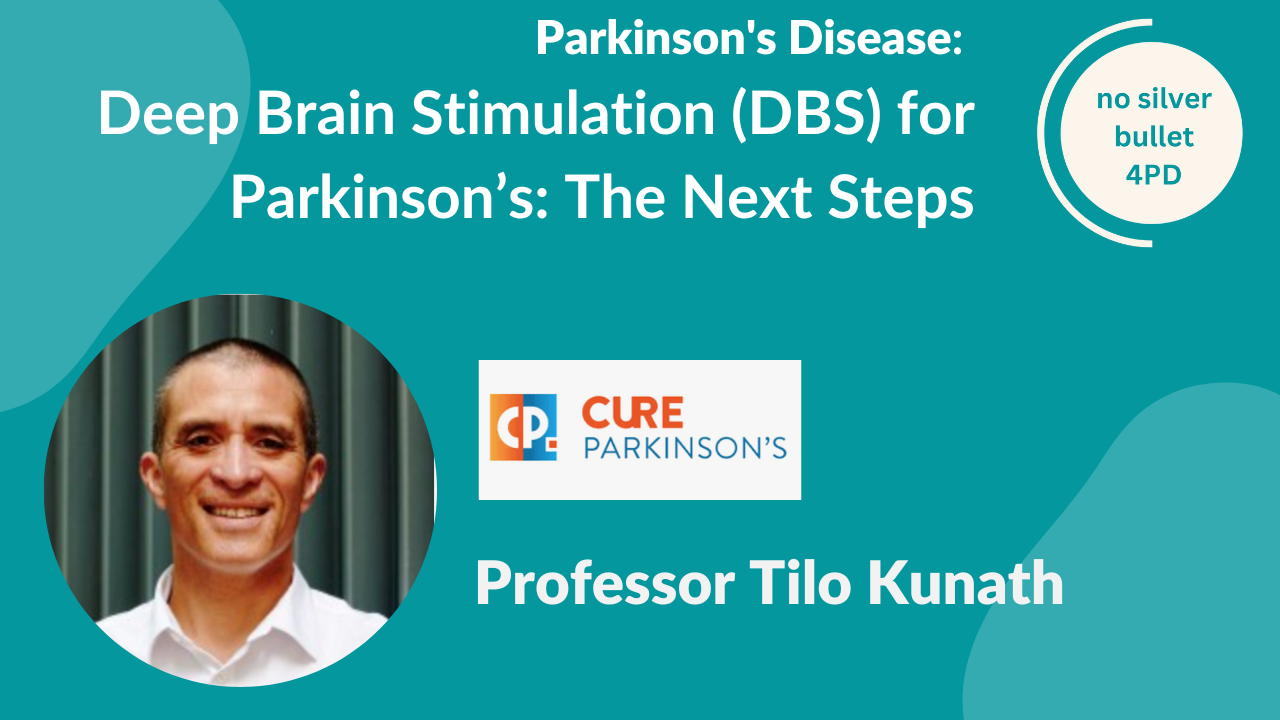
Deep brain stimulation today and tomorrow: highlights from a Cure Parkinson’s webinar
October 4, 2025
We are delighted to share key takeaways from a Cure Parkinson’s webinar run with the University of Edinburgh and the Journal of Parkinson’s Disease, chaired by Professor Tilo Kunath. The panel brought together three perspectives.
Dr Alfonso Fasano, University of Toronto and Humanitas University, a neurologist and world leader in deep brain stimulation.
Dr Rhonda McFleder, Universitätsklinikum Würzburg, an immunology and neurobiology researcher studying how deep brain stimulation may influence inflammation in Parkinson’s.
Ben Stecher, writer, advocate and early recipient of adaptive deep brain stimulation, offering a lived experience view.
What deep brain stimulation is and what it is not
Deep brain stimulation places thin electrodes in precise brain targets and connects them to a small computer under the collarbone. Think of it as a brain pacemaker that steadies abnormal signals. It is an established therapy with strong evidence in Parkinson’s, not an experiment.
What it helps most
Tremor, stiffness, slowness and movement swings through the day. It can reduce involuntary movements and often lets people lower medicine doses. Many report better sleep because symptoms are calmer at night.
What it helps less
Speech, balance problems, severe freezing, thinking and memory issues. A simple rule of thumb still holds. What improves with a levodopa dose test tends to improve with deep brain stimulation, with the key exception that tremor can respond to surgery even when it resists medicine.
How it works in plain English
When dopamine falls, parts of the movement network become overactive and jittery. Stimulation calms those hot spots and helps the wider circuit fall back into rhythm. Programming is tailored. People can have several settings on a hand held controller and switch depending on the task, for example a setting that is great for tremor and another that is kinder to speech.
Could deep brain stimulation change the course of the disease
The panel was refreshingly honest. No one should sell deep brain stimulation as a cure. Human proof that it slows the underlying disease is not there yet. That said, two ideas matter.
Direct effects. Dr McFleder’s lab work suggests stimulation can cool harmful immune activity and lower stress signals that drive damage. Early patient blood data hint that immune changes seen in Parkinson’s may shift in a healthier direction after surgery.
Indirect effects. Better movement often means better sleep and more exercise. Those two alone are linked to better long term outcomes. Deep brain stimulation can make them possible.
What adaptive deep brain stimulation adds
Classic systems deliver steady stimulation. Adaptive systems also record a tell tale brain rhythm and adjust the stimulation up or down in real time. In theory this can reduce side effects and keep control tighter through the day. It is now available in some regions and some brands can be upgraded by software. It is not the only good option. Standard deep brain stimulation remains excellent and no one should delay suitable surgery just to wait for an adaptive unit.
Ben has lived with adaptive stimulation for almost four years. He needs little or no levodopa on many days and can train hard in the gym. One practical note. Battery use depends on how much stimulation you need. Some people will favour rechargeable devices, which avoid frequent replacements but require regular top ups at home.
Who should consider deep brain stimulation and when
The best candidates have clear movement benefit from levodopa but troublesome swings, a strong tremor that medicines do not control, or difficult involuntary movements. Age is a guide not a stop sign. Choice of brain target can shift with age and goals. Your team will weigh frailty, memory, mood and support at home.
A successful journey rests on three pillars. An experienced clinical team. An experienced surgical team that can place the leads precisely. A supportive home environment to help through recovery and programming. Distance is less of a barrier than it once was. Some systems now allow remote programming by your neurologist.
Risks and how to think about them
Serious complications are uncommon but real. The headline surgical risks are bleeding in the brain which is rare, infection which is usually treatable, and seizures which are uncommon. A careful centre will explain personal risk, prepare you well and follow you closely. People with heart pacemakers can still be considered for deep brain stimulation with extra planning between teams.
Access and fairness
Across the world access is uneven. In some countries the operation is not funded. Even in wealthy systems women and people from minority groups are less likely to receive it. Naming the gap matters. So does practical work to improve referral, education and follow up.
Common questions
Can I move from standard to adaptive later
Sometimes yes. It depends on the brand and the year of implant. Your team can check.
Will deep brain stimulation stop me joining future trials
Often yes. Many interventional trials exclude people with implanted stimulators because the device affects symptom scores. If you are very keen on trials, discuss this trade off before deciding.
What about stem cells
Stem cell transplants in Parkinson’s are still experimental. They act as a living source of dopamine rather than repairing the disease process. They sit in a different box from deep brain stimulation, which is proven symptom control.
The lived experience
Ben’s core message was simple. Deep brain stimulation gave him back the ability to move and to exercise hard every day. Turning the system off in clinic showed him what life would be without it. For him the difference is night and day.
Bottom line
Deep brain stimulation is one of the most effective treatments in Parkinson’s care. It steadies the movement network, improves day to day function and often transforms sleep and activity. Adaptive systems are an exciting step forward but not essential for success. If you are considering surgery, ask your team to test your response to levodopa, to score rest and action tremor separately, to explain the likely gains and limits for your profile, and to set clear goals for programming after the operation. Match the target to your symptoms, go in with your eyes open, and plan how you will use the extra control to live well.
Comments (0)
Loading comments...