


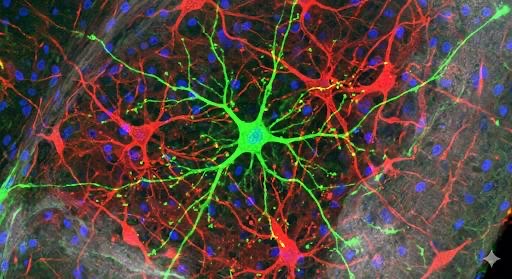
Targeted Therapies and the Role of Striatal Parvalbumin Interneurons in Parkinson’s
April 9, 2026
The search for treatments that do more than just mask symptoms has led researchers to look deep within the brain’s circuitry, specifically at a group of cells called parvalbumin-expressing (PV) interneurons. These cells act as the brain's internal brakes, regulating the flow of information within the striatum, which is the area responsible for coordinating movement. New evidence suggests that these specific neurons are not just bystanders as Parkinson's progresses; they might actually be a key lever we can pull to slow the condition down.
In the typical Parkinson's brain, the loss of dopamine causes the striatum to become overactive and disorganized. This chaos leads to the familiar difficulties with movement. Traditionally, we have focused on replacing that lost dopamine. However, this study highlights that PV interneurons are uniquely positioned to restore order. Because they provide powerful inhibition to the main output cells of the striatum, boosting their function could theoretically dampen the erratic signaling that causes motor symptoms.
What makes this approach particularly exciting is the "druggable" nature of these cells. Researchers have identified specific ion channels and receptors that are almost exclusively found on these PV interneurons. This means scientists could potentially develop medications that target these cells specifically, without interfering with other parts of the brain. By strengthening these "brakes," it might be possible to protect the remaining dopamine-producing neurons from being overworked and exhausted, potentially shifting the focus from symptom management to actually altering the course of the condition.
While much of this research is currently in the hypothetical and experimental stages, it opens a sophisticated new front in neurological science. Instead of a broad-brush approach, the goal is to fine-tune the brain’s existing regulatory systems. If we can successfully harness the power of these parvalbumin interneurons, the future of Parkinson's care could move toward precision therapies that maintain balance and stability in the brain for much longer periods.
Comments (0)
Loading comments...