


New Approach to 'OFF' Time: Solengepras Shows Promise in Phase 2 Trials
December 7, 2025
For many people living with Parkinson's, the daily management of the condition is less like a steady drive and more like a ride on a very unpredictable rollercoaster. The medication works, until it suddenly doesn’t. These periods, known as 'OFF' time, occur when the standard levodopa treatment wears off before the next dose is due, causing symptoms like stiffness, slowness, and tremors to return. It is a frustrating reality that impacts quality of life significantly.
Cerevance, a biopharmaceutical company, recently shared positive results from a Phase 2 study that might offer a new way to smooth out this ride. Their investigational drug, solengepras, has shown it can significantly reduce this troublesome OFF time without relying on the traditional method of simply flooding the brain with more dopamine.
A Different Mechanism
Most current treatments for Parkinson's focus on the 'accelerator' of the brain's movement system—the direct pathway—by replenishing dopamine. While effective, this approach often comes with a ceiling; push it too hard for too long, and it can lead to side effects like dyskinesia (involuntary, jerky movements).
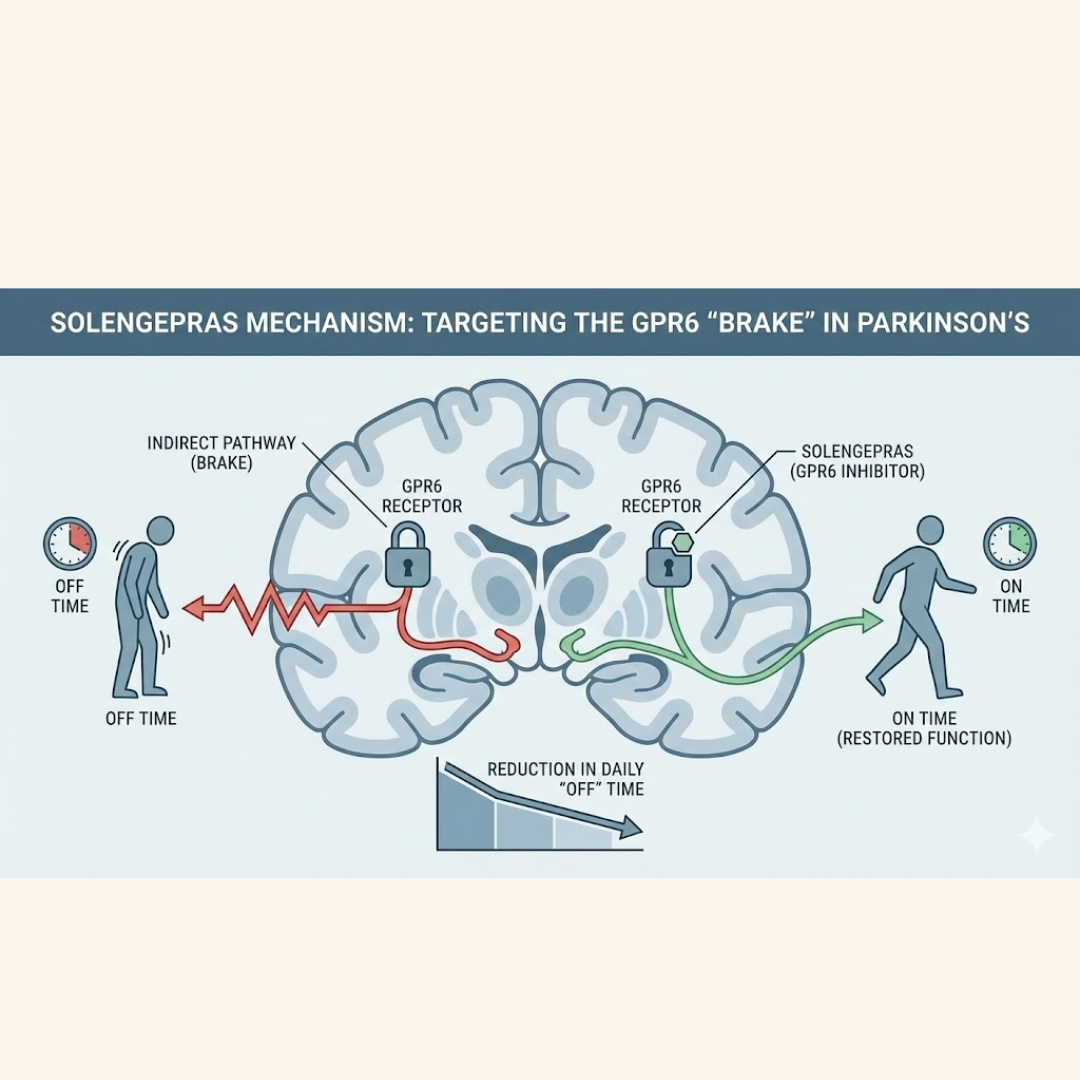
Solengepras takes a different route. It is a non-dopaminergic drug that targets the 'brake' of the movement system, known as the indirect pathway. Specifically, it inhibits a receptor called GPR6. By easing off this brake, the drug aims to restore motor function without overstimulating the dopamine system. It is an oral medication taken once a day, designed to work alongside existing levodopa treatments rather than replace them.
The Study Results
The Phase 2 study was a randomised, double-blind trial involving adults with Parkinson's who were already experiencing motor fluctuations. The goal was to see if adding solengepras to their current regimen would help keep symptoms at bay for longer.
The data indicates that it did. Participants who took 150 mg of solengepras daily saw a statistically significant reduction in their average daily OFF time. Over the course of the 28-day treatment period, these individuals gained back an average of 1.3 hours of 'ON' time—the period when medication is working and symptoms are controlled—compared to those taking a placebo.
For those with a higher burden of OFF time at the start of the study (three hours or more per day), the results were even more pronounced, with a reduction of 1.78 hours. Importantly, this increase in good hours did not come at the cost of increased troublesome dyskinesia, a common trade-off with dopaminergic drugs. The study also noted that the drug was generally well-tolerated, with a low incidence of the side effects typically associated with dopamine therapies.
Looking Ahead
These findings are encouraging because they suggest that targeting the GPR6 receptor could be a viable strategy for managing the fluctuations that plague the later stages of the condition. By attacking the problem from a different biological angle, it may provide a necessary alternative for those who have maxed out the benefits of their current dopaminergic medications.
While these Phase 2 results are a positive step, they are not the finish line. Solengepras is now being evaluated in a larger, pivotal Phase 3 trial called ARISE, which is currently enrolling participants. This next stage will be crucial in determining whether the benefits observed here hold true across a wider population and over a longer period. For now, however, the data offers a grounded reason for optimism in the ongoing search for better symptom control.
Comments (0)
Loading comments...