


The Stress-Blocking Alternative: Propranolol
February 13, 2026
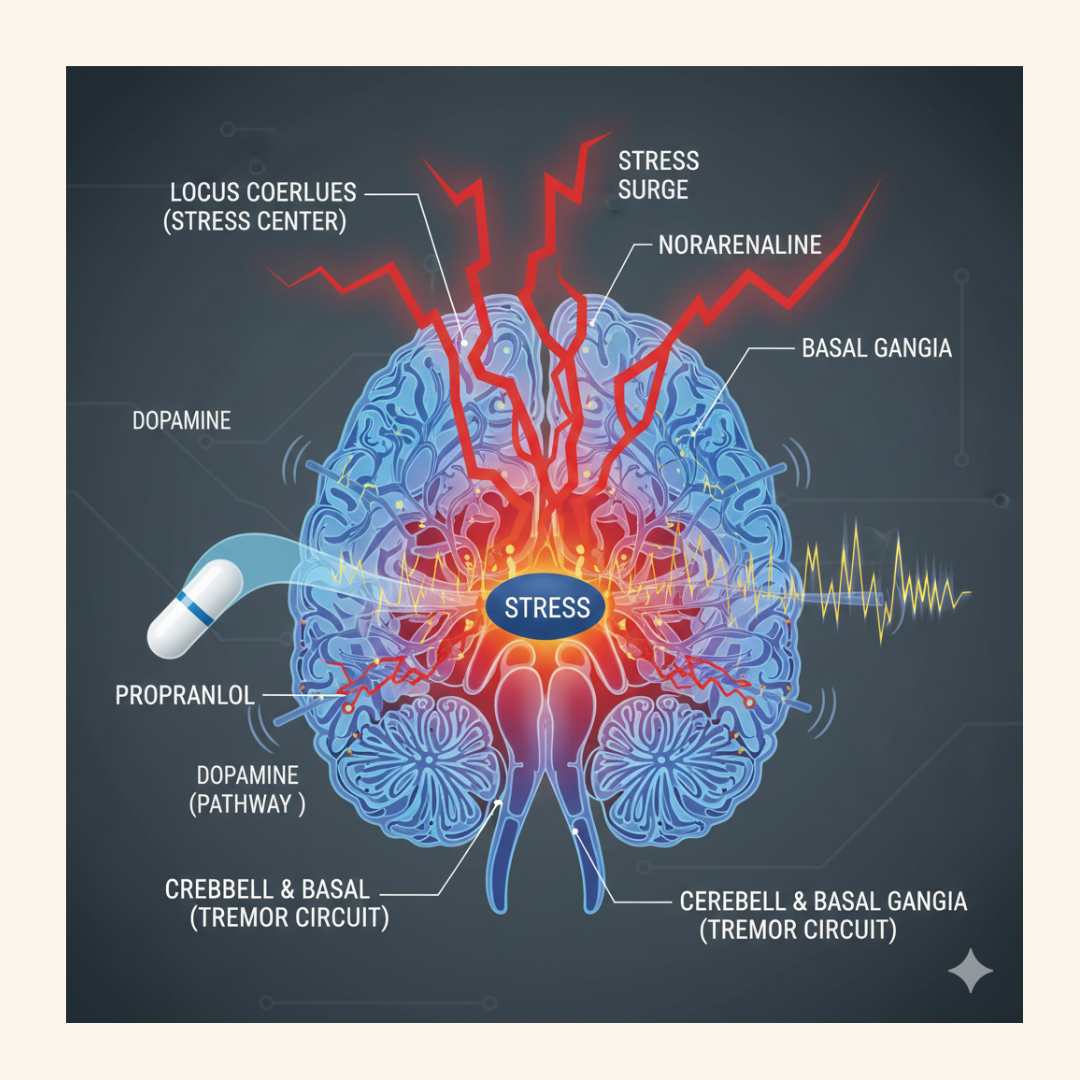
For many people, standard dopamine-based medications do not fully stop tremors. New research from Radboudumc explains why: while stiffness and slowness are driven by dopamine, tremors are often triggered by noradrenaline—the chemical the brain releases during stress or anxiety.
Because of this "stress connection," a common heart medication called propranolol is now being used as a highly effective alternative. Propranolol is a beta-blocker that blocks the effects of noradrenaline, essentially "muting" the signal that causes the tremor to spike when you are under pressure or in a social situation.
The Discovery: Shifting the Focus from Dopamine
The discovery was led by neurologist Michiel Dirkx and his team. By using brain scans and movement sensors, they found that in many cases, the tremor is being controlled by a separate circuit in the brain that does not rely on dopamine.
Key Findings:
The Locus Coeruleus: This is the brain's "stress centre." Dirkx found that this area is hyper-active in people with dopamine-resistant tremors.
Brain Circuit Switching: When standard medication fails, it is because the tremor has "switched" to this noradrenaline-driven circuit.
Propranolol Success: In clinical trials, the team proved that blocking noradrenaline directly reduced the severity of the tremor for those who saw no improvement from traditional Parkinson's drugs.
Why this matters now
This research has already led to updated clinical guidelines. Instead of simply increasing dopamine dosages—which can lead to more side effects—neurologists are now prescribing propranolol much earlier for tremor management. Dirkx is currently developing a tool to use brain scans to predict exactly who will benefit from this alternative, avoiding months of trial-and-error with ineffective medications.
Comments (0)
Loading comments...