


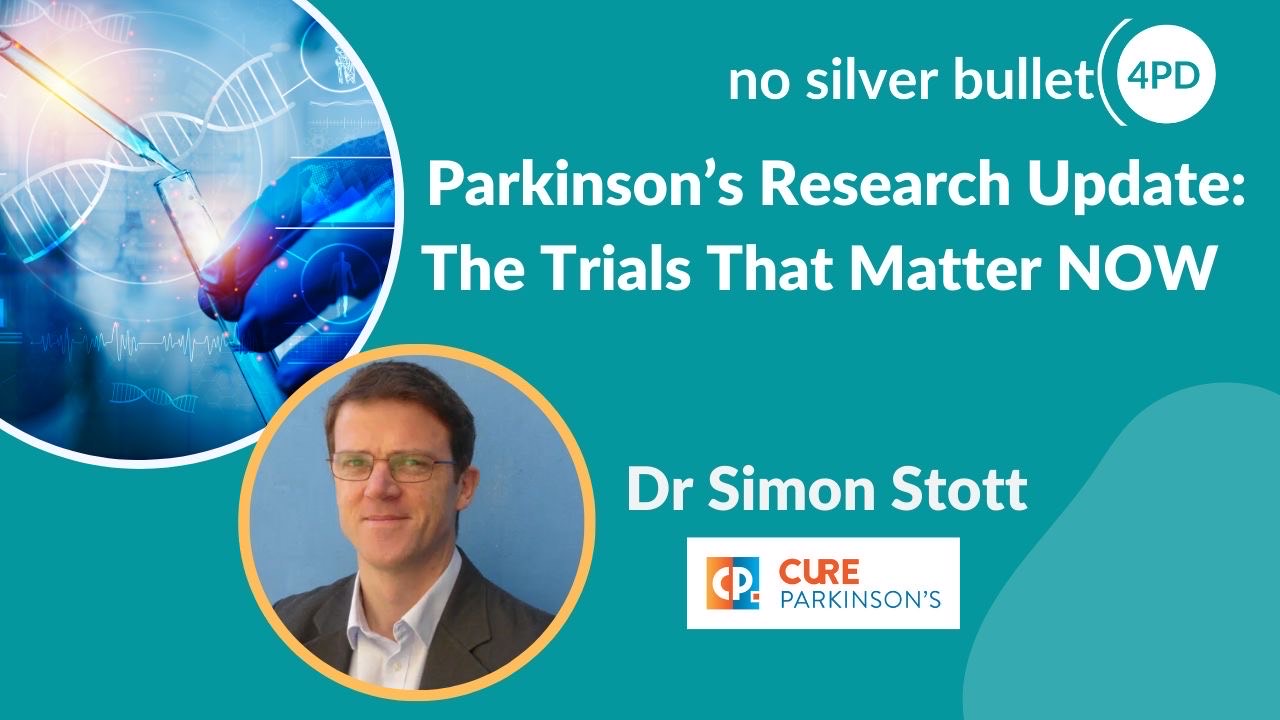
The State of Science: A Review of 2025 and the Roadmap for 2026
January 13, 2026
It is fast becoming a new year tradition for the No Silver Bullet community to sit down with Dr Simon Stott, Director of Research at Cure Parkinson’s, to dissect the year just gone and look ahead to the breakthroughs we hope are on the horizon. If 2025 was a year of mixed messages and hard lessons, 2026 promises to be a defining year for precision medicine and the results of long-awaited clinical trials.
The GLP-1 Rollercoaster
The past year was dominated by the conversation around GLP-1 receptor agonists, the class of drugs famously used for diabetes and weight loss. The community had high hopes following promising data in 2017, but 2025 delivered a complex "mixed bag" of results. While a study in France looking at lixisenatide showed encouraging signs that the drug could stabilise the condition, a major Phase 3 trial of exenatide in the UK found no difference between the drug and a placebo after two years. To add to the confusion, a separate study in Stockholm also returned a negative result.
Dr Stott suggests that rather than abandoning this avenue, the field needs to pause and refine its approach. We acted with urgency when we perhaps needed more agency, rushing to replicate results before fully answering questions about whether these drugs are penetrating the brain effectively or if they are simply not potent enough on their own. The future of this field may lie in newer, "dual-agonist" drugs currently being developed, which hit multiple biological targets at once, or in better identifying exactly which individuals are most likely to respond.
The Rise of the "Conveyor Belt" Trials
One of the most exciting shifts in 2025 was the move away from the slow, stop-start nature of traditional testing towards Multi-Arm Multi-Stage (MAMS) platforms. Think of this as upgrading from a single-lane road to a superhighway. In the UK, the EJS ACT-PD platform is now up and running, testing multiple drugs simultaneously against a single placebo group. If a drug fails, it is removed and instantly replaced by another, creating a continuous conveyor belt of research.
This model is being replicated globally. Australia’s Parkinson’s Mission will report results this year, Norway has launched its own platform called Sleptnia to rapidly de-risk new drugs, and the Michael J. Fox Foundation is setting up a massive initiative to test treatments in people before they even receive a formal diagnosis—potentially stopping the condition before it starts.
Sleep, Cycling, and Brain Sensors
Beyond the big drug trials, 2025 offered some fascinating insights into lifestyle and technology. A massive study of military veterans highlighted a crucial link between obstructive sleep apnoea and Parkinson’s. Strikingly, it found that people who treated their sleep apnoea early with a CPAP machine significantly lowered their risk of developing the condition later in life. It is a powerful reminder that good sleep hygiene is not just about feeling rested; it is neuroprotective.
On the exercise front, the Cycle-2 study reinforced what we already suspect: high-intensity exercise matters. Participants who cycled three times a week at a high cadence showed a slower rate of progression. Meanwhile, technology took a leap forward with the approval of "adaptive" Deep Brain Stimulation (DBS). Unlike traditional DBS which delivers a constant hum of stimulation, these new devices listen to the brain’s activity and adjust the electrical pulses in real-time, offering a truly personalised therapy.
2026: The Year of Precision
If 2025 was about setting the stage, 2026 is about the performance. Dr Stott believes this will be a watershed year because we are finally seeing the results of "precision medicine." For decades, we treated Parkinson’s as one single thing. Now, we are testing drugs that target specific biological hiccups that only affect certain subgroups of people.
We are awaiting results from major trials targeting the LRRK2 gene, a common genetic risk factor. Companies like Denali and Biogen will report on whether their drugs can calm this hyperactive protein and slow progression. Similarly, we will see results from trials targeting the GCase enzyme, which acts as the cell’s waste disposal system. In some people, this system is sluggish, and new drugs aim to boost its activity to clear out toxic proteins.
We will also see the data from the No-Park study in Norway, which has been testing whether taking Nicotinamide Riboside can boost the energy levels of mitochondria—the batteries of our cells.
A Community-Centred Future
Perhaps the most anticipated event of 2026 is not a trial result but a gathering. The World Parkinson’s Congress (WPC) returns, bringing together researchers, clinicians, and the community in a way no other medical conference does. It is a place where a person living with the condition can stand before a poster and ask a scientist to explain their work in plain English, breaking down the barriers between the lab and the living room.
As we move deeper into 2026, the landscape of research is undeniably changing. We are moving away from the "one size fits all" approach towards a future of stratified, personalised care. The trials are smarter, the technology is sharper, and our understanding of the underlying biology is deeper than ever. There may be no single silver bullet yet, but the arsenal of options is growing rapidly.
Comments (0)
Loading comments...