


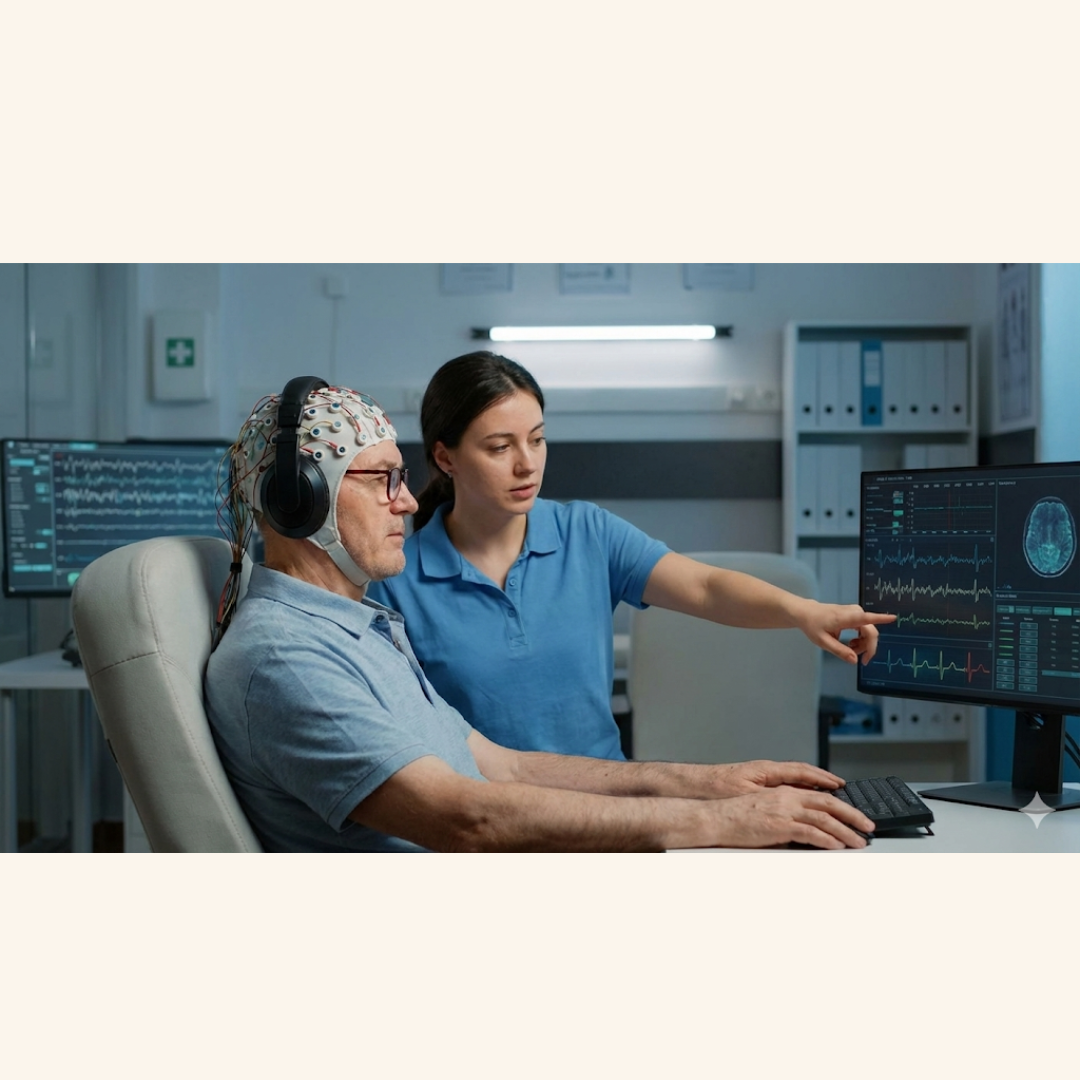
How Brain Waves Could Predict Cognitive Issues Years in Advance
January 8, 2026
Current standard tests for cognitive changes in Parkinson's are often too blunt to catch issues early, meaning patients usually have to wait until a problem is obvious before a doctor can measure it. However, a fascinating new study from the University of Melbourne suggests we might finally have a way to spot these changes long before they affect daily life, using nothing more than a listening task and a standard EEG cap.
The Theory of 'Brain Chaos'
To understand this research, you have to understand "entropy." In physics, entropy is a measure of disorder or randomness. It turns out, your brain waves have entropy too. When your brain is resting, it is somewhat chaotic. But when it hears a specific sound or needs to process information, a healthy brain should instantly "tidy up." The chaos drops, and the brain waves become organised to deal with the task. This is called "entropy reduction."
The Oddball Task
The researchers asked a group of people with Parkinson’s—all of whom were considered "cognitively normal" with no thinking or memory issues—to sit and listen to a sequence of sounds. Most were standard beeps, but occasionally there was an "oddball" target sound. They compared these results with a group of healthy adults of the same age.
The Findings: A Hidden Delay
Here is the breakthrough: even though the participants with Parkinson’s felt fine and tested normal on standard cognitive exams, their brains told a different story.
When a healthy brain heard the target sound, the "chaos" (entropy) dropped instantly. In the participants with the condition, the brain did eventually reduce the chaos, but there was a distinct delay. It took longer for the brain to organise itself. The researchers believe this is the electrical signature of "bradyphrenia"—slowness of thought. The brain is getting there, but the internal drive (specifically the connection between the thalamus and the cortex) is just a fraction slower to engage.
Why This Matters
This might sound technical, but the implications are huge. It means we could potentially screen for cognitive changes years before a person notices them. Instead of waiting for memory slips, a simple 15-minute EEG test could tell a neurologist, "This person’s processing speed is starting to lag; let’s intervene now." It moves us away from relying on subjective questionnaires and towards objective, biological proof of how the brain is functioning.
Comments (0)
Loading comments...