


New research uses microengineering to reveal how Parkinson's affects the brain's blood vessels
April 29, 2026
Scientists have long understood that Parkinson's involves the loss of dopaminergic neurons in the midbrain. However, new research published in Communications Engineering suggests that the condition is not just a neuronal issue, but also a vascular one. By using advanced "human-organ-on-a-chip" technology, researchers have successfully built a three-dimensional model that mimics the tiny blood vessels, or capillaries, of the human midbrain to see how they interact with the condition.
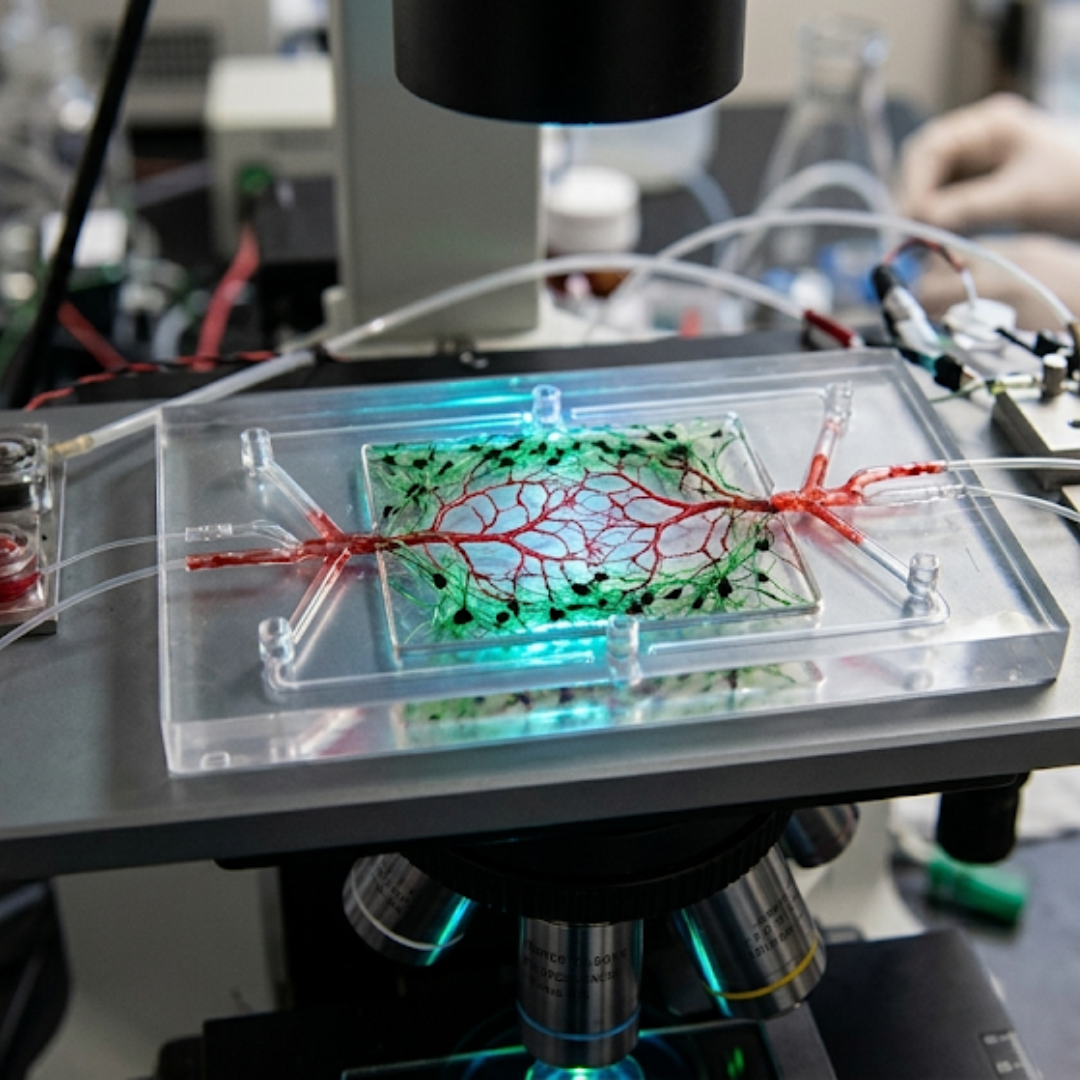
For a long time, studying the relationship between blood vessels and neurodegeneration was difficult. Traditional laboratory tests often use flat, two-dimensional layers of cells, which cannot replicate the complex, three-dimensional physical environment of the human brain. This new study changed the approach by using 3D printing and microfluidics to create a "midbrain-on-a-chip." This device allows researchers to grow real human dopaminergic neurons alongside a functional network of microscopic blood vessels, just as they would exist in the substantia nigra.
The researchers introduced alpha-synuclein—the protein that clumps together to form Lewy bodies in Parkinson's—into this microengineered environment. They observed that the protein did not just damage the neurons; it also caused significant "vascular regression." The blood vessels began to lose their structural integrity, becoming leaky and less efficient at transporting nutrients. This barrier disruption is a critical finding, as a compromised blood-brain barrier can allow harmful substances to enter the brain more easily, potentially accelerating the progression of the condition.
One of the most striking observations from the study was how these vascular changes created a "hostile environment" for the neurons. When the capillaries failed, the neurons were deprived of essential support, which seemed to worsen the inflammation and the clumping of alpha-synuclein. This suggests a feedback loop where neuronal damage hurts the blood vessels, and those failing vessels then speed up the decline of the neurons.
By creating this "window" into the midbrain, scientists can now test how new treatments might protect both the brain's "wiring" and its "plumbing." The goal is to find therapies that don't just stop the loss of neurons, but also repair the vital vascular networks that keep those neurons alive. This dual-focus approach could be a key step in developing more effective ways to manage Parkinson's in the future.
Comments (0)
Loading comments...