


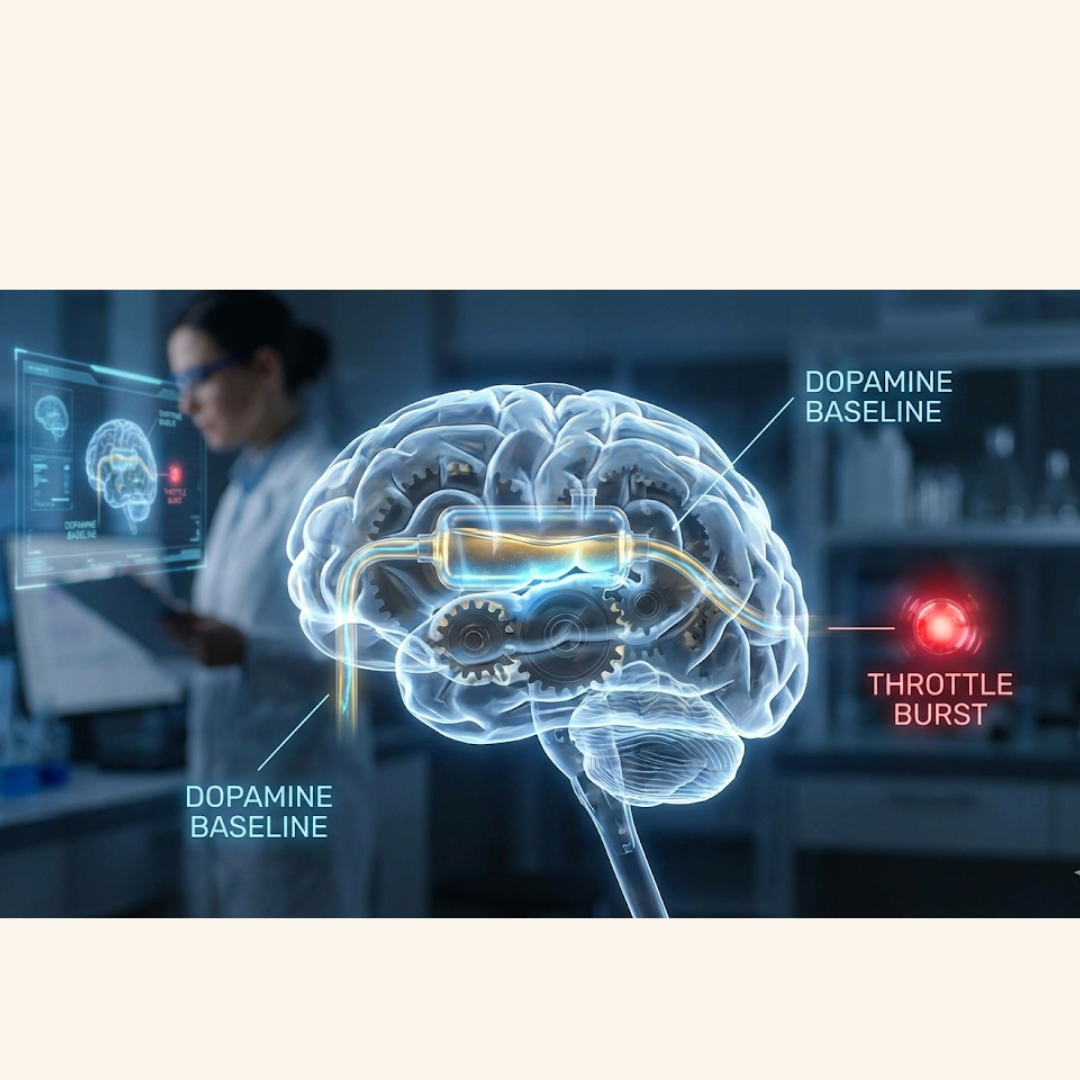
Dopamine: Engine Oil, Not the Throttle
December 18, 2025
For years, the scientific community has operated under a specific assumption about how dopamine drives movement. The prevailing theory suggested that dopamine acted like a throttle or a gas pedal—short, sharp bursts of the chemical were thought to dictate the speed and force of every action we take. If you wanted to move faster, your brain supposedly fired a bigger burst. However, a new study led by McGill University and published in Nature Neuroscience suggests that we might have had this backward all along.
The researchers discovered that dopamine does not actually set the speed or force of each individual movement. Instead of being the gas pedal that you press to zoom off, dopamine acts more like the engine oil. It is the crucial background substance that keeps the entire system running smoothly, but it isn't the signal that tells the body how fast to go.
This distinction is massive for understanding why treatments like Levodopa work. In the study, researchers found that Levodopa restores movement not by recreating those rapid, millisecond bursts of dopamine, but by simply boosting the overall "baseline" levels in the brain. It fills the reservoir, so to speak, allowing the motor engine to turn over without seizing up.
This is incredible news because it simplifies the target. It suggests that future therapies don't need to be hyper-complex enough to mimic the brain's rapid-fire electrical signals. Instead, they simply need to be better at maintaining a steady, consistent level of dopamine in the background. It explains why "peaks and troughs" in medication cause such havoc and reinforces the idea that the Holy Grail of treatment is consistency. If we can keep the oil level steady, the engine runs just fine.
Comments (0)
Loading comments...