


The Fibre Game
December 26, 2025
Each time I speak to Dr Laurie Mischley, our favourite naturopath and diet guru, she always drops a line that I find myself obsessing over for days afterwards. It makes me dig deeper, look for better understanding, and hunt for more answers. A couple of weeks ago, that line was deceptively simple: "People with Parkinson's do not eat enough fibre."
Well, not a big deal, you might think. We’ve all heard it before. But then I started to really think about it, and I realised just how significant that statement actually is. It is not just a diet tip; it is a fundamental biological truth that we are largely ignoring.
Let’s be honest, fibre has a branding problem. It sounds like something your grandmother worries about, or something found in cardboard-tasting cereals. But for the general population, fibre is the absolute rockstar of nutrition. It is the fuel for your microbiome—the trillions of bacteria living in your gut. When you feed them fibre, they reward you by producing Short-Chain Fatty Acids (SCFAs), which lower inflammation, regulate blood sugar, and keep your immune system sharp. Without it, your gut bugs get "hangry" and can actually start eating the lining of your intestines. So, whether you have Parkinson’s or not, if you aren't eating fibre, you are essentially starving your internal ecosystem.
Why Fibre is the "Special Sauce" for Parkinson’s? Now, why did Laurie single out the Parkinson’s community? Two massive reasons. First, the obvious one: Constipation. It is the bane of the Parkinson’s existence. A sluggish gut makes life miserable, but scientifically, it also ruins the effectiveness of your medication. Levodopa needs to get from your stomach to your small intestine to work; if you are backed up, that pill is just sitting in your stomach acid, disintegrating before it ever reaches your brain.
But secondly, and perhaps more importantly, is the Gut-Brain Axis. We now know that the vagus nerve acts as a superhighway between your belly and your brain. If your gut is inflamed because it lacks the bulk and "sweeping" motion of fibre, that inflammation sends "Mayday!" signals straight up to the brain, potentially driving neuroinflammation. A happy, fibre-fed gut sends calming signals. It is that simple.
The Mediterranean Secret:
You cannot read a health article these days without someone singing the praises of the Mediterranean Diet for Parkinson’s. It is the gold standard. But do you know why? It isn't just the olive oil. It is the plants. The secret of the Mediterranean diet is that it is essentially a high-fibre delivery system. It is chock-full of beans, lentils, whole grains, fruits, and veggies.
Here is a fact that blows people’s minds: Meat, dairy, and eggs have zero fibre. None. Zilch. So, a diet heavy on steak and cheese might be delicious, but it is chemically boring for your gut bacteria. The Mediterranean success is purely a numbers game, they just eat more plants.
So, Where Is It Hiding? We need to get better at spotting fibre in the wild. It comes in two main forms, and you need both.
- Soluble Fibre: This dissolves in water to form a gel (think porridge oats). It feeds the good bacteria. You find it in oats, apples, beans, and citrus fruits.
- Insoluble Fibre: This is the "roughage." It adds bulk and keeps the train moving down the tracks. You find this in whole wheat, nuts, cauliflower, and green beans.
The Superstars: If you want the most bang for your buck, look at lentils, chia seeds, raspberries or any berries (surprisingly high!), avocados, and artichokes.
The Magic Number: 30
So, how much do we actually need? If you look at the guidelines from the NHS in the UK, they are shouting for 30 grams a day. The US guidelines hover between 25-38g depending on age and gender. In Japan, they aim for over 20g but acknowledge higher is better.
Let’s stick with the average: 30 grams.
I played around with calculating this in my own diet recently, and I had a bit of a shock. It is not as easy as it sounds! You don't get to 30g by accident. It requires effort, planning, and a bit of tactical eating. A slice of white toast has barely 1g. You’d need to eat the whole loaf to hit the target (please don't do that).
My Strategy to Hit the Big 30:
After realising I was falling short, I developed a few tricks to pack it in without feeling like I’m grazing on a pasture.
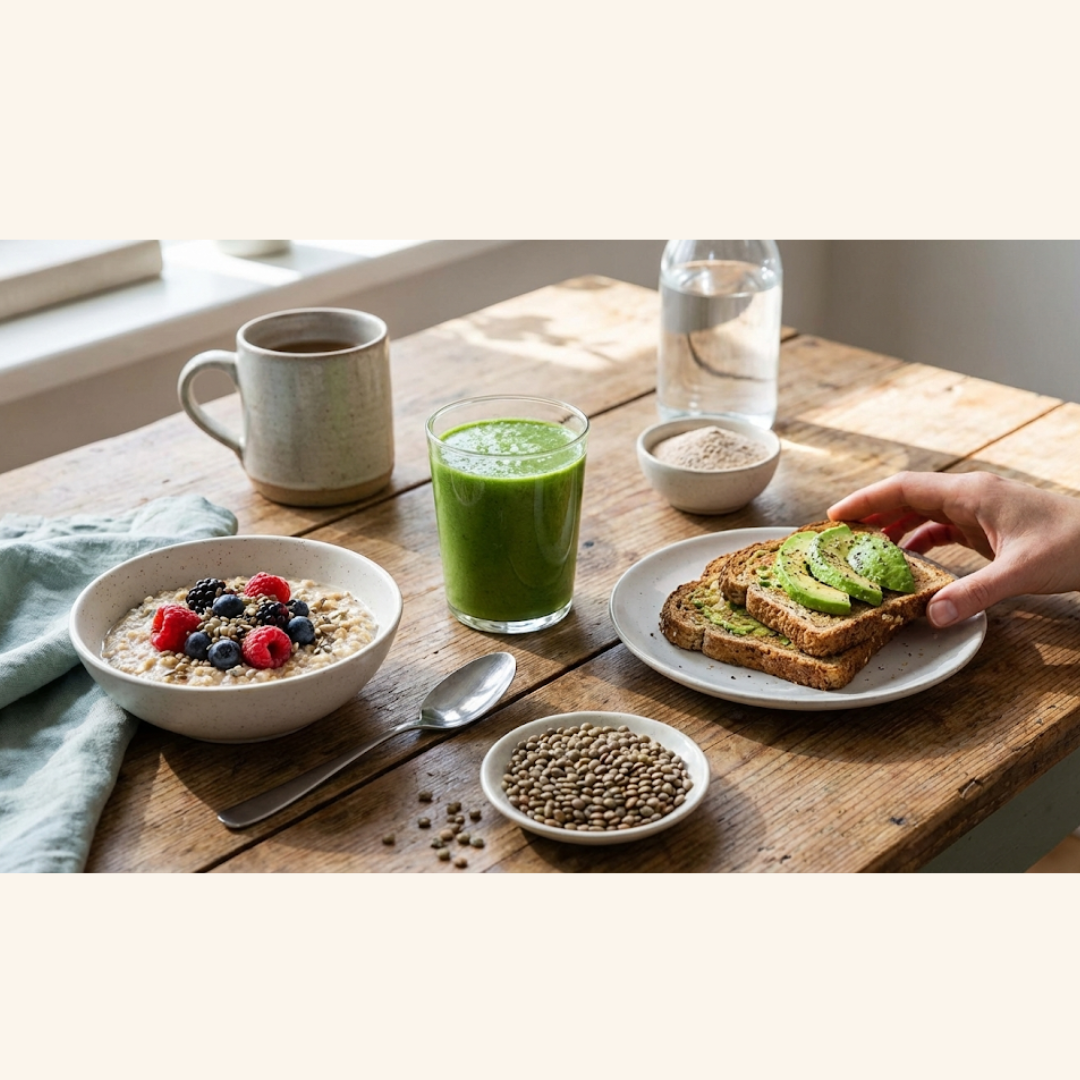
1. The Breakfast Boost: Start strong. If you have a bowl of porridge or Greek/Coconut yogurt, throw in a handful of berries (8g of fibre per cup!). I also cheat a little by adding a scoop of specific fibre powder (like psyllium husk or a prebiotic blend or my fav Apple fibre powder). That is an easy 5 grams right off the bat. Suddenly, you are at 10g before 9:00 AM.
2. The Lunchtime Swap: We have been trained to view bread as the vehicle for lunch. Swap it. Instead of a sandwich, I’ve started doing "crudités" as a starter or side. A handful of cherry tomatoes is good, but carrot sticks and sliced peppers are even better.
Parkinson’s Hack: Since protein interferes with Levodopa absorption, lunch is the perfect time to go vegetarian. This prevents the "protein collision" and naturally boosts your fibre. Think thick vegetable soups with lentils, or a massive salad with chickpeas. You are saving your movement and feeding your gut.
3. The Avocado Advantage: Did you know half an avocado has about 6-7 grams of fibre? It is creamy, delicious, and fits with almost anything. Add it to that lunchtime salad.
4. The Dinner Side Hustle: Make sure every dinner has a "fibre buddy." Steamed broccoli, a side of beans, or even a pear for dessert.
The Golden Rule: Hydrate or Regret:
Finally, a massive word of warning. Fibre works like a sponge—it absorbs water to bulk up. If you dramatically increase your fibre intake but don’t drink enough water, you aren't creating a healthy digestive system; you are essentially manufacturing concrete in your colon. That is the opposite of what we want.
If you up the fibre, you must up the water.
It takes a bit of planning, but when you hit that 30g sweet spot, you feel lighter, your meds tend to work more consistently, and you can sleep better knowing you’ve kept your microbiome happy. As Laurie Mischley says, let’s stop ignoring the fibre.
If you want to learn more about fibre and gut health in Parkinson’s, I highly recommend the NeuroFiber blog. I’ve attached the link below—it’s a great resource from a food scientist specialising in PD.
Comments (0)
Loading comments...