


Predicting cognitive decline through AI brain scans confirms the immediate need for proactive, holistic Parkinson's care
July 1, 2026
 Beatrice
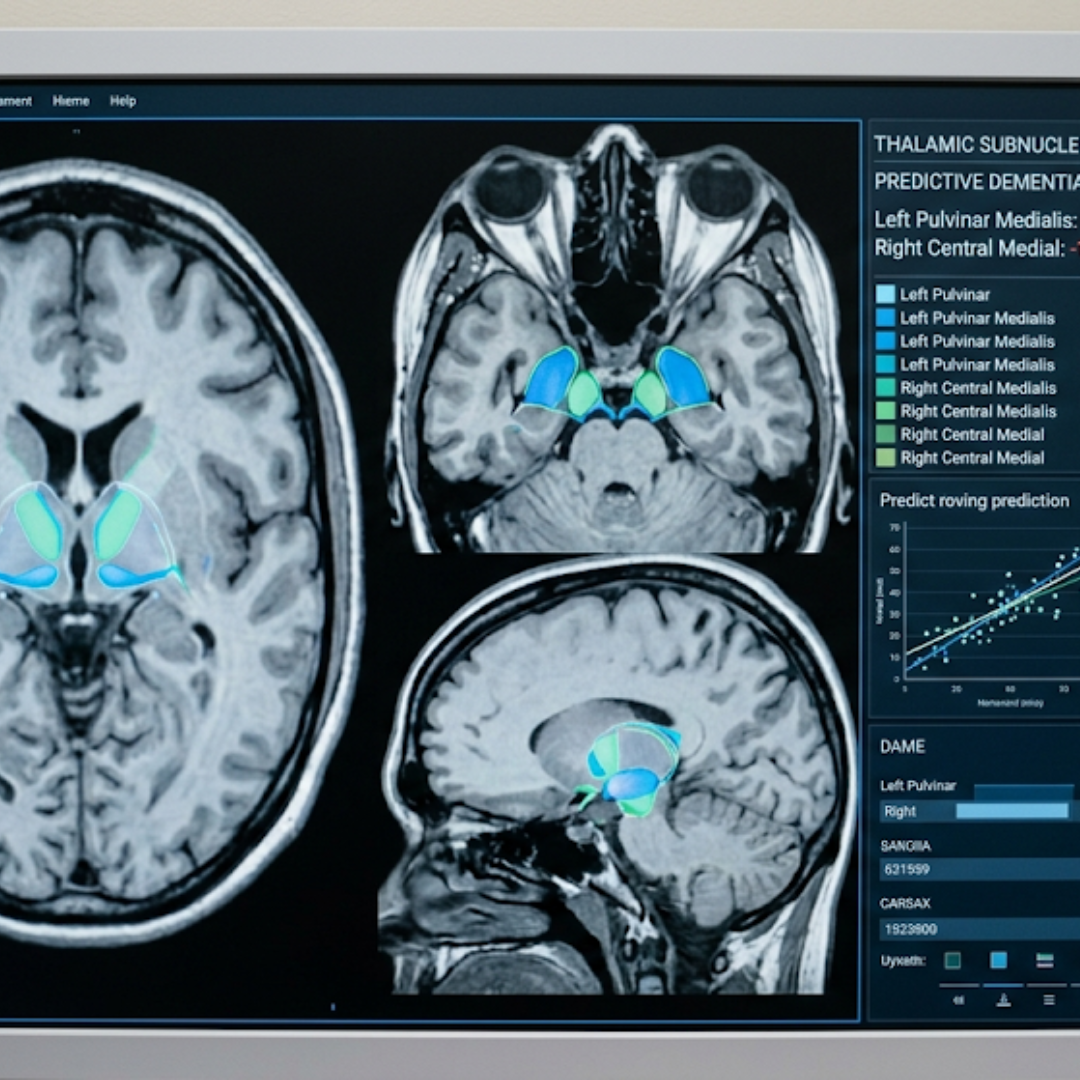
The thalamus is the main sorting office of the brain, sending information back and forth to control your movement, memory, and attention. While we often think about Parkinson's affecting movement, it can also bring changes to how we think. A new study by scientists in Beijing looked at how the shape of this sorting office shifts when people experience cognitive changes. They combined incredibly detailed brain scans with artificial intelligence to see if technology can predict these changes before they become obvious.
The researchers looked closely at brain scans from three groups: sixty healthy people, sixty-three people with Parkinson's and clear thinking, and fifty-seven people with Parkinson's dementia. Instead of looking at the thalamus as one big lump, they used clever software to chop it up into twenty-five tiny sections. They discovered that people with Parkinson's dementia had real shrinkage in several specific tiny sections, particularly on the left side of the brain. The smaller these sections were, the lower the person scored on standard clinical thinking and memory tests.
To make sense of all these measurements, the team fed the scan data into a smart computer program. The artificial intelligence became incredibly good at spotting who was who. It could tell the difference between someone with Parkinson's dementia and someone with no thinking changes with over eighty-three percent accuracy. It was even more accurate when comparing people with dementia to completely healthy individuals, getting it right ninety-four percent of the time. The computer could even guess quite accurately how a person would score on a standard paper and pencil memory test just by looking at the shapes in their brain.
This naturally brings up a major question: what is the actual point of all this high-tech guesswork? There is a justifiable worry that this is simply another expensive tool for a neurologist to look at a screen and give a vague countdown like "you have five good years left" without offering any real solutions. It feels like a high-tech echo of the traditional pen and paper tests doctors already do in the clinic. If a computer program just tells you what is already predictable, it does not automatically change your daily life.
However, there is a different way to look at how this technology might help people with Parkinson's right now. The real benefit is not about getting a digital prophecy; it is about proof and timing. When a computer can flag subtle structural changes early, it gives people concrete evidence to demand proactive, holistic care immediately. Instead of waiting around for noticeable symptoms to appear or for a doctor to confirm a decline, these insights can be the trigger to adjust nutrition, step up targeted exercise, and build a protective lifestyle strategy straight away.
Ultimately, everyone living with Parkinson's deserves a holistic, supportive approach to their care from day one, regardless of what a brain scan or a computer algorithm predicts. While this technology might give neurologists a sharper window into the brain, the best response to any scientific prediction is to focus on the proactive steps you can take today to support your brain health and well-being.
Comments (0)
Loading comments...