


Brain implant made from graphene is set to begin UK clinical trial
August 3, 2024
The first brain implant made of graphene, discovered at Manchester University 20 years ago, is set to begin a clinical trial in Manchester at the end of this month. Researchers at Manchester’s National Graphene Institute hope the trial will lead to more sensitive interfaces between the human brain and external computers. Potential applications include better treatments for neurological conditions like Parkinson’s disease and stroke, as well as translating the thoughts of disabled people into speech or movement.
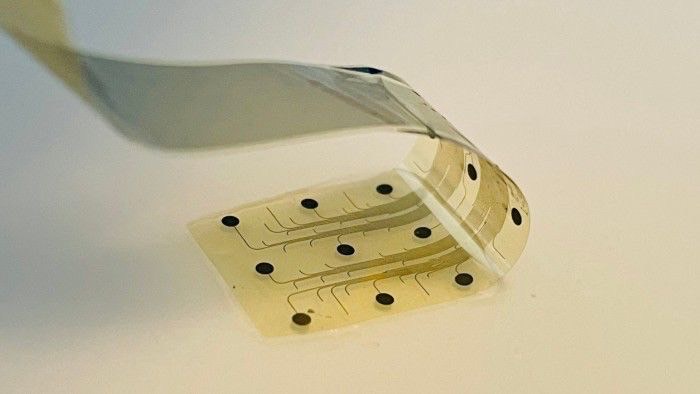
A medical team at Salford Royal hospital is preparing to place a flexible interface with 64 graphene electrodes on the brain of the first trial patient during neurosurgery to remove a glioblastoma tumour. The implant will stimulate and read neural activity with high precision, preserving functional parts of the brain when the cancer is removed.
“The primary objective of this ‘first in human’ trial is to demonstrate the safety of graphene electrodes applied to the brain in eight to ten patients,” said Professor Kostas Kostarelos, chief scientific investigator for the trial. “We’ll also assess the quality of the signals recorded and the implant’s ability to stimulate the brain.”
The implants were produced by InBrain, a neurotech company in Barcelona, in collaboration with the Catalan Institute of Nanotechnology and Manchester University. The next stage, according to InBrain CEO Carolina Aguilar, is to carry out clinical trials with the company’s therapeutic implant for Parkinson’s disease. This device will have two linked components: one on the brain’s surface layer, reading and interpreting electrical activity, and another inserted into the brain to provide precise stimulation to regions controlling movement and other functions impaired by Parkinson’s.
“With artificial intelligence, the device can learn from the brain of individual patients to deliver personalized neurological therapy,” Aguilar said. Graphene sheets consist of a single layer of carbon atoms in a hexagonal lattice, giving the material extraordinary electrical and mechanical properties. Its discoverers, Andre Geim and Kostya Novoselov, won the Nobel Physics Prize in 2010. Although the graphene market has not grown as rapidly as expected, it is growing at an annual rate above 30 percent, with global sales estimated at $300 million to $400 million for 2023.
“I still think graphene is a ‘wonder material’ because it does many wonderful things,” said Jose Garrido, InBrain’s chief scientist. While translating scientific discoveries into applications is time-consuming and expensive, Kostarelos expressed confidence that graphene’s advantages over metal electrodes in brain-computer interfaces would be demonstrated in the clinic. “No other technology offers such a combination of miniaturized, high-resolution interfaces with such selectivity in signal decoding.”
Comments (0)
Loading comments...