


The Case of the Invisible Clutter: Solving the Mystery of the LRRK2 Brain
December 18, 2025
For years, a specific group of people with Parkinson’s has presented a baffling puzzle to the scientific community. Those carrying a mutation in the LRRK2 gene—one of the most common genetic causes of the condition—often have brains that look remarkably "clean" under a microscope. While typical Parkinson’s is marked by large, messy clumps of a protein called alpha-synuclein (known as Lewy bodies), these LRRK2 brains often appeared to have none. It was as if the crime had been committed—the neurons were dying—but there was no weapon to be found.
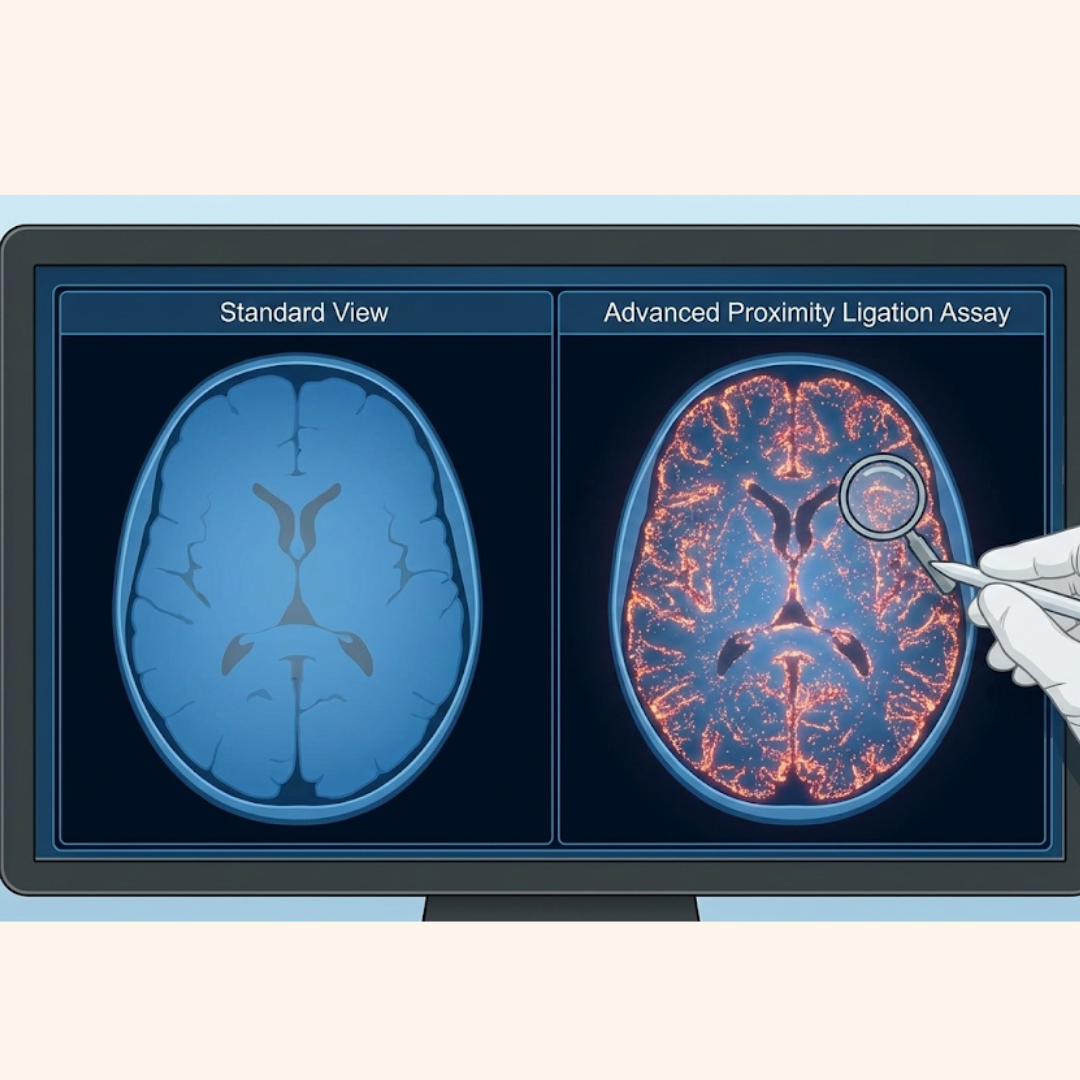
This mystery led to a troubling question: were we looking at a completely different mechanism? If the toxic protein wasn't there, would the new treatments designed to clear it even work for these individuals? A new study published in Science Advances has finally provided the answer, and it turns out we weren't looking at a different crime scene—we just didn't have the right magnifying glass.
Using a cutting-edge visualization technique known as a Proximity Ligation Assay, researchers were able to look beyond the large, obvious Lewy bodies and hunt for something much smaller: oligomers. Think of these as the "micro-clutter" of the brain. While Lewy bodies are like piles of trash bags visible from the street, oligomers are like fine dust accumulating in the corners—invisible to the naked eye, but potentially just as dangerous.
The findings were a revelation. The study showed that these "clean" LRRK2 brains were actually teeming with widespread alpha-synuclein oligomers. The toxic protein was there all along, hiding in plain sight, just in a smaller, stealthier form. Crucially, the researchers found that these oligomers were widespread even in areas of the brain usually thought to be unaffected.
This is incredible news for the development of future therapies. It confirms that LRRK2-related Parkinson’s is indeed driven by the same toxic protein as the sporadic form of the condition; it just wears a different disguise. This suggests that the drugs currently being developed to target and clear alpha-synuclein could potentially be effective for LRRK2 carriers as well. It unifies the battlefield, giving us renewed hope that a single strategy could help a much wider range of people. The weapon has been found, and now we know exactly what we are aiming at.
Comments (0)
Loading comments...