


Sound clicks boost deep sleep brainwaves by nearly thirty per cent in people with Parkinson’s
May 27, 2026
A pioneering clinical trial at the University Hospital Zurich has revealed that playing precisely timed clicks through headphones during deep sleep can give a massive boost to healing brainwaves in people with Parkinson's. Deep sleep is the brain's ultimate maintenance window. It is the vital phase where the brain consolidates memories, tops up the immune system, and flushes out metabolic waste. However, people living with Parkinson’s frequently struggle with severely disrupted sleep, meaning they often miss out on these crucial, restorative hours. Finding a drug-free way to protect and enhance this deep rest has become a major goal for researchers looking to improve daily life.
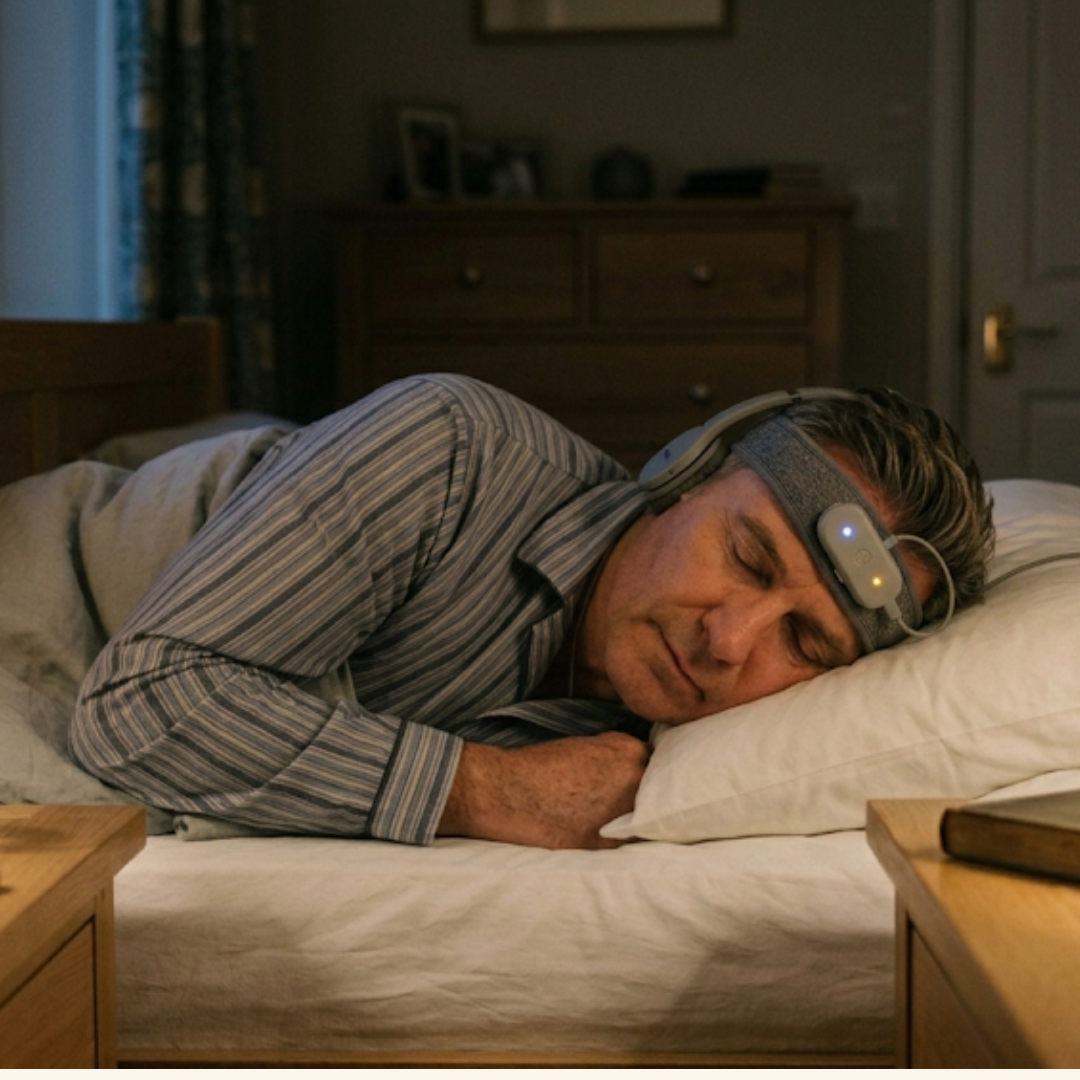
To solve this, the Swiss research team turned to a clever technique called phase-targeted auditory stimulation, which uses a high-tech, wearable headband. As you sleep, the headband monitors your brainwaves in real time, waiting for the large, slow, synchronized waves that signal you have entered deep, non-rapid eye movement sleep. The moment the device detects one of these waves, it plays a series of brief, incredibly quiet clicks. These sounds are timed perfectly to hit the upward peak of the brain's natural rhythm, acting like a gentle push on a playground swing to amplify the wave without waking the person up.
The trial involved twenty-one participants who tested the specialized headband in the comfort of their own homes. In this rigorous, double-blind study, each person wore the headband for two separate three-night periods. During one period, the device actively played the synchronized clicks, while during the other "sham" period, the device merely listened to their sleep without making a sound. When the scientists analyzed the data, they discovered that the active sound stimulation boosted low-frequency slow-wave activity by nearly thirty per cent, making the deep sleep waves noticeably taller and stronger. Crucially, they found a clear dose-dependent effect, meaning the more clicks the brain received, the stronger the deep sleep waves became.
The timing of these clicks also turned out to be incredibly important. The researchers experimented by giving some participants the acoustic clicks all night long, while others only received them during the first half of the night. Intriguingly, the people who received the sounds during that first block of deep sleep reported feeling significantly less sleepy during the day by the third morning. Because this was a short proof-of-concept trial, the main goal was simply to prove that this headband technology actually works at home, but the bonus boost in daytime alertness is a highly promising sign. This success opens the door for much longer trials to see if strengthening these deep sleep waves over several months can dramatically ease daytime symptoms and transform long-term well-being.
Comments (0)
Loading comments...