


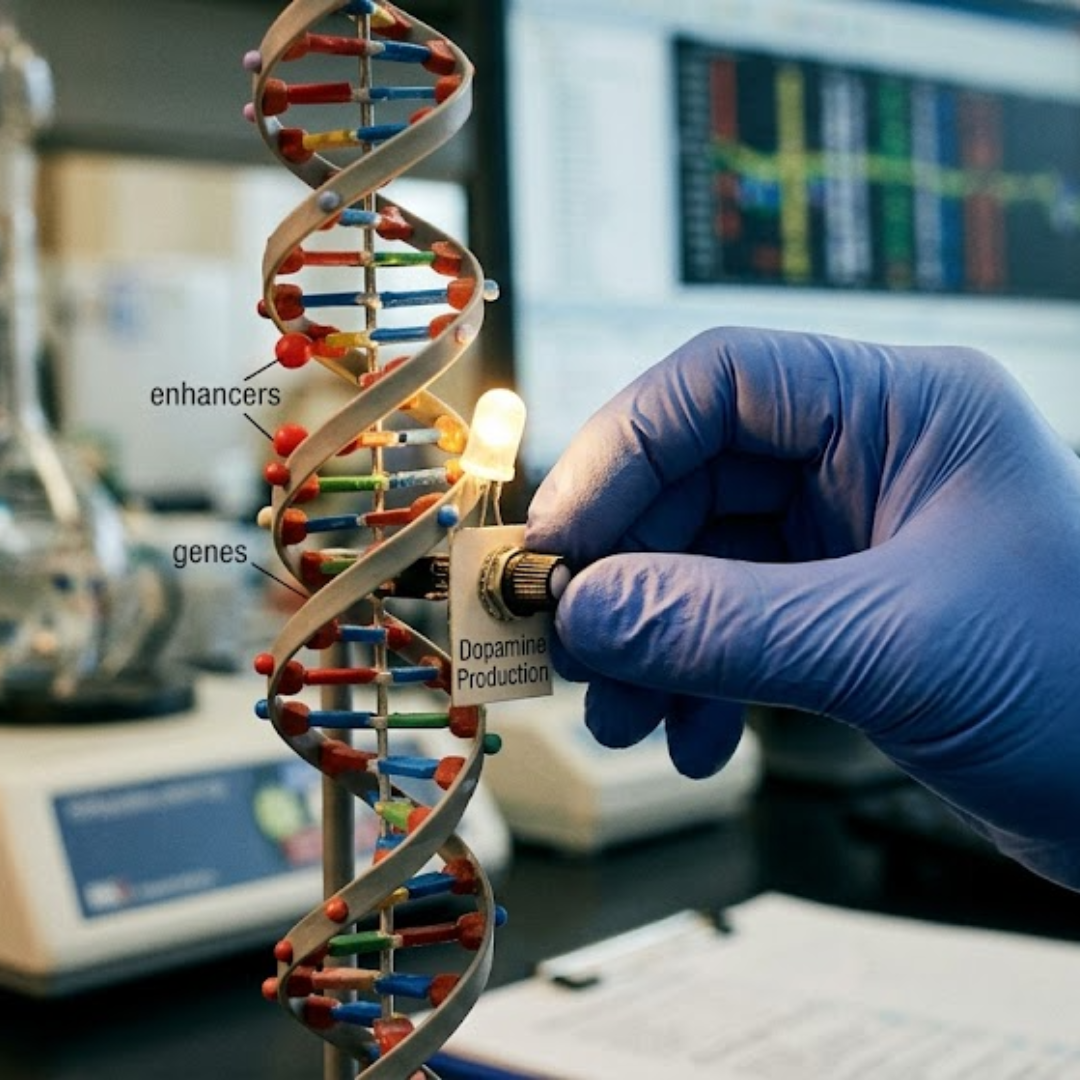
The Master Control Panel: Searching for the ‘Dimmer Switches’ of Parkinson’s
April 17, 2026
For years, genetic research into Parkinson’s has felt like reading a massive instruction manual where the most important pages seemed to be missing. We knew about certain "risk genes," but they didn't tell the whole story. A groundbreaking study recently published in bioRxiv has finally found where those missing instructions are hidden. By looking at a massive cohort of 190 brains, researchers have shifted their focus away from the genes themselves and toward the "master control panel" that runs them: the brain’s enhancers.
This research, titled Modeling cis-regulatory variation in human brain enhancers across a large Parkinson's Disease cohort, represents a major shift in our understanding of the condition’s biological blueprint.
Beyond the "Junk" DNA
To understand why this is so important, we have to look at how our DNA actually works. Only about 2% of our DNA consists of actual genes—the recipes that tell our cells how to build things like dopamine. For a long time, the other 98% was dismissed as "junk DNA."
However, we now know that this 98% is actually the management layer of the cell. It contains enhancers, which act like "dimmer switches" for our genes. They don't build anything themselves; instead, they tell the genes when to turn on, when to turn off, and how brightly to shine. In Parkinson’s, it turns out that the "recipes" (the genes) are often perfectly fine, but the "dimmer switches" (the enhancers) have been bumped to the wrong setting.
Mapping 50,000 Genetic Switches
The researchers used advanced technology to look inside the specific areas of the brain most affected by the condition, such as the substantia nigra. Their goal was to find the tiny genetic glitches that cause these switches to malfunction.
The scale of the discovery is staggering. The team identified over 53,000 high-confidence genetic switches that influence how brain cells behave. By using artificial intelligence to model these switches, they could see exactly how a single tiny change in a person's DNA could "jam" the switch. For example, they found specific glitches that turn down the volume on genes like BAG3, which helps the brain clear out toxic proteins. If that "dimmer switch" is set too low, the brain can’t clean itself properly, leading to the cellular stress we see in the condition.
A Roadmap for Precision Medicine
The most exciting part of this study is its ability to "prioritise" the problems. In the past, scientists might find a hundred different genetic variations in a patient and have no idea which one was actually causing the symptoms. This new model acts like a diagnostic map, pointing directly to the specific switch that is failing.
This moves us significantly closer to a future of precision medicine. Instead of a "one-size-fits-all" treatment, we could eventually design therapies that act like a hand reaching into the control panel to nudge a specific switch back to the correct setting. It is no longer just about knowing which genes are involved, but understanding the entire electrical system that keeps them running.
By uncovering this "management layer" of the brain, researchers have opened a new door for treatments that target the very root of the biological disruption. It is a powerful reminder that in the search for a path forward, sometimes we have to stop looking at the parts being built and start looking at the master controls that run the factory.
Comments (0)
Loading comments...